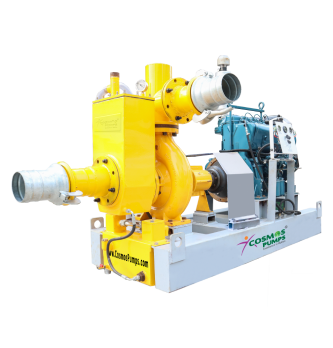
CAP on Skid
Details as follows:

Head
30-169 m

Flow
160m3 / hr - 4469m3 / hr

HP
32-1550+

Prime Mover
Engine/Motor
Permanent dewatering installations — power plant sumps, industrial water intake, flood control stations — need a pump that stays in one place and runs reliably for years. The CAP on Skid mounts on an anti-vibration steel base frame, craned into position on first delivery and never moved again. Unlike portable configurations, the CAP on Skid auto-primes to a 9.8 m suction lift with no foot valve and no manual priming, eliminating operator dependency for every start cycle across the system’s full service life.
What Is a Skid-Mounted Pump?
A skid-mounted pump is a diesel engine-driven pump assembly permanently fixed to a fabricated steel base frame — commonly called a skid — designed for anchored installation on a concrete pad or plant room plinth. The steel skid incorporates anti-vibration mounts between the engine-pump assembly and the base frame itself, isolating rotational and reciprocating vibration so it does not propagate into the floor structure or adjacent pipework flanges. The frame includes forklift pockets at standard spacing, allowing a plant room installation to be positioned precisely using material-handling equipment without manual lifting. For elevated pump rooms or installations above ground level, crane lifting lugs are welded to the skid frame so the complete assembly can be lifted as a single rigid unit.
The distinction from a trolley-mounted unit is fundamental. A trolley configuration provides portability — wheels, tow points, and a lightweight frame that allows the pump to be repositioned as a sump face advances. A skid is the opposite design intent: placed once, anchored, and connected to permanent flanged suction and delivery pipework designed around the pump’s fixed position. Vibration isolation protects the building structure and nearby instrumentation. Bolt-down anchoring provides the positional stability that flanged pipework joints demand.
CAP on Skid — Technical Specifications
| Parameter | Specification |
|---|---|
| Shut-Off Head | 2 M – 169 M |
| Flow Rate | Up to 74,483 LPM |
| Power Range | Up to 1,550+ HP |
| Suction Lift | 9.8 m (auto-prime) |
| Engine Options | KOEL · Eicher · Baudouin · CAT |
| Mounting | Anti-vibration steel base frame (skid) |
| Lifting | Forklift pockets + crane lifting lugs |
| Installation Type | Permanent — concrete pad or plant room |
| Impeller Type | Closed (15 mm passthrough) / Open (75 mm solids) |
| Anchoring | Foundation bolt holes at skid perimeter |
| Certification | ISO & CE |
| Priming Method | Automatic — no foot valve, no manual priming |
| Duty Cycle | Continuous duty (24/7 permanent installation) |
| Start Method | Electric start (battery) with manual backup |
| IoT Integration | CosmoSmart — remote monitoring compatible |
Why Permanent Dewatering Stations Specify Skid Mounting
When a dewatering pump is installed permanently in a power plant pump room, any vibration not absorbed at the pump base transmits into the reinforced concrete plinth and from there into the building structure. Power plant pump rooms are typically located adjacent to or beneath turbine foundations, condenser basements, and instrumentation galleries where structure-borne vibration causes fatigue in instrument impulse lines, loosens flange bolts, and creates noise compliance issues. Anti-vibration mounts integrated into the CAP skid frame decouple the engine and pump assembly from both the base frame and the concrete pad.
Foundation bolt anchoring through holes at the skid perimeter locks the pump assembly permanently to the plinth. When a pump shifts position by even a few millimetres under operating torque or thermal cycling, flanged suction and delivery connections accumulate misalignment stress that eventually cracks welds, fatigues gaskets, or pulls at pipe supports. A skid anchored to specification eliminates this entirely.
For plant engineers specifying equipment that must perform reliably for a 10 to 15-year service cycle without repositioning, without flange rework, and without vibration-related warranty claims on adjacent equipment, the skid frame is the only technically correct base configuration.
Four Applications Where the CAP on Skid Is Specified
1. Thermal and Hydel Power Plants — Permanent Dewatering
Power plants generate continuous drainage across turbine hall floors, condenser pits, cable trenches, transformer bund areas, and underground sumps — permanent water management duties that run continuously for the plant’s operational life. Cosmos Pumps completes more than 30 power plant pump supply projects per year across thermal, hydel, and gas-based generating stations operated by NTPC, NHPC, state gencos, and IPPs. Vibration isolation is not optional in power plant pump rooms — proximity to turbine foundations makes it a design specification. The auto-prime mechanism handles sump level variation through the full tidal range of a condenser pit without operator intervention, which is operationally significant in unmanned pump rooms on automated duty/standby control.
2. Industrial Water Intake and Process Water Supply
Steel plants, cement plants, paper mills, and large manufacturing facilities source process water from rivers, canals, or open reservoirs requiring high-volume intake pumps that run continuously against a permanent suction line. These intake structures are fixed civil installations — the pump must be permanently aligned to flanged suction pipework running back to the process water header. The CAP on Skid handles the intake lift with auto-prime from whatever water level the source presents, including seasonal low-water conditions that would strand a pump requiring a foot valve. Remote intake structures often operate without resident operators; auto-prime eliminates the need for an attendant at each start, and CosmoSmart IoT allows the facility’s central control room to monitor pump status remotely.
3. Municipal Permanent Flood Control Stations
Urban flood control pump stations — underpass drainage sumps, river-front tidal barriers, stormwater management infrastructure — are permanent civil structures designed for a 20–30 year service life. The CAP on Skid bolts to the pump station plinth, integrates with flanged suction and delivery pipework, and operates automatically on water level control. For outdoor permanent flood control stations, the skid frame provides a stable platform that does not require repositioning between flood events, ensuring flanged pipework remains aligned and pressure-tight season after season. CosmoSmart IoT integration allows municipal engineers to monitor pump status, event logs, and operational hours from a central control room.
4. Mining Permanent Sump Installations
Active mining operations progress through phases where sump location is fixed for extended periods — the base level of an open pit bench, an underground pump station at a specific development level, or long-term tailings management. Once a sump is established and surrounding development is committed, the pump may remain in position for 2–5 years. For these semi-permanent and permanent installations, the CAP on Skid provides positional stability and suction reliability that a trolley-mounted pump cannot. The open impeller option with 75 mm solids passthrough addresses the grit and fines content typical of groundwater in hard rock and open pit mining environments.
CAP on Skid vs CAP on Trolley — Permanent vs Mobile
| Factor | CAP on Skid | CAP on Trolley (EW or ET) |
|---|---|---|
| Installation type | Permanent | Mobile / portable |
| Vibration isolation | Anti-vibration base frame | Trolley frame (less isolation) |
| Positional stability | Foundation-bolted | Free-standing (may shift) |
| Pipework connection | Flanged — permanent alignment | Quick-connect / flexible hose |
| Relocation | Crane or forklift required | Move by tow or operator |
| Best for | Power plants, industry, permanent flood control | Construction, mining (moving sump) |
| Civil work | Concrete pad + anchor bolts | Minimal |
Decision rule: If the pump location is fixed for more than 12 months — or if the installation connects to permanent flanged pipework — specify the skid. If the pump must follow an advancing sump face, move between construction phases, or redeploy to a different site, specify the trolley.
How to Commission a Permanent Skid-Mounted Dewatering Pump — Five Steps
- Prepare the concrete pad — pour to skid dimensional drawing, cast anchor bolt positions, finish level to installation manual tolerance
- Lift skid into position — crane via lifting lugs or forklift via forklift pockets; set down onto prepared plinth with anchor bolts located through skid perimeter holes
- Align and anchor — set and adjust anti-vibration mounts for even load distribution; torque anchor bolts to specification; verify skid levelness before final torquing
- Connect flanged pipework — align without applying force to pump flanges; pressure test to 1.5× operating pressure and hold before accepting
- Commission and integrate — test auto-prime from fully dry suction line to confirm 9.8 m lift achieved within priming time; confirm flow rate against pump curve at duty point; connect and configure CosmoSmart IoT; test duty/standby automatic changeover if specified
Frequently Asked Questions — Skid-Mounted Auto-Prime Pump
1. What is a skid-mounted pump?
A skid-mounted pump is a pump and engine assembly permanently fixed to a fabricated steel base frame with anti-vibration mounts, forklift pockets, and crane lifting lugs. Once installed and anchored, it provides a stable, permanently aligned base for flanged suction and delivery pipework connections across its full service life.
2. Why use a skid frame instead of a trolley for a permanent installation?
A trolley frame prioritises mobility over isolation and alignment stability. A skid frame prioritises permanence — anchors to a concrete pad, isolates vibration from the structure, and provides positional stability that flanged pipework connections require. For any installation where the pump will remain in position for more than one year and connects to permanent pipework, the skid frame is the technically correct specification.
3. How is the CAP on skid transported to site?
Transported as a complete factory-assembled unit on a flatbed trailer. Skid dimensions and weight are specified in the technical datasheet. The customer coordinates crane or forklift access for offloading and placement. On arrival, the skid is lifted directly from the transport vehicle and placed on the prepared plinth in a single lift.
4. What is the maximum flow rate of the CAP on skid?
Up to 74,483 LPM depending on the pump model and engine configuration. Shut-off head spans 2 M to 169 M, power ranges to 1,550+ HP. Cosmos Pumps selects the specific model based on the customer’s duty point and provides a pump curve confirming performance before order confirmation.
5. Can the CAP on skid be used outdoors permanently?
Yes. Designed for permanent outdoor installation on a concrete pad with weatherproof covers appropriate for the installation environment. Can be supplied with a canopy or weather enclosure for open-air industrial intake structures. Specify installation environment (indoor plant room / outdoor covered / outdoor exposed) at time of order.
6. Does the skid-mounted pump work with CosmoSmart monitoring?
Yes. All CAP on Skid models are compatible with CosmoSmart IoT — providing real-time monitoring of engine parameters, pump run hours, alarm conditions, and operational status via remote interface. For permanent installations in power plants, municipal flood control stations, or remote industrial intake structures, CosmoSmart eliminates the need for a dedicated on-site pump attendant.
7. What engine options are available for the base frame pump?
KOEL, Eicher, Baudouin, and CAT diesel engines. Engine selection based on power requirement at the duty point, customer’s preferred make for spare parts and service network compatibility, and any site-specific fuel or emission requirements. All engine options are factory-fitted and commissioned as part of the complete skid assembly before dispatch.
8. Can the skid pump handle variable sump levels automatically?
Yes. The auto-prime mechanism maintains suction up to 9.8 m lift without a foot valve, meaning the pump restarts successfully from a dry suction line regardless of sump water level at the time of starting. When the sump cycles between low and high levels — condenser pit, mine sump with variable inflow, underpass drainage — the pump restarts automatically without operator intervention.
Get a Quote for CAP on Skid
Cosmos Pumps Pvt. Ltd. · ISO & CE Certified · Faridabad, NCR · +91 99333 22238 · cosmos@cosmospumps.com
WhatsApp: +91 99333 22238 | Download Catalogue | Request Technical Drawings
Why Choose Cosmos Pumps for Permanent Installations
- Anti-Vibration Steel Skid Frame — Forklift and Crane Ready — fabricated with structural steel, anti-vibration mounts, standard forklift pocket spacing, load-rated crane lifting lugs; no site fabrication required
- Auto-Prime to 9.8 m — No Operator Priming Required — eliminates the most common cause of pump non-start in conventional centrifugal permanent installations: a lost prime
- CosmoSmart IoT Integration for Remote Monitoring — proprietary platform; native sensor integration; real-time data trail for infrastructure maintenance reporting and asset management
- 30+ Power Plant Projects / Year — 250+ EPEC projects completed; manufacturing consistency, commissioning experience, and aftersales parts availability validated by deployment volume
Cosmos Auto-Prime Skid Pumps
Features and Benefits
Auto-prime to 9.8 m, flow to 74,483 LPM, heads to 169 M, anti-vibration skid frame, forklift pockets and crane lifting lugs, foundation bolt holes, closed or open impeller, multiple engine options, CosmoSmart IoT, ISO & CE certified.
Design Features
Structural steel skid frame fabricated to dimensional drawing with protective coating. Anti-vibration mounts at engine and pump attachment points rated for continuous duty. Forklift pocket spacing at standard material-handling equipment fork dimensions. Crane lifting lugs welded and load-rated for full assembled weight. Suction and delivery pump flanges positioned and drilled to customer’s pipework specification during manufacture. Closed impeller for clean/mildly turbid water; open impeller for slurry and solids-laden flows up to 75 mm.
Applications / Use Cases
Thermal power plant turbine hall and condenser pit dewatering; hydel power station penstock and draft tube drainage; state genco and IPP permanent pump house installations; steel plant, cement plant, and paper mill raw water intake; municipal urban flood control and stormwater management stations; river-front tidal and flood barrier permanent pump stations; mining permanent sump at open pit bench levels; underground mine pump station installations; large irrigation and water distribution permanent pumping stations.
Maintenance and Service
All maintenance performed in-place with skid anchored — impeller access, seal replacement, and engine service without disconnecting flanged pipework. Cosmos Pumps maintains service network across India for scheduled preventive maintenance, breakdown response, and major overhaul at site or at Faridabad works. Genuine spare parts — impellers, mechanical seals, wear rings, engine service components — held in stock at Faridabad and dispatched within 24 hours for all engine and pump model variants.
Countries We Supply
India · UAE · Saudi Arabia · Qatar · Kuwait · Oman · Bahrain · Bangladesh · Vietnam · Indonesia · Kenya · Tanzania · Nigeria · Ghana
Download Catalogue: CAP on Skid