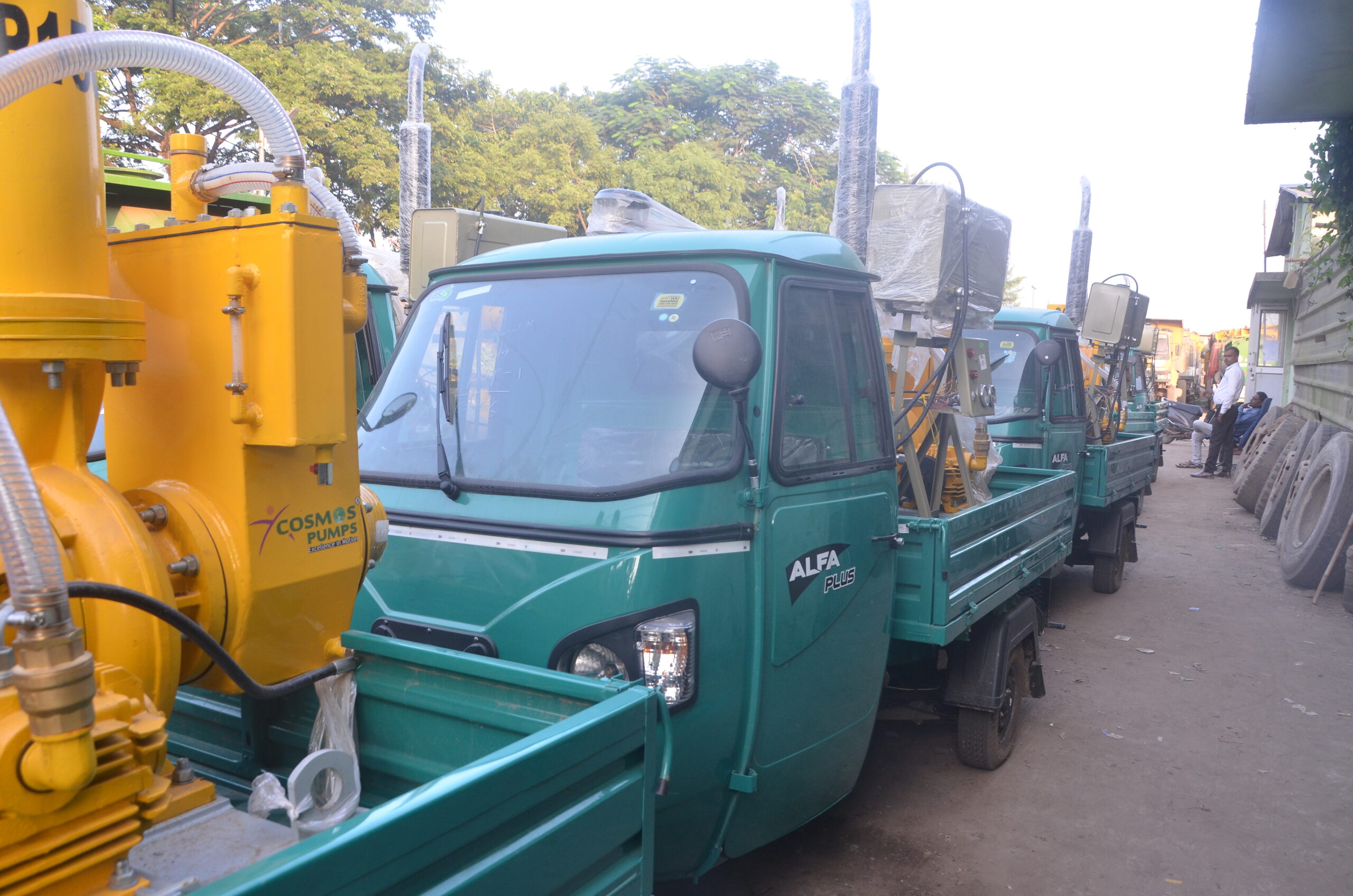
Cosmos Dewatering and Wastewater Management Service
What Is Flood Control Dewatering?
Flood control dewatering is the emergency removal of stormwater, floodwater, or sewage overflow from urban areas using high-capacity pumps deployed at surge points — underpasses, roads, drains, and pump stations — to protect infrastructure and restore civic functions within hours of a flood event.
Municipal Flood Control Challenges
Urban flooding during the monsoon tests every municipal corporation in India. A single high-intensity rain event — 50–200 mm in 24 hours — overwhelms storm drains and sewage networks simultaneously. The result: waterlogged roads, submerged underpasses, sewage overflow, and a public health crisis.
Municipal agencies — NDMC, BBMP, GHMC, NMMC, PMC, and others — need flood pumping solutions that are fast to deploy, dependable under continuous unattended operation, and able to handle water loaded with suspended solids, sewage, and urban debris. A standard pump fails at this task. The right flood control dewatering pump must prime itself automatically, run dry without damage between flood surges, and restart instantly when the next surge arrives.
Cosmos Pumps has supplied and commissioned flood control dewatering equipment for 80+ pump deployments per year across North India — deploying CAP auto-prime engines, CNC non-clog submersibles, and CSW sewage pumps at municipal pump stations, urban drains, and sewage bypass sites.
Municipal Applications: Three Scenarios, Three Products
Municipal flood control covers three distinct pumping duties. Each requires a different product configuration:
Urban Flood Control — CAP Auto-Prime Surface Pump
The CAP auto-prime series is the primary fleet pump for urban flood control. Engine-driven (no grid power required), self-priming from a dry start, and capable of moving up to 4,469 m³/h (74,483 LPM), the CAP is the standard specification for underpass pump stations, stormwater pump houses, and temporary flood diversion points where mains power cannot be relied upon during a flood emergency.
Key capabilities for flood control duty:
- Auto-prime with suction lift up to 9.8 m — no manual priming, no startup delay during emergency deployment
- Runs dry without damage — critical when flood surges recede and suction is momentarily broken
- Open impeller: handles solids up to 75 mm — leaves, plastic waste, and urban grit pass through without clogging
- Engine options: KOEL, Eicher, Baudouin, CAT — matched to service network availability in every state
- Trolley-mounted variants for rapid relocation between flood sites
HP range: 60–1,550+ HP. The CAP carries the largest single-pump dewatering capacity in the Cosmos range.
Sewage Bypass — CSW Sewage Submersible
When sewer mains are overwhelmed during a flood event, raw sewage must be bypassed around the blockage or pump station failure to prevent backflow into homes and commercial premises. The CSW sewage submersible handles this duty:
- Flow rate: 775–33,000 LPM
- Solids handling: up to 100 mm — passes rags, silt, and urban waste mixed with floodwater
- Specific gravity: handles up to SG 1.7 — diluted sewage mixed with floodwater
- HP range: 2–200 HP — from a small bypass point to a major trunk main
For manhole clearing and smaller bypass points, the CNC non-clog submersible (6–20 HP, 70 mm bottom discharge) is the standard tool for municipal drain desludging and manhole emptying.
Drain Desilting — CNC Non-Clog Submersible
Urban drains accumulate silt, municipal waste, and construction debris throughout the year. Before monsoon season and during active flood events, desilting crews use the CNC non-clog pump for manhole clearance and drain flushing. The CNC’s vortex impeller and 14-inch diameter form factor handles the thick sludge-water mix that blocks municipal drainage systems — it is one of the highest-demand rental products in the Cosmos fleet for urban works contracts.
Product Selection Table
| Application | Recommended Pump | Key Specification | Drive Type |
|---|---|---|---|
| Urban flood control — high capacity | CAP Auto-Prime | Up to 74,483 LPM; 75mm solids; up to 1,550+ HP | Engine (KOEL/Eicher/Baudouin/CAT) |
| Urban flood control — medium sites | CAP Auto-Prime | 60–105 HP (rental range) | Engine |
| Sewage bypass — trunk main | CSW Sewage Submersible | Up to 33,000 LPM; 100mm solids; SG 1.7 | Electric |
| Sewage bypass — local point | CNC Non-Clog Submersible | 1,250–1,500 LPM; 70mm solids | Electric |
| Drain desilting — manhole | CNC Non-Clog Submersible | 14″ dia; bottom discharge vortex | Electric |
Monsoon Readiness: Smart Fleet Management with CosmoSmart IoT
Municipal flood control cannot be reactive. A flood pump that arrives after an underpass is submerged is not a flood control asset — it is a recovery tool. Cosmos supports municipal clients with pre-season fleet readiness packages that include deployment planning, rental fleet allocation, and India’s only IoT-monitored flood pump fleet.
Pre-Season Deployment
CAP auto-prime pumps are pre-positioned at critical flood-prone pump stations before the monsoon season opens. With 50+ CAP units in the Cosmos rental fleet (60–105 HP), municipal corporations can draw on guaranteed fleet availability without capital expenditure — no procurement delay, no tender lead time, no off-season holding cost.
CosmoSmart™ IoT Monitoring — The Flood Control Differentiator
Cosmos is the only Indian dewatering pump manufacturer with live IoT fleet monitoring for flood control deployments. Kirloskar, CRI, and TKFlo do not offer this capability.
The CosmoSmart mobile app gives municipal engineers and site supervisors real-time visibility into every pump in the flood control fleet:
- Real-time pump location — know which sites are active and where each unit is deployed across the city
- Real-time running data — track operating status, engine hours, and flow without visiting the site
- Fuel consumption monitoring — live fuel level tracking with refuelling alerts before a site runs dry mid-event
- Fuel theft alerts — documented risk at unattended flood pump stations; CosmoSmart flags anomalous consumption immediately
- Service alerts — CosmoSmart triggers a maintenance alert at the point when service is due, not after breakdown
For municipal corporations managing 10–80 pump sites simultaneously during a peak monsoon event, CosmoSmart is not a convenience feature. It is the difference between coordinated, data-driven flood response and reactive crisis management.
EPEC Flood Control: Turnkey Project Delivery
Cosmos’s EPEC (Engineering, Procurement, Execution, Commissioning) division has completed 250+ projects across flood control, mining, construction, power plants, and sewage. For municipal flood control, the EPEC model means Cosmos delivers a working flood dewatering system — not a pump and a bill of materials:
- Engineering: site survey, sump design, pump station layout, hydraulic calculations
- Procurement: pump selection, suction and discharge pipework, control panel, fuel storage
- Execution: installation, civil integration, operator training
- Commissioning: trial runs, flow verification, CosmoSmart integration and dashboard handover
Municipal corporations that have historically managed pump station projects through fragmented procurement — separate tenders for pumps, pipework, installation, and controls — find that EPEC delivery eliminates the coordination overhead and the risk of mismatched equipment from multiple vendors, with a single accountable project owner from engineering through commissioning.
Case Study: NCR Urban Flood Control Fleet, CosmoSmart Integration
Note: Representative scenario — Cosmos team to replace with a named municipal project before publishing
Project: Urban flood control pump station upgrade, National Capital Region
Client type: Municipal corporation, NCR
Challenge: 12 underpass pump stations using manual-start diesel pumps with no remote monitoring. Diesel theft and undetected failures caused repeated underpass flooding events during the 2024 monsoon.
Solution deployed: CAP auto-prime fleet (80 HP, 6 units per cluster), CosmoSmart IoT integration across all 12 sites, centralised operations dashboard
Outcome: Zero undetected pump failures during monsoon 2025; fuel consumption verified within 5% of theoretical for all pump-months of operation; manual patrol visits reduced from daily to weekly
Cosmos scope: Full EPEC delivery — site survey, pump supply, pipework, CosmoSmart installation, commissioning, operator training
Frequently Asked Questions
What is the best pump for flood control in India?
For high-capacity urban flood control, the CAP auto-prime surface pump is the standard specification — engine-driven, capable of handling 75 mm solids, auto-priming from a dry start, and available in 60–1,550+ HP configurations. For sewage bypass during flood events, the CSW sewage submersible (up to 100 mm solids, SG 1.7) is the recommended model.
How many pumps are needed for an urban flood control site?
A typical single-lane underpass pump station in North India requires 2–4 CAP units of 60–80 HP to remove peak inflow within 30–45 minutes of a high-intensity rain event. Multi-lane or arterial underpasses may require 6–8 units. Cosmos EPEC engineers size the fleet based on catchment area, runoff coefficient, and local design rainfall data.
Auto-prime vs submersible pump for flood control — which is better?
Choose CAP auto-prime when the site needs portability, engine drive (no grid power), or suction from a pit or sump up to 9.8 m. Choose a submersible (CDW or CSW) when the pump must be permanently installed in a wet well and grid power is reliable. Most municipal flood control pump stations specify CAP auto-prime as the primary pump because it can be pre-positioned and relocated between sites within a season.
Can Cosmos supply flood control pumps for municipal tender specifications?
Yes. Cosmos EPEC supplies and commissions flood control pumping systems to municipal corporations, smart city SPVs, and state PWDs in accordance with IS and BIS specifications. CosmoSmart integration can be scoped as a separately specified item. Contact cosmos@cosmospumps.com or call +91 99333 22238 for a technical specification and BOQ.
What is CosmoSmart IoT monitoring for flood control?
CosmoSmart is Cosmos’s proprietary IoT fleet monitoring system. For flood control deployments, it provides real-time pump location, operating status, fuel consumption data, refuelling alerts, theft alerts, and service reminders via a mobile app. Municipal engineers manage an entire flood pump fleet remotely — without site visits — and respond to fuel depletion or pump failure before it causes an underpass flood event.
Does Cosmos offer flood control pump rental for the monsoon season?
Yes. Cosmos operates a rental fleet of 50+ CAP auto-prime pumps (60–105 HP) available for seasonal monsoon rental across North India. The rental model eliminates off-season holding costs and provides immediate backup units if an owned pump requires service during the season. Contact Cosmos for seasonal rental rates and availability.
What is the typical suction lift for an underpass pump station?
Most urban underpass pump stations have suction heads of 2–6 m between the sump floor and the pump centreline. The CAP auto-prime handles suction lift up to 9.8 m — covering all standard underpass configurations with margin to spare. For deeper sumps exceeding 9.8 m, submersible pump installation is recommended.
Does Cosmos provide turnkey flood control pump station projects?
Yes — through the EPEC division. With 250+ EPEC projects commissioned across flood control, sewage, mining, construction, and power sectors, Cosmos delivers a complete, ready-to-operate system including site engineering, pump supply, pipework, installation, CosmoSmart integration, and operator training.
Need dewatering pump rental for Smart City and Metro projects in Lucknow? See dewatering rental Lucknow Smart City.
Need dewatering pump rental for Bihar flood control, NMCG STP, and Patna Metro projects? See dewatering pump rental Patna.
Objectives:

Prevent Infrastructure Flooding

Manage Urban Flood Risks

Protect Against Waterlogging

Ensure Public Safety