Cosmos Smart Dewatering Solutions
Cosmos Pumps supplies construction dewatering pumps for building foundations, basement excavations, trench dewatering, and tunnel construction across India. With 300+ building construction projects delivered per year and a rental fleet of 500+ submersible units and 50+ diesel auto-prime pumps, we deliver the right pump for every site depth and groundwater inflow rate — from a 3 m residential foundation to a 50 m underground metro station.
Construction dewatering pumps remove groundwater and surface water from excavations, basements, foundations, and trenches so that civil work can proceed safely and on schedule. Cosmos Pumps supplies submersible dewatering pumps, diesel auto-prime pumps, and non-clog pumps for building construction sites across India — from high-rise foundations in North India to airport terminal excavations and industrial factory basements.
What Are Construction Dewatering Pumps?
Construction dewatering pumps are submersible or surface-mounted pumps engineered to handle dirty, muddy, and debris-laden water at high volumes for extended run cycles. On a building construction site, water ingress comes from multiple sources: seasonal groundwater, monsoon runoff, concrete wash-water, and sub-soil springs. A proper dewatering pump setup prevents excavation collapse, keeps shuttering dry, and protects reinforcement from corrosion — all of which directly affect structural integrity and construction timelines.
At Cosmos Pumps, we have deployed dewatering equipment on 300+ building construction projects per year, covering everything from single-basement residential buildings to multi-level underground parking structures and airport terminal facilities.
Types of Construction Dewatering Applications
Foundation Dewatering
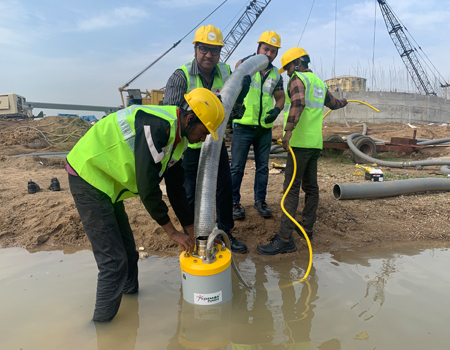
Foundation dewatering removes water from the zone below the design founding level — typically 2–8 m BGL for multi-storey buildings. The challenge is groundwater from the water table, which constantly refills the excavation sump. The CDW submersible dewatering pump is the standard choice for foundation sumps: it handles muddy water with solids up to 12 mm, operates in confined sump pits, and runs continuously for 24h/day duty cycles. For a comparison of dewatering approaches for different site conditions, see our dewatering methods guide.
Site scenario: High-rise tower foundation, North India (alluvial zone, water table 2–4 m BGL), sump size 2m × 2m × 1.5m. Recommended: CDW-15 (15 HP, 86.5 m shutoff head, 3,000 LPM at 25 m head) with standby pump on-site.
Explore CDW Submersible Dewatering Pumps →
Basement Dewatering
Basement dewatering is the most demanding construction dewatering application because water must be pumped from multiple floors below ground simultaneously. Multi-basement developments (B1, B2, B3) require staged dewatering: the sump is progressively deepened as each slab is cast, requiring pumps with increasing head capability.
Recommended solution: CDW High Head submersible dewatering pump for depths exceeding 30 m. The CDW High Head series (40–140 m shutoff head, 5–75 HP) is specifically designed for basement excavations where head requirements exceed the CDW standard’s range.
CDW High Head Dewatering Pump →
Basement construction also involves thick sump sludge, concrete debris, and construction effluent with suspended solids. The CNC non-clog pump is deployed as a companion unit for sump cleaning — its bottom-discharge design and 70 mm solids capacity handle what a standard CDW cannot.
CNC Non-Clog Pump for Sump Cleaning →
Trench Dewatering
Trench dewatering applies to utility trenches, pile cap trenches, and drainage installation excavations — typically 1–4 m deep with high inflow rates during monsoon. CAP Auto-Prime surface pumps are the preferred solution for trench dewatering when electricity is unavailable or when multiple short trenches are being worked simultaneously. The CAP pump self-primes in under 60 seconds, runs dry without damage, and can be moved between work zones without a crane.
Site scenario: 200 m utility trench, 3 m deep, laterite soil with perched water table. Recommended: CAP-60HP (60 HP diesel auto-prime) on a trolley mount for mobility.
Tunnel and Metro Work in Buildings
Deep basement diaphragm wall construction and metro station box excavations require tunnelling-grade dewatering with heads up to 100–140 m. The CDW High Head and CDW Ultra High Head series are specified for these applications — the CDW Ultra High Head reaches 200 m shutoff head and is used on the deepest metro station box excavations and car park basements in India.
Read more on our Construction Dewatering guide →
Project Case Studies
Project 1 — Multi-Level Basement, Commercial Tower, North India
Project type: B3 basement excavation, commercial tower Depth: 14 m below ground Groundwater inflow: 120–200 m³/hr at peak monsoon Challenge: Alluvial soil with high water table (1.5 m BGL); monsoon season deployment; three simultaneous sump locations
Cosmos solution deployed:
- 4 × CDW-20HP submersible pumps at primary sumps (continuous duty)
- 2 × CNC-10HP non-clog pumps for sump cleaning and concrete washwater
- 1 × CAP-80HP diesel auto-prime as standby surface pump (power outage contingency)
Outcome: Excavation completed on schedule during monsoon season. Zero dewatering-related shutdowns. Standby CAP activated on 3 occasions during grid power interruptions — each time, the auto-prime cycle was complete in under 90 seconds.
Project 2 — Airport Terminal Construction, North India
Project type: Airport terminal expansion, 4-level underground services basement Depth: 18 m below finished ground level Groundwater inflow: 80–150 m³/hr sustained Challenge: Confined sump geometry, high head requirement (>70 m), strict noise standards near operational terminal
Cosmos solution deployed:
- 6 × CDW High Head 30HP pumps across primary and secondary sump network
- 1 × CNC-15HP non-clog pump per sump for debris management
- CosmoSmart™ remote monitoring on all primary pumps (real-time alerts to site manager)
Outcome: 24/7 dewatering maintained for 11 months continuous operation. CosmoSmart alerts prevented three potential pump failures (seal wear, motor temperature) before they caused downtime.
Project 3 — Industrial Factory Complex, West India
Project type: Greenfield factory with 2 m deep RCC raft foundation across 25,000 sq. ft. Depth: 3.5 m excavation Groundwater inflow: Moderate (30–50 m³/hr) Challenge: Multiple simultaneous sump points across large plan area; limited power availability in early construction phase
Cosmos solution deployed:
- 2 × CDW-10HP submersible pumps (electric) at primary sumps
- 1 × CAP-60HP diesel auto-prime for outlying work areas without electrical hookup
- Rental arrangement — all units supplied and maintained by Cosmos with backup fleet on standby
Outcome: Foundation concrete poured over two phases, both dry. Rental model saved client capital outlay of approx. ₹8–12 lakhs versus purchase.
Pump Selection Guide for Construction Sites
| Application | Recommended Pump | Head Range | Why |
|---|---|---|---|
| Foundation sump, 3–15 m depth | CDW submersible dewatering pump | 15–86 m | Continuous duty, muddy water, compact sump fit |
| Basement B1/B2/B3, >15 m depth | CDW High Head submersible | 40–140 m | Higher head capability as excavation deepens |
| Deep basement, >50 m head | CDW Ultra High Head | 90–200 m | Metro/deep car park box excavations |
| Sump cleaning, 70mm solids | CNC non-clog submersible | 22–30 m | Bottom discharge; handles concrete debris |
| Trench dewatering, no power | CAP diesel auto-prime | Up to 169 m | Engine-driven; self-primes; mobile on trolley |
| Monsoon emergency / standby | CAP diesel auto-prime | Up to 169 m | Fast self-prime (<60 sec); no grid dependency |
All products are available for purchase or rental from Cosmos Pumps.
Construction Dewatering Planning Guide
Effective dewatering on a building construction site requires planning before excavation begins. Key decisions:
Sump design: Minimum sump size for a CDW pump is 500 mm × 500 mm at 600 mm depth. For sites with high inflow (>100 m³/hr), use two parallel sumps with each pump rated at 60–70% of total inflow — this provides operational redundancy without oversizing.
Pump sizing: Total dynamic head (TDH) = static lift + friction losses in rising main. For every 10 m of 100 mm HDPE rising main, add approximately 0.8 m friction head. Oversize the pump by 25% for monsoon surge.
Standby requirement: CPWD dewatering specifications and standard site practice recommend one standby pump for any dewatering system. Cosmos recommends the standby pump be of the same model as the duty pump — direct motor swaps in the field are faster when parts are interchangeable.
Monsoon planning: In North India, peak groundwater inflow during July–August can be 3–5× the non-monsoon baseline. Commission your monsoon standby pump by June 15. Cosmos Pumps offers monsoon readiness contracts with pre-positioned backup units.
Sump cleaning: Install a CNC non-clog pump alongside your CDW pump at every sump to handle concrete washwater, silt accumulation, and any debris that bypasses the strainer. CNC handles solids up to 70 mm — the CDW handles solids up to 12 mm.
Construction Site Dewatering Rental
Many building contractors prefer rental over purchase for dewatering equipment — especially for projects where the dewatering phase is 6–18 months.
Cosmos Pumps Rental Advantages for Building Construction:
- Immediate availability from our Faridabad depot (serving NCR, Delhi, UP, Haryana)
- No capital outlay — operating expense only
- Full maintenance coverage: Cosmos technician visits every 30 days
- Standby/backup unit included in all rental agreements
- Pan-India deployment — Mumbai, Chennai, Hyderabad, Pune all served
- CosmoSmart IoT monitoring optional — track pump runtime and alerts remotely
View Dewatering Pump Rental Options →
Frequently Asked Questions
What size dewatering pump do I need for a building foundation?
For a typical residential or commercial tower foundation (5–10 m deep, North India alluvial soil), a CDW-10HP or CDW-15HP submersible dewatering pump handles groundwater inflow of 1,500–3,000 LPM. For monsoon season, add a standby CDW or CAP diesel unit. Cosmos will size the pump for your specific soil report and groundwater data — contact us for a free site assessment.
What is foundation dewatering?
Foundation dewatering is the process of removing groundwater from the zone below the designed foundation level so that concrete can be poured in dry conditions. It uses submersible pumps placed in collection sumps within the excavation, discharging groundwater to a safe point away from the building footprint.
Can a single pump dewater a full basement excavation?
In most cases, no — a large basement (>500 sq. m plan area) requires multiple sumps with individual pumps, plus a standby unit. Groundwater flows laterally through soil to the lowest point; multiple strategically placed sumps reduce inflow volume per pump and ensure even drawdown across the excavation.
How long does construction dewatering take?
Construction dewatering runs for the duration of the below-ground construction phase — typically 6–24 months depending on project complexity. Dewatering must continue until the permanent waterproofing structure (raft foundation, diaphragm wall) reaches its design level and the building’s hydrostatic uplift resistance is verified.
What is trench dewatering?
Trench dewatering removes water from utility and drainage trenches during excavation. It is typically intermittent — pumped when inflow accumulates — using portable diesel auto-prime pumps (CAP series) that can be moved along the trench route as work progresses.
Can a dewatering pump handle concrete washwater and silt?
Standard CDW dewatering pumps handle solids up to 12 mm. For sumps that accumulate concrete washwater, silt, or larger debris (up to 70 mm), the CNC Non-Clog pump is the correct choice. On most large construction sites, both models are deployed: CDW for continuous groundwater removal, CNC for periodic sump cleaning.
What is the difference between a dewatering pump and a drainage pump?
A dewatering pump handles dirty or muddy water with suspended solids (4–12 mm typically), designed for continuous duty in confined spaces like sumps and excavations. A drainage pump handles clean or lightly contaminated surface water. On construction sites, dewatering pumps are required — drainage pumps lack the solids-handling capacity for excavation groundwater.
How do I choose between a submersible dewatering pump and a diesel surface pump for my construction site?
Use a submersible CDW pump when electricity is available at the site, the sump is confined, and the pump must operate continuously. Use a CAP diesel auto-prime surface pump when electrical supply is unreliable, multiple work zones need to be served, or portability (trench work, outlying foundations) is required. Most large construction sites use both — CDW as primary, CAP as standby and mobile unit.
Get a Dewatering Solution for Your Construction Project
Cosmos Pumps works with EPC contractors, project management consultants, and site engineers across India to specify and supply the right dewatering solution from day one of excavation.
Contact us:
- WhatsApp: +91 99333 22238
- Email: cosmos@cosmospumps.com
- Factory: I-23 DLF Industrial Area-I, Faridabad, Haryana
Request Pump Selection Support → | View Rental Fleet →
City-specific dewatering pump rental: pump rental Jaipur | pump rental Lucknow | pump rental Bhopal | pump rental Indore | pump rental Surat | pump rental Chandigarh | pump rental Meerut | pump rental Kanpur | pump rental Bhubaneswar | construction dewatering Faridabad | construction dewatering Visakhapatnam | construction dewatering Kochi | pump rental Vadodara | pump rental Patna.
Cosmos Pumps Pvt. Ltd. is an ISO & CE certified manufacturer of dewatering pumps, serving 300+ building construction projects per year across India.
For the full CDW submersible dewatering pump range u2014 covering CDW Standard 1.5u201350u00a0HP, CDW High Head 5u201375u00a0HP, and CDW Ultra High Head 50u2013120u00a0HP u2014 see the Dewatering Pumps u2014 CDW Series product hub.
Objectives:

Ensure Effective Dewatering

Implement larger, more robust pumps

Prolonging equipment lifespan

Enhance Pump Reliability