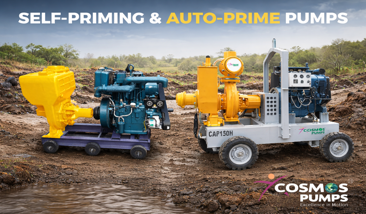
Priming is an essential requirement in many pumping systems, particularly those that draw liquid from a level below the pump inlet. The purpose of centrifugal pumps is to create a vacuum. But it will not work properly if any air gets into the suction line because it will not be able to make enough vacuum. This can result in total loss of flow or failure to operate entirely. The situation is often affected by the changing water levels in several applications and the intermittent operation of these pumps.
Self-priming and auto-prime pumps are specifically designed to address these challenges. They eliminate or significantly reduce the need for manual priming by automatically removing air from the suction line and restoring pumping action in industrial plants and construction sites. The design makes them especially suitable for environments where maintaining a fully flooded suction line is impractical.
How A Self-Priming Pump Prevents Airlock
Self-priming pumps are designed in such a way that they do not require external help in the management of the presence of air in the pumping system. They can blow out and preserve suction even when interrupted due to their internal structure.
What An Airlock Is and Why It Occurs
Airlock is the condition where the air is caught between the suction pipe or the pump casing, so that the liquid does not flow inside the impeller. The centrifugal pumps use liquid to create force, and therefore, the presence of air will cause a break in pressure development. Airlock usually occurs during the first startup, following maintenance processes, when the level of liquid source falls below the suction inlet, or when the suction lines are drained.
Airlocks are hard to avoid in industrial and construction areas because of open sumps, temporary pipelines and disparate working conditions. Pumps may run dry without a priming solution, which can cause them to overheat, damage seals, and shorten their lifespan.
Internal Design That Enables Self-Priming
A self priming pump has a specially designed volute casing that holds a capacity of liquid when it has been shut off. This is a liquid that is necessary for priming. As the pump starts again, the impeller in the casing rotates the liquid, causing a partial vacuum at the suction inlet. This vacuum will pull air in the suction line into the pump.
The casing design of the self-priming pumps is optimised to facilitate this air-handling mechanism, unlike the normal centrifugal pumps, which operate temporarily on a combination of air and water.
Separation Of Air and Liquid Inside The Pump
The internal flow pattern separates air and liquid once the pump casing receives air. The denser liquid is maintained close to the impeller, whereas the lighter air is pushed to a discharge chamber. When the pump continues operating, more air is pumped out via the discharge line and the liquid is pumped back into the priming chamber.
This separation cycle is repeated till all air is removed from the suction line and a uniform flow of liquid is created. When completely loaded, the pump acts as a standard centrifugal pump with normal efficiency.
Re-priming during intermittent operation
The use of self-priming pumps is good, especially in systems that are intermittently operational. In case the pump is blocked and the air is drawn into the suction pipe, the remaining liquid provides the pump with the ability to automatically re-prime itself during the next start. This is useful in eliminating dependency on operators and avoiding repetitive hand priming, which is not always feasible in field installations.
When Should Auto-Prime Pumps Be Used
Auto-prime pumps are made to be used in high-demand situations where the operating conditions frequently change, and the intrusion of air cannot be prevented. They offer superior priming in harsh conditions.
1. Applications With Frequent Start-Stop Cycles
Automatic control systems or timers tend to have high rates of start-stop cycles. With every shutdown, there is a high possibility of air getting into the suction line. To accommodate these conditions, auto-prime pumps are made to offer rapid restoration of suction without manual intervention, hence offering similar performance even after repeated restarts.
2. Use In Fluctuating Water Levels
In an open system, like a sump, pit, canal, or temporary reservoir, the level of the water can increase and decrease at any moment. Auto-prime pumps are able to withstand the suction loss with the decreasing liquid levels, and then recommence pumping on the availability of liquid again. This makes them appropriate in flood management, stormwater management, and drainage in excavations.
3. Industrial and Construction Site Examples
Auto-prime pumps in construction sites are common in trench dewatering, foundation drainage and the removal of water combined with debris or sediment. They are also used in wastewater transfer, cooling water circulation and process drainage systems where the industries tend to have air entrainment.
As they can work well in harsh and unstructured environments, they are often better than regular pumps when it comes to keeping prime.
4. Situations Where Manual Priming Is Impractical
Manual priming requires access to the pump, additional piping, or external water sources. They might not be practical in remote areas, small spaces or in emergency uses. Auto-prime pumps do not require manual operation and can therefore be allowed to run without any supervision, resulting in a faster recovery of the system following a shutdown.
Advantages Of Using A Self-Priming Water Pump
The self-priming water pumps have some beneficial advantages, which enhance the efficiency, safety, and continuity of the system directly.
1. Reduced Downtime
By automatically getting rid of air and bringing the pumping rate back up, self-priming pumps reduce downtime. The faster the recovery after a shutdown, the more productivity is maintained, especially in operations that go on all the time.
2. Ease Of Installation
Self-priming pumps eliminate the need to have complex priming in the form of foot valves, vacuum pumps and flooded suction lines. This makes piping designs simple and saves time spent on installation. A less complex configuration also reduces the chances of installation errors, which can affect the long-term performance.
3. Minimal Operator Intervention
The pumps do not need much maintenance once they are set up correctly. The operators will not have to manually refill the pump casing or monitor conditions of suction at all times. This makes labour less dependent and enables the personnel to work on other important tasks.
4. Suitability For Dirty or Mixed Water
There are several self-priming pumps that are meant to manage water that is full of suspended solids, debris, and air. This makes them applicable in wastewater, sludge-infested water, construction runoff and industrial effluents. Their capability to handle air-water mixtures without loss of performance increases reliability in real-life scenarios.
FAQs
1. What is a self-priming pump?
This is a centrifugal pump that has a mechanism to clear the suction line of air automatically and then start pumping without repeated manual priming.
2. How does an auto-prime pump work?
An auto-prime pump evacuates air from the suction line during startup, allowing it to re-establish suction even after a temporary loss of prime.
3. What is the difference between self-priming and auto-prime pumps?
Self-priming pumps use liquid that is already there to start up, while auto prime pump manufacturers are made to work well when air comes in and out frequently, and the condition changes.
4. Can self-priming pumps handle air-water mixtures?
Yes, they are supposed to run on a temporary basis with air-water mixtures until full priming is obtained.
5. Where are self-priming pumps commonly used?
They are widely applied in construction dewatering, wastewater management, industrial drainage systems, irrigation systems, and flood management systems.
Conclusion
One of the most persistent challenges of pumping systems is the air in the suction line, which can be handled using self-priming and auto-prime pumps. These pumps are capable of operating reliably in conditions where standard centrifugal pumps cannot operate due to specialised casing designs and methods of air-liquid separation.
Understanding the working principles, operating conditions, and application requirements is essential when selecting the appropriate pump. These pumps should be considered when there are priming issues associated with fluctuating water levels, intermittent operation, or air entrainment. They will provide a dependable, efficient, and practical solution for long-term performance in your system.