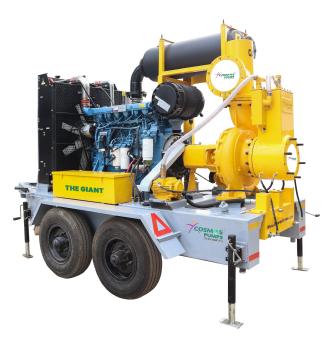
AutoPrime without Canopy heavy trolley CAP ET/MT
Details as follows:

Head
30-169 m

Flow
160m3 / hr - 4469m3 / hr

HP
32-1550+

Prime Mover
Engine/Motor
Mining sumps don’t stay in one place as the pit deepens — the pump must follow across rough haul roads and unformed tracks. CAP ET/MT is built for exactly this: full auto-prime capability on a heavy-duty pneumatic trailer engineered to cross active mine terrain under tow by your existing fleet. With flow rates to 74,483 LPM and suction lift to 9.8 m without a foot valve, this is the dewatering unit specified when both hydraulic performance and rough-terrain mobility are non-negotiable.
What Is a Heavy Trolley Auto-Prime Pump?
A heavy trolley auto-prime pump combines two distinct engineering provisions. The auto-prime mechanism uses a vacuum-assisted priming chamber that evacuates air from the suction line at start-up, drawing water up to 9.8 m of suction lift without a foot valve. Once primed, the system holds prime through normal stop-start cycles. After relocation — suction pipe pulled, moved, reinstalled in a new sump — auto-prime restores full suction on the next start without any manual re-priming or foot valve reinstallation. Dry starts do not damage the pump.
The heavy trolley is a large-format pneumatic tyre trailer with a robust welded steel frame, heavy-duty axle assembly, and a rigid tow-bar coupling designed for connection to mine trucks, bulldozers, or agricultural tractors. Large pneumatic tyres — the same profile used on agricultural and mine support equipment — absorb impact on shot-rock ballast, potholed haul roads, and clay overburden.
The distinction from the small trolley variant (CAP EW/MW): the heavy trolley is designed for inter-sump relocation over distance on unpaved and rough terrain, towed by fleet vehicles as the active sump migrates with mining benches. The small trolley handles intra-site moves on paved or compacted surfaces, typically by one or two operators over short distances.
CAP ET/MT — Technical Specifications
| Parameter | Specification |
|---|---|
| Shut-Off Head | 2 M – 169 M |
| Flow Rate | Up to 74,483 LPM |
| Power Range | Up to 1,550+ HP |
| Suction Lift | 9.8 m (auto-prime) |
| Engine Options | KOEL · Eicher · Baudouin · CAT |
| Drive Type | ET = Engine-driven / MT = Motor-driven |
| Trolley Type | Heavy-duty pneumatic tyre trailer |
| Tyre Specification | Large pneumatic — mine / agricultural profile |
| Terrain Capability | Unpaved mine haul roads, shot-rock ballast, rough ground |
| Towing Method | Tow-bar coupling — mine truck / tractor / bulldozer |
| Impeller Type | Closed (15 mm solids) / Open (75 mm solids) |
| Dry-Run Capability | Yes — no mechanical damage on dry start |
| Foot Valve Required | No |
| Canopy | Without canopy (open frame) |
| Certification | ISO & CE |
| Fleet Available | 50+ auto-prime units for rental — Cosmos Pumps |
Why Mining Dewatering Demands Rough-Terrain Mobility
Open-pit mining is not a static operation. As benches are cut and the pit deepens, the active sump migrates with the working face. A dewatering pump that cannot follow the sump across the pit floor, up haul ramps, and through bench transitions becomes an obstruction. In practice, a pump left at a fixed point while the sump moves forces operators to run progressively longer suction lines until suction lift is exceeded — or to dewater to a secondary collection point at additional cost.
Underground mines present the same constraint: as development headings advance, pump stations must move with them. A pump requiring specialist transport — crane lifts, flat-bed trucks with ramps — adds lead time to every heading advance cycle.
Flood relief dewatering introduces the most demanding mobility requirement: access roads to inundated areas are washed out or submerged. Conventional light trolley pumps cannot cross these conditions. Small-wheel trolleys are designed for paved or compacted-surface mobility; their wheels, axles, and frames are not rated for shot-rock ballast, deep mud, or the dynamic loading of towing across potholed mine haul roads.
The CAP ET/MT resolves this. Towed by vehicles already operating within the mine fleet — no specialist transport contract, no crane hire, no flat-bed mobilisation — the pump moves with the sump wherever the working face leads.
Four Applications Where the CAP ET/MT Is Specified
1. Open-Pit Mining Dewatering
As benches are blasted and loaded, the active sump shifts — sometimes weekly. Mine trucks or bulldozers tow the CAP ET/MT across the pit floor and up haul ramps to the new sump location as part of normal mining cycle logistics. The open impeller variant handles solids up to 75 mm without blockage, matching the duty that closed-impeller centrifugal pumps cannot safely sustain. Coal India Ltd., SCCL, Vedanta mining operations, and private mining contractors across Rajasthan, Odisha, Chhattisgarh, and Jharkhand specify this configuration. Cosmos Pumps deploys to 50+ mining projects per year.
2. Quarry and Aggregate Pit Drainage
Limestone quarries, granite quarries, and aggregate pits flood heavily in monsoon and require rapid, repeated dewatering to maintain blast schedules. Quarry floor terrain — shot-rock ballast, clay overburden — is impassable for small-wheel trolleys. A front loader or farm tractor can tow the CAP ET/MT between quarry pits without road preparation. The open impeller handles silty, gritty quarry water carrying clay-laden groundwater with fine aggregate and drill cuttings.
3. Remote Infrastructure Construction — Highway and Bridge Projects
Remote NH/SH alignment work, bridge pier dewatering, dam foundation excavation in remote corridors require equipment that operates where access roads exist only as unformed tracks. The CAP ET/MT crosses unformed access tracks without road preparation. The auto-prime mechanism eliminates the foot valve that standard surface pumps require — removing a recurring failure mode and a recurring mobilisation task on sites where labour access is constrained. The engine-driven variant (CAP ET) operates independently of site power supply, frequently unavailable at the working face in early construction phases.
4. Flood Relief and Emergency Dewatering
NDRF, SDRF, and municipal disaster response teams deploy Cosmos Pumps units to flood relief operations — 80+ flood control pumps per year. The locations that need dewatering most urgently are exactly where access roads are least able to serve. The CAP ET/MT is towed by relief trucks directly to the point of operation. The heavy pneumatic trolley crosses flooded rural roads, soft agricultural ground, and partially submerged access tracks. Auto-prime restarts without operator intervention after air-locking during flood surges — critical when continuous dewatering through intermittent surges is required.
CAP ET/MT vs CAP EW/MW — Heavy Trolley vs Small Trolley
| Factor | CAP ET/MT (Heavy Trolley) | CAP EW/MW (Small Trolley) |
|---|---|---|
| Terrain capability | Rough mine roads, unpaved tracks, shot-rock ballast | Paved / compacted surfaces only |
| Move distance | Long-distance inter-site towing | 100 m–1 km intra-site |
| Towing method | Mine truck / tractor / bulldozer tow-bar | Manual push or light vehicle |
| Trolley build | Heavy-duty — high payload, robust axle | Compact — one or two operators |
| Mobility speed | Slower — integrated with fleet vehicle movement | Fast — one operator repositions between sumps |
| Primary use | Mining, quarrying, remote construction, flood relief | Multi-sump construction, roads, metro, urban drainage |
| HP range | Full range to 1,550+ HP | Full range to 1,550+ HP |
Decision rule: Specify CAP ET/MT when the pump must travel across terrain that mine or construction vehicles traverse — rough, unpaved, or heavily damaged surfaces over distance. Specify CAP EW/MW when the pump moves frequently between sumps on the same site across paved or prepared surfaces.
How to Plan Sump Relocation in an Active Mine — Six Steps
- Map new sump location relative to the advancing bench / development heading
- Assess haulage route — obstacles, gradient, surface condition; confirm tow vehicle
- Confirm pump dry-down timing — pump current sump to minimum safe level before pulling suction
- Disconnect suction and delivery pipework, cap delivery valve; no foot valve to retrieve
- Attach tow-bar to mine truck, tow to new sump location across haul road
- Reinstall suction pipe, open delivery, restart — auto-prime evacuates suction line in normal priming time
Frequently Asked Questions — Auto-Prime Pump on Heavy Trolley
1. What is a heavy trolley auto-prime pump?
A heavy trolley auto-prime pump is a self-priming centrifugal pump mounted on a large-format pneumatic tyre trailer engineered for towing across rough terrain. The auto-prime system achieves suction lift up to 9.8 m without a foot valve. The heavy trolley frame and large pneumatic tyres allow the unit to be towed by mine trucks, tractors, or bulldozers across unpaved haul roads, shot-rock surfaces, and difficult terrain.
2. What terrain can the CAP ET/MT travel across?
Unpaved mine haul roads, shot-rock ballast quarry floors, clay overburden, rough construction access tracks, and partially damaged or flooded rural roads. Large pneumatic tyres absorb impact loading from uneven surfaces. The heavy-duty axle and frame handle the dynamic loads generated during towing across rough ground.
3. What is the difference between CAP ET/MT and CAP EW/MW?
The ET/MT designates the heavy trolley variant — large pneumatic tyres, heavy-duty frame, tow-bar coupling for mine trucks, for inter-sump moves across rough terrain over longer distances. The EW/MW designates the small trolley variant — compact frame, manually manoeuvred or towed by light vehicles, for frequent intra-site moves on paved or compacted surfaces. Same hydraulic performance range; different mobility configuration.
4. Does the pump need re-priming after being moved to a new sump?
No. The auto-prime mechanism re-engages on every start. Disconnect the suction pipe, move the pump, reinstall the suction pipe in the new sump, and start — the system evacuates the air and achieves full prime without manual intervention. No foot valve to retrieve, clean, or reinstall.
5. What is the maximum flow rate of the CAP ET/MT?
Up to 74,483 LPM depending on pump model, head requirement, and impeller configuration. Contact Cosmos Pumps with your flow rate, head, pipe diameter, and power unit requirements for a specific duty-point selection.
6. What engine options are available?
KOEL, Eicher, Baudouin, and CAT engines across the range up to 1,550+ HP. Engine selection depends on power requirement, fuel availability, service infrastructure, and client preference.
7. Is the heavy trolley pump available for rental?
Yes. Cosmos Pumps operates a fleet of 50+ auto-prime pumps for rental including the CAP ET/MT heavy trolley configuration. Available for mining dewatering, flood relief, and construction dewatering. Contact Cosmos Pumps for availability and mobilisation timeline.
8. Can the CAP ET/MT handle mine water with rock particles?
Yes. The open impeller variant handles solids up to 75 mm, covering rock fines, clay particles, and coarse aggregate fragments typical in mine sump water. The closed impeller variant handles solids up to 15 mm for cleaner mine water or higher-head duties.
Get a Quote for CAP ET/MT
Cosmos Pumps Pvt. Ltd. · ISO & CE Certified · Faridabad, NCR · +91 99333 22238 · cosmos@cosmospumps.com
WhatsApp: +91 99333 22238 | Download Catalogue | Rental enquiries welcome
Why Choose Cosmos Pumps for Mining Dewatering
- Heavy-Duty Pneumatic Trolley for Rough Terrain — designed from the outset for towing across active mine haul roads and quarry floors; not a construction site trolley adapted for mine use
- Auto-Prime — No Foot Valve, No Re-Priming After Every Move — eliminates the most common cause of surface pump downtime in mining
- Open Impeller Handles 75 mm Mine Water Solids — tolerates abrasive duty mine water without rapid wear
- ISO & CE Certified + 50+ Mining Projects/Year — deployment record validates mine-specific technical understanding
Cosmos Auto-Prime Heavy Trolley Pumps
Features and Benefits
Auto-prime to 9.8 m, flow to 74,483 LPM, heads to 169 M, open impeller to 75 mm solids, up to 1,550+ HP, heavy pneumatic trolley, engine or motor drive, ISO & CE certified.
Design Features
Close-coupled centrifugal with integrated priming chamber. Mechanical seals rated for dry-run during priming cycle. Heavy-section structural steel trolley frame, hot-dip galvanised. Solid beam axle rated for loaded-weight towing over rough terrain. Rigid drawbar coupling for agricultural and mining tow-hitches. Anti-vibration engine mounting.
Applications / Use Cases
Open-pit mine sump dewatering (following advancing bench); underground mine drainage; coal mine dewatering; iron ore, limestone, granite, and aggregate quarry drainage; NH/SH bridge pier and foundation dewatering; dam and barrage foundation coffer dam support; NDRF/SDRF flood relief dewatering; agricultural land monsoon drainage; river training and bank protection.
Maintenance and Service
Impeller clearance adjustment for open impeller restores efficiency as wear occurs. Mechanical seal replacement is standard workshop task. Priming chamber cleaning removes accumulated sediment. Cosmos Pumps provides site visits for inspection, seal replacement, and impeller adjustment for remote/mine-site deployments. Spare parts inventory at Faridabad.
Countries We Supply
India · UAE · Oman · Bangladesh · Nepal · Kenya · Tanzania · Mozambique · Nigeria · Ghana
Download Catalogue: AutoPrime without Canopy heavy trolley CAP ET/MT