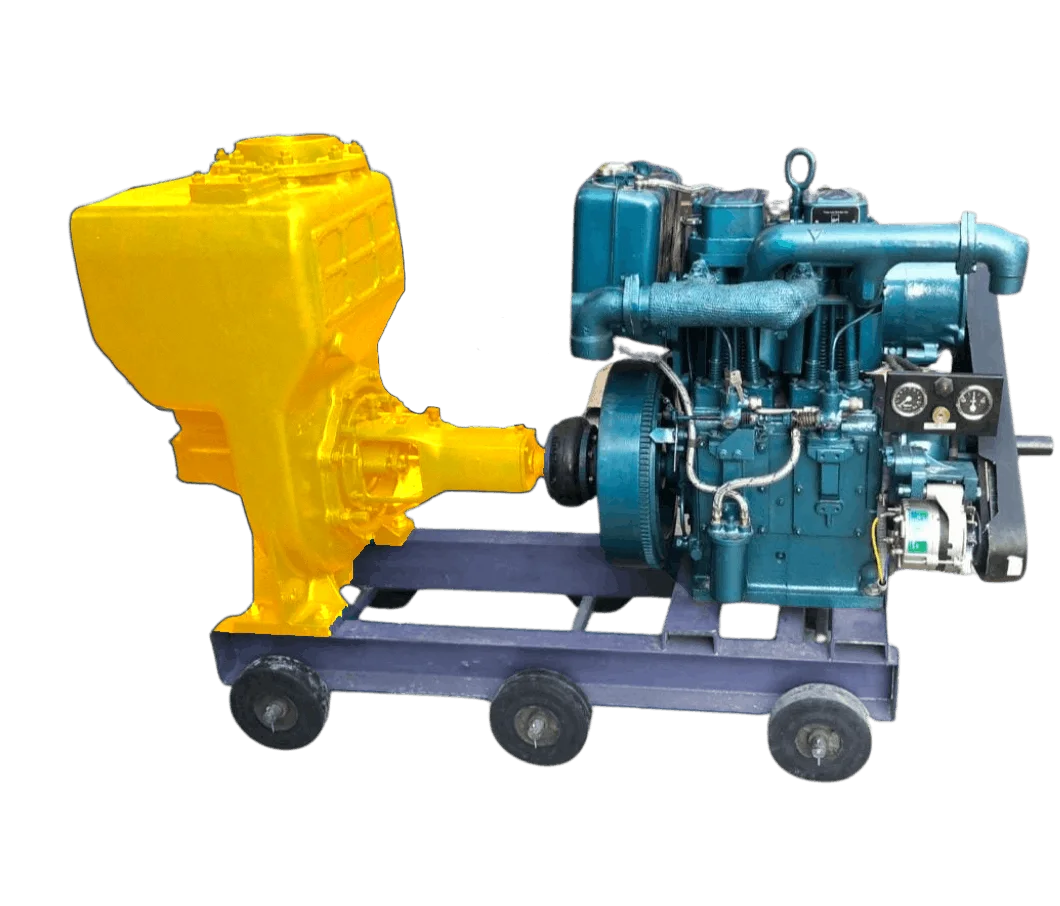
A self-priming pump is a centrifugal pump that can evacuate air from its suction line without external priming equipment, foot valves, or manual filling. The Cosmos Pumps CSP Series (up to 30 HP, 4,500 LPM, 28 M head) self-primes a dry 3–6 inch suction line in 30–60 seconds — making it the standard choice for construction site drainage, chemical effluent transfer, STP/ETP bypass, and basement or trench dewatering where a submersible pump cannot be positioned.
Standard centrifugal pumps lose prime when the suction line entrains air, requiring a foot valve at the inlet and manual re-priming after every shutdown. The CSP Series eliminates this problem through a sealed recirculation casing that retains sufficient liquid to re-prime the impeller on every restart — even after the pump runs dry.
With 300+ construction dewatering deployments per year across India and 22+ export countries, the CSP Series is engineered for demanding site conditions: abrasive slurry, suspended solids, chemical effluents, and continuous flood-duty operations that demand reliable restart performance without operator intervention.
CSP Series — Technical Specifications
The CSP Series covers a wide range of construction, industrial, and flood dewatering duty from small basement sumps to high-capacity site drainage applications:
| Parameter | CSP Series | Notes |
|---|
| Shut-Off Head | 28 M | Maximum discharge pressure head |
| Flow Rate | Up to 4,500 LPM | 75 m³/hr at duty point |
| HP Range | Up to 30 HP | Electric motor driven |
| Suction Lift | Up to 7 M | Measured from pump centreline to water surface |
| Suction Port Size | 3–6 inch | Matched to discharge hose or pipe diameter |
| Priming Time | 30–60 seconds | Dry suction line from rest; no foot valve required |
| Water Type | Construction drainage, chemical effluents, sewage, ash-water | Suitable for lightly laden liquids with suspended solids |
| Casing Material | Aluminium alloy | Lightweight; reduces installation effort on site |
| Mounting | Small-wheel trolley (EW/MW) | Portable; repositionable across site within 100m–1km |
| Power Source | Electric motor | Requires stable grid or generator supply |
| Certifications | ISO 9001:2015 · CE · ZED Gold · NSIC · UL Compliance · EAC | 6 accreditations; manufactured at Faridabad NCR facility |
CSP Self-Priming vs CAP Auto-Prime — Comparison Guide
Cosmos Pumps manufactures two surface-mounted, non-immersible pump series for dewatering. Choosing between CSP (self-priming) and CAP (auto-prime) depends on flow requirement, power availability, and site portability needs:
| Selection Criterion | CSP Self-Priming | CAP Auto-Prime |
|---|
| HP Range | Up to 30 HP | Up to 1,550+ HP |
| Max Suction Lift | 7 M | 9.8 M |
| Max Flow Rate | 4,500 LPM | 74,483 LPM |
| Engine / Power | Electric motor | Diesel or electric; KOEL/Eicher/Baudouin/CAT engine options |
| Priming Time | 30–60 seconds | 30–90 seconds |
| Portability | Small-wheel trolley; 100m–1km repositioning | Heavy trolley / base frame / canopy; rough-road and mining terrain |
| Best For | Construction pits, basements, trenches, STP/ETP bypass, chemical transfer | Flood control, large infrastructure dewatering, mining sumps, oil & gas |
| Power Supply Required | Yes — grid or generator | No — diesel engine is self-sufficient on remote sites |
Rule of thumb: Choose CSP when the flow requirement is below 4,500 LPM, grid power is available, and the application involves controlled site drainage. Choose CAP when flow exceeds 4,500 LPM, power supply is intermittent or unavailable, or the project demands a fully mobile engine-driven unit for remote or flood-duty operation.
CSP Self-Priming vs CDW Submersible — When to Choose Which
The CSP and the CDW Series submersible dewatering pump are frequently compared on construction sites. The correct choice depends on site geometry, water depth, and whether the pump can be immersed in the liquid being handled:
Choose CSP Self-Priming When:
- The water source is accessible from the surface and suction lift is within 7 M
- The pump cannot be submerged — chemical effluents, solvents, or corrosive liquids where motor immersion is unsafe
- Portability is required and the unit must be repositioned frequently across multiple sump points on site
- The liquid contains dissolved gases or volatile components unsuitable for a submerged motor configuration
- Quick dry-start and re-prime capability is needed after suction line interruption or power outage
Choose CDW Submersible When:
- No suction head is available — the pump must be placed directly at the bottom of the sump
- The dewatering depth exceeds 7 M below pump installation level
- Multiple sumps in sequence require independent pump stations at each low point
- Space is constrained on the surface and a surface-mounted unit is impractical
- Seawater or saline duty is required (CDW SS316 variant rated for marine-grade environments)
For very high-head dewatering above 28 M or flows beyond 4,500 LPM, neither the CSP nor the standard CDW is the right tool — consider the CDW High Head (up to 140 M) or the CAP Auto-Prime for very large-volume site applications.
CSP Self-Priming Pump — Application Matrix
The CSP Series is deployed across six principal application categories in building and infrastructure construction, industrial operations, and municipal services:
| Application | Typical Scenario | CSP Advantage |
|---|
| Construction Pit & Foundation Dewatering | Shallow open excavations 2–6 M deep; basement raft foundations; pile cap areas across active build sites | Surface-mounted; no need to rig submersible pump at each pour stage; quick repositioning between sump locations |
| Chemical Effluent Transfer | Acid/alkali wash-down drainage from plant floors; ETP inlet sumps; chemical storage area drainage and spill containment | Pump stays above the hazardous liquid; corrosion-resistant hose connection options; no submerged electrical risk |
| STP/ETP Bypass During Maintenance | Diverting raw sewage or effluent around a treatment unit while it is taken offline for inspection or repair | Immediate self-prime from a dry suction line; no priming tank setup; compact trolley-mount fits tight plant layouts |
| Basement & Trench Drainage | Residential and commercial basements; road trenches; cable duct excavations; utility service trenches in urban areas | Small-wheel trolley fits standard corridor widths; up to 7 M suction lift handles typical basement-to-surface runs |
| Flood & Waterlogging Removal | Inundated low-lying areas; stormwater collection points; road underpasses and subways after monsoon events | Fast self-prime on restart after power interruption; high flow at low head matches typical flood drainage requirement |
| Agricultural & Irrigation Water Transfer | Irrigation channel filling; pond-to-field transfer; temporary water supply on remote project sites and camp areas | No foot valve required; single operator can deploy and relocate without mechanical tools or specialist supervision |
3-Step CSP Self-Priming Pump Selection Guide
Correct sizing of a self-priming pump prevents under-performance — insufficient flow to drain the sump before the next inflow cycle — and over-sizing, which causes excessive velocity, accelerated wear, and wasted energy. Follow these three steps before specifying a CSP model:
Step 1 — Confirm Available Suction Lift
Measure the vertical distance from the centre of the pump to the lowest water surface in the sump or pit. This is your static suction head (Hs).
- If Hs ≤ 7 M: the CSP Series is suitable — proceed to Step 2
- If Hs > 7 M: a submersible CDW placed at the sump floor is the correct solution; the CSP cannot develop sufficient vacuum to lift water from greater depth
Friction losses in the suction hose reduce effective suction lift in practice. As a rule of thumb, add 0.5 M of head loss per 10 M of 4-inch hose at typical dewatering flow rates. Keep the suction hose as short, straight, and large-diameter as site conditions allow.
Step 2 — Estimate Peak Flow Requirement
Calculate the peak inflow rate into the sump using one of the following methods:
- Observed rate method: Time how fast the sump fills (litres per minute) and multiply by a safety factor of 1.25–1.5 to size the pump above peak inflow
- Area-based estimate: Q (LPM) = Site catchment area (m²) × Design rainfall intensity (mm/hr) ÷ 60 × Run-off coefficient × Safety factor
For most construction basement dewatering applications, a peak flow of 500–2,000 LPM covers the majority of inflow scenarios. The CSP Series spans flows up to 4,500 LPM at reduced head, covering the full range of typical site drainage demand.
Step 3 — Select HP from the CSP Performance Range
Match the required flow and total dynamic head (TDH) to the nearest CSP performance point. As a quick-select reference for typical applications:
- Small basement or trench (≤ 500 LPM, ≤ 10 M TDH): 5–7.5 HP CSP
- Medium construction pit (500–1,500 LPM, ≤ 20 M TDH): 10–15 HP CSP
- Large site drainage or flood duty (1,500–4,500 LPM, ≤ 28 M TDH): 20–30 HP CSP
If your flow requirement exceeds 4,500 LPM or TDH exceeds 28 M, the CAP Auto-Prime Series (up to 74,483 LPM / 169 M head) is the correct next step. Use the iDEWA AI Advisor (below) to calculate the specific HP for your site parameters.
Why Choose a Self-Priming Pump? The Engineering Case for the CSP
A standard centrifugal pump requires the casing and suction line to be completely filled with liquid before startup. On a construction site, this creates two practical problems: first, a foot valve must be installed at the bottom of the suction pipe to prevent back-drainage between pump cycles; second, if the pump runs dry or loses prime during operation, it stops pumping and must be manually re-primed before it can restart.
How the CSP Self-Priming Mechanism Works
The CSP Series solves both problems through a sealed recirculation chamber mounted above the impeller. When the pump starts dry, the impeller churns the residual liquid retained in the recirculation chamber, mixing it with incoming air and creating a low-pressure zone at the suction inlet. This draws liquid up the suction pipe until the casing floods and full centrifugal pumping action begins — typically within 30–60 seconds on a 3–6 inch suction line at a suction lift up to 7 M.
Field Evidence: 300+ Construction Deployments Per Year
Across 300+ construction site deployments per year, the two most common failures with conventional centrifugal pumps are prime loss after power interruptions and foot valve blockage in silty groundwater. Both failure modes are eliminated by the CSP design: the recirculation chamber re-primes automatically on every restart without operator intervention, and no foot valve is required at the suction inlet.
For municipal flood control and drainage applications, the no-foot-valve design also reduces maintenance costs — there are fewer mechanical components to inspect, clean, or replace during high-frequency seasonal deployments. CSP units deployed for monsoon flood dewatering are typically restarted dozens of times per day; the self-prime mechanism handles each cycle reliably.
For pump rental requirements, CSP units are available from the Cosmos Pumps fleet for short-term and long-term construction site deployment with fast dispatch from the NCR hub across North India and pan-India.
Use iDEWA to Verify Your CSP Pump Selection
Not sure whether your site needs a CSP self-priming pump, a CAP auto-prime unit, or a CDW submersible? The iDEWA AI Dewatering Advisor analyses your suction lift, peak inflow rate, discharge head, liquid type, and site constraints to recommend the correct pump series and HP rating — in under two minutes, backed by data from 5,000+ completed Cosmos Pumps projects and installations worldwide.
iDEWA is the fastest way to move from site measurement to a defensible, engineer-reviewed pump specification without back-and-forth with a sales team.
Consult iDEWA — Verify Your CSP Selection
Self-Priming Pump — Frequently Asked Questions
What is the difference between a self-priming pump and a centrifugal pump?
A standard centrifugal pump requires the casing and suction pipe to be filled with liquid before it can generate flow — it cannot move air by itself. A self-priming pump, such as the Cosmos CSP Series, incorporates a recirculation chamber that retains residual liquid and uses it to evacuate air from the dry suction line on startup. The result: a CSP pump self-primes in 30–60 seconds without manual filling, foot valves, or external priming equipment. All self-priming pumps are centrifugal pumps; not all centrifugal pumps are self-priming.
How deep can a Cosmos CSP self-priming pump draw from?
The Cosmos CSP Series has a maximum static suction lift of 7 M, measured from the pump centreline to the water surface. In practice, friction losses in the suction hose reduce effective lift by approximately 0.3–0.5 M per 10 M of 4-inch hose. For sump depths greater than 7 M, the CDW Series submersible dewatering pump is the correct solution — it is installed directly in the sump floor and requires no suction lift at all.
What HP self-priming pump do I need for a construction site basement?
For a typical construction site basement of 100–300 m² in plan area with a design rainfall of 25–50 mm/hr and a sump depth of 2–4 M, a 10–15 HP CSP (producing 500–1,500 LPM at 10–20 M TDH) covers most inflow scenarios with a 25% safety margin. Larger basements or sites with significant groundwater infiltration — such as sandy soils near a river or coastal locations — may require a 20–30 HP CSP or a parallel two-pump arrangement. Use iDEWA to calculate the specific HP for your site dimensions and soil conditions.
Does a self-priming pump need a foot valve?
No. A foot valve is required by standard centrifugal pumps to keep the suction pipe filled with liquid between pump cycles — without it, the liquid drains back and the pump loses prime. The Cosmos CSP self-priming pump does not require a foot valve because its recirculation chamber retains sufficient liquid to re-prime the suction line on every restart, even after extended dry periods. Eliminating the foot valve removes a common site failure point: blocked foot valves are one of the most frequent causes of pump downtime in silty or debris-laden groundwater environments.
Can a self-priming pump handle sludge and muddy water?
Yes, within limits. The Cosmos CSP Series is rated for construction drainage, municipal stormwater, chemical effluents, sewage, and ash-water containing the suspended solids typical of site runoff. It is not designed for high-concentration slurry (specific gravity above 1.1 or solids content above 15% by volume) — for those applications, the CSL Hi-Chrome Slurry Pump is the correct series. If the liquid contains large solids above 15 mm or highly abrasive particles such as coarse sand and gravel in mining operations, specify the CSL or the CNC Non-Clog submersible pump series instead.
What is the difference between the CSP self-priming pump and the CAP auto-prime pump?
Both are surface-mounted, non-immersible pumps that can prime from a dry suction line without a foot valve. The key differences: the CSP is electric-motor-driven (up to 30 HP, 4,500 LPM, 7 M suction lift) and suited to construction sites, basements, and STP/ETP applications with grid or generator power available. The CAP Auto-Prime is predominantly diesel-engine-driven (up to 1,550+ HP, 74,483 LPM, 9.8 M suction lift) and built for large-scale flood control, mining, oil & gas, and remote sites without reliable power supply. The CAP is also rated to run dry without damage, making it the standard for emergency flood-duty and intermittent dewatering in remote locations.
Get a CSP Pump Specification — Consult iDEWA