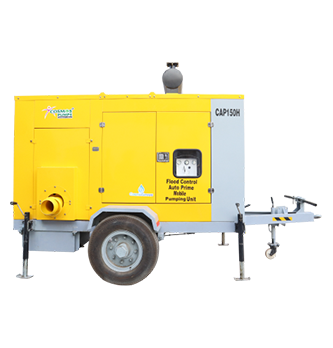
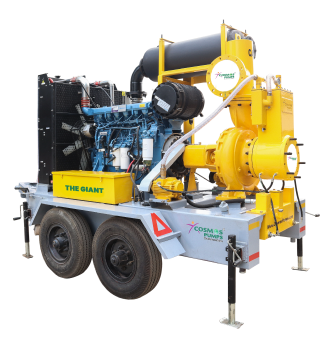
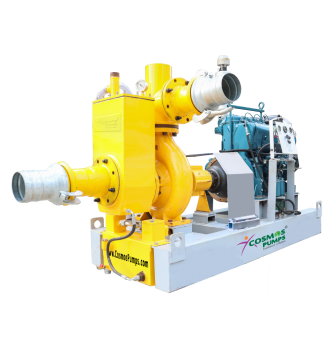
An auto-prime pump is a surface-mounted centrifugal pump that self-evacuates its suction line before water reaches the intake — eliminating the need for external priming, foot valves, or manual flooding. The Cosmos Pumps CAP Series (up to 1,550+ HP, 74,483 LPM, 169 M shut-off head) achieves suction lifts of up to 9.8 m, handles solids up to 75 mm, and can operate dry during the initial prime cycle without impeller damage — making it the industry-standard choice for large-scale flood control, mining dewatering, oil & gas pipeline construction, and any high-flow site where a submersible pump cannot be positioned or where grid power is unavailable.
Standard centrifugal pumps require a flooded suction or a submerged inlet to develop discharge pressure. The CAP Series removes that constraint entirely: an internal vacuum mechanism evacuates the suction line and establishes stable flow without operator intervention. Once primed, the pump delivers continuous high-volume output across diesel or electric power configurations, on skid, trolley, or base-frame mounts, with or without a soundproof canopy.
With 50+ auto-prime pumps deployed annually across flood control operations and 2,500+ customers served across 5,000+ completed projects and installations in 22+ countries, the CAP Series is Cosmos Pumps' flagship product for large-site and mission-critical dewatering.
What is an auto-prime pump?
An auto-prime pump is a surface centrifugal pump that self-evacuates air from its suction line using an internal vacuum mechanism, allowing it to run dry before water arrives at the intake and to prime at suction lifts up to 9.8 m. Unlike submersible pumps, it does not need to be submerged to operate.
When to choose auto-prime (CAP) over self-priming (CSP) or submersible (CDW): Choose CAP when your site requires engine-driven independence from grid power, very high flow rates (above 30 HP), large suction lifts, or rapid multi-point portability across a mining bench or flood zone. Choose submersible CDW for confined sumps with stable power supply. Choose self-priming CSP for medium-duty electric-powered drainage on urban construction sites.
What's the Difference Between Auto-Prime and Self-Priming Pumps?
Both auto-prime and self-priming pumps can evacuate their suction lines and operate without being submerged — but they differ significantly in scale, power source, and application fit. The table below also includes submersible dewatering pumps for a complete three-way comparison. For a detailed guide to the CSP Self-Priming Series, see the dedicated product page.
| Criterion | Auto-Prime (CAP Series) | Self-Priming (CSP Series) | Submersible (CDW Series) |
|---|
| Suction lift | Up to 9.8 m | Up to 7 m | Fully submerged — no suction lift |
| HP range | Up to 1,550+ HP | Up to 30 HP | 1.5–120 HP (CDW series) |
| Power source | Diesel engine or electric | Diesel or electric | Electric only |
| Flow capacity | Up to 74,483 LPM (4,469 m³/h) | Up to 4,500 LPM | 450–8,500 LPM |
| Solids handling | 15 mm (closed impeller) / 75 mm (open impeller) | Up to 13 mm | 4–12 mm standard; 25–70 mm (CNC vortex) |
| Runs without prime (dry start) | Yes — self-evacuates on startup | Yes — recirculation casing retains prime | No — must be submerged |
| Site portability | High — small trolley, heavy trolley, or skid | Medium — small trolley (EW/MW) | Low — requires fixed sump position |
| Best for | Flood control, mining, oil & gas, large infrastructure | Construction drainage, STP/ETP bypass, medium sites | Fixed sumps, confined spaces, electric-grid sites |
Get CAP Pump Recommendation from iDEWA →
CAP Series — Technical Specifications
The CAP Series is designed for continuous-duty, high-volume dewatering where maximum flow, suction flexibility, and engine independence are critical. Specifications below cover the full CAP range; individual model curves are available on request.
| Parameter | CAP Series | Notes |
|---|
| Shut-Off Head | 2 M – 169 M | Model-dependent; match to total dynamic head requirement |
| Max Flow Rate | Up to 74,483 LPM (4,469 m³/h) | Large flood-duty and mine-dewatering configuration |
| HP Range | Up to 1,550+ HP | Full portfolio range; engine or motor drive |
| Suction Lift | 9.8 m | Auto-prime mechanism; no foot valve required |
| Solids — Closed Impeller | Up to 15 mm | Standard dewatering and construction drainage |
| Solids — Open Impeller | Up to 75 mm | Slurry and aggregate-laden discharge |
| Specific Gravity (SG) | Up to 1.1 | Lightly turbid water; for SG >1.1 see CSL Slurry Pump |
| pH Range | 5–8 | Standard dewatering duty; consult for extremes |
| Engine Options | KOEL · Eicher · Baudouin · CAT | Engine selected per HP duty and export compliance |
| Variants | CAP EW / CAP MW (open frame) · CAP EC / CAP MC (canopy) | EW/MW: open sites; EC/MC: noise-restricted environments |
| Dry-Run Capability | Yes — during initial prime cycle | Extended dry running not recommended without guidance |
| Certifications | ISO 9001:2015 · CE · ZED Gold · NSIC · UL Compliance · EAC | 6 accreditations; manufactured at Faridabad NCR facility |
Note: For applications requiring fluid specific gravity above 1.1 or solids content above 70% by weight, see the CSL Slurry Pump Series.
CAP Auto-Prime vs CDW Submersible — Which Pump Do You Need?
The decision between a surface auto-prime pump and a submersible dewatering pump depends on site access, power availability, flow volume requirements, and whether the pump can be installed above or below the water line. Use the selection guide below to match your site profile:
| Site Condition | Choose CAP (Auto-Prime Surface) | Choose CDW (Submersible Dewatering) |
|---|
| Power supply | No grid power / intermittent generator | Stable electrical grid available |
| Pump positioning | Must remain above water surface (engine protection, access) | Pump can be fully submerged in sump |
| Flow volume | Very high flow rate required (above 30 HP) | Moderate flow; multiple small sumps in sequence |
| Portability | Pump must move between multiple points on site | Fixed installation with permanent sump |
| Suction head | Suction head up to 8.5 m available | No available suction head — pump must be immersed |
| Fluid type | Construction drainage, floodwater, mine effluent | Sewage, slurry, highly solids-laden fluid (with CNC/CSL) |
| Space constraint | Open site with surface access | Confined sump — surface equipment not viable |
For electric submersible dewatering across the 1.5–120 HP range, see the Submersible Dewatering Pumps → product page.
CAP Auto-Prime Pump Applications
The CAP Series operates across a wide range of high-volume industrial and infrastructure dewatering applications. Engine-driven models are particularly well suited to remote sites, export deployments, and mission-critical flood operations where grid power cannot be guaranteed:
| Application | Why CAP is the Right Choice | Typical HP Requirement |
|---|
| Municipal flood control | High flow capacity for rapid water removal; diesel independence during power outages; canopy models suitable for dense urban deployment | 100–500 HP |
| Mining & quarry dewatering | Handles turbid, lightly solids-laden mine drainage at high lifts; heavy trolley mount for bench-to-bench relocation on rough terrain | 100–1,550+ HP |
| Oil & gas pipeline construction | Engine-driven operation at remote sites with no grid infrastructure; high-volume sump clearance during hydro-test and trench dewatering operations | 200–500 HP |
| Large building & infrastructure construction | Foundation pit and basement dewatering; diesel portability across multiple excavation zones; no foot valve required | 25–100 HP |
| Railway & road tunnel dewatering | Continuous-flow suction from confined sump; no submerged pump required in tight tunnel cross-section; 9.8 m suction lift covers most TBM sump depths | 50–200 HP |
| Export & remote international sites | CAT and Baudouin engine options for global parts support; EAC certification for CIS/Russia export; CE marking for European deployments | 100–500 HP |
| Thermal & hydro power plant dewatering | High-volume intake channel and penstock dewatering during maintenance shutdowns; flood-duty standby at plant boundaries | 100–500 HP |
Cosmos Pumps deploys 80+ auto-prime pumps per year for flood control operations and supports 50+ mining projects annually across India and 22+ export countries. CAP rental fleet → (50+ units, 60–105 HP) provides immediate deployment without capital outlay for project-based requirements.
CAP Mounting Options & Model Variants
The CAP Series is available in four mounting configurations and two canopy options to match site conditions, noise requirements, and portability needs:
Open-Frame Models: CAP EW & CAP MW
CAP EW (electric with wheels) and CAP MW (motor with wheels) are open-frame configurations for sites where noise is not a constraint and rapid visual access to the engine and pump assembly is preferred. Both variants are skid or trolley mounted for repositioning across open construction, mining, or flood-control sites.
| Mounting Type | Best For | Typical Site |
|---|
| Small trolley | Short-duration, urban construction sites; repositioning within 100 m–1 km | Foundation dewatering, basement clearance, road works |
| Heavy trolley | Long-term sites; rough terrain and unpaved mine haul roads; offshore access | Open-pit mining, quarrying, remote pipeline routes |
| Base frame | Permanent or semi-permanent installation at plant boundary or pump station | Thermal power plants, industrial facilities, municipal pump stations |
Canopy Models: CAP EC & CAP MC
CAP EC (engine canopy) and CAP MC (motor canopy) are soundproof, enclosed variants designed for urban environments and residential-adjacent deployment zones. The acoustic canopy significantly reduces engine noise output to comply with local ordinance requirements without compromising pump access during routine maintenance.
- Urban flood dewatering: Canopy models are the preferred configuration for municipal flood-duty operations within city limits where noise ordinances apply after 10 pm.
- Hospital, airport, and institutional sites: Canopy models reduce operational noise below the threshold required for sensitive facilities.
- Custom branding: Canopy panels can be painted to customer or project brand guidelines for EPC and BOOT project deployments.
Note: Canopy models (CAP EC/MC) comply with local noise ordinances in urban and residential-adjacent deployments.
How to Select the Right Auto-Prime Pump for Your Site
Selecting the correct CAP model requires matching your site's peak inflow rate, total dynamic head, and power availability to the pump's flow-head curve. The three-step sizing process below covers most standard site conditions:
Step 1 — Calculate Required Flow Rate
Measure or estimate the peak inflow rate at your dewatering point in cubic metres per hour (m³/h). For open excavations, this is the design storm runoff rate multiplied by your catchment area. For mine sumps, it is the combined inflow from all active seams and precipitation during the design rainfall event.
Add a minimum 20% safety margin to your calculated flow rate to cover unanticipated inflows, pipe friction losses, and operational headroom. This becomes your target pump duty flow.
Step 2 — Determine Total Dynamic Head
Total Dynamic Head (TDH) is the sum of static head (vertical lift from water surface to discharge point), friction losses in suction and discharge piping, and any velocity head. Ensure the suction lift component does not exceed 9.8 m — the maximum suction capability of the CAP Series auto-prime mechanism.
Select the CAP model whose flow-head curve intersects your duty point (design flow × TDH) within the high-efficiency zone of the pump curve, typically 70–85% of the Best Efficiency Point (BEP).
Step 3 — Choose Power Source and Mounting Configuration
If reliable grid power is unavailable, select a diesel engine configuration (KOEL / Eicher / Baudouin / CAT) matched to the required HP. For sites with strict noise restrictions, specify the CAP EC/MC canopy model. For multi-point site operations requiring frequent relocation, specify the small or heavy trolley mount based on terrain conditions.
For automated pump sizing and model selection, use the iDEWA AI Dewatering Consultant → — enter your flow, head, and site conditions for an instant CAP model recommendation.
Get CAP Pump Recommendation from iDEWA →CosmoSmart™ IoT Monitoring for CAP Auto-Prime Pumps
Cosmos Pumps' CosmoSmart™ IoT system integrates with the CAP Series to provide real-time operational monitoring across multiple pump deployment sites from a single mobile application. For fleet operators running multiple CAP units across a flood control network or mining bench, remote visibility eliminates the need for continuous on-site supervision:
- Real-time pump location tracking — GPS position of each unit across the site network
- Live engine running data — fuel consumption, operating hours, RPM
- Fuel theft and refuelling alerts — automated notifications when fuel levels drop unexpectedly
- Predictive service alerts — triggered by engine hours to prevent unplanned breakdown
- 6-month running data archive — for maintenance planning and project reporting
CosmoSmart™ is particularly valuable for CAP fleet deployments in flood-prone districts where multiple high-capacity pumps operate simultaneously and where unexpected shutdown of a single unit can have significant consequences for downstream flood management.
Why Cosmos Pumps for Auto-Prime Pump Supply & Rental
Cosmos Pumps Pvt. Ltd. has been supplying auto-prime pumps for large-scale dewatering projects since 2013, growing from a specialist rental and trading company to a vertically integrated manufacturer with a 25,000 sq. ft. manufacturing facility in Faridabad, NCR.
| Credential | Detail |
|---|
| Track record | 2,500+ customers served across 5,000+ completed projects and installations worldwide |
| Export reach | Active presence in 22+ countries including UAE, Saudi Arabia, Nigeria, Australia, Russia, and South Africa |
| Quality certifications | ISO 9001:2015 · CE Marking · ZED Gold (Ministry of MSME) · NSIC · UL Compliance · EAC (Eurasian Conformity) |
| Rental fleet | 50+ CAP auto-prime units (60–105 HP) for immediate deployment; no capital outlay required |
| EPEC capability | Engineering, Procurement, Execution & Commissioning — full project ownership from scoping to O&M handover |
| Engine support | KOEL, Eicher, Baudouin, and CAT engine options with pan-India and international parts availability |
| IoT integration | CosmoSmart™ fleet monitoring available for rental and purchased units; iDEWA AI sizing available online |
Frequently Asked Questions — Auto-Prime Pumps (CAP Series)
What does auto-prime mean in a pump?
An auto-prime pump self-evacuates air from its suction line using a vacuum mechanism, allowing it to run dry before water reaches the pump intake. Unlike submersible pumps, auto-prime surface pumps do not need to be submerged to start, and they can maintain prime at suction lifts up to 9.8 m without foot valves or manual flooding.
What is the difference between self-priming and auto-priming pumps?
Both self-priming (CSP) and auto-priming (CAP) pumps can evacuate air and prime without being submerged. The key differences are scale and power: CSP pumps reach up to 30 HP for medium-duty electric-powered applications, while CAP auto-prime pumps scale to 1,550+ HP and are engine-driven for large-scale flood control, mining, and oil & gas sites. CAP pumps are designed for high-flow, engine-independent operation; CSP pumps are suited to urban construction and STP/ETP bypass where stable grid power is available.
What is the difference between CAP EW/MW and CAP EC/MC models?
CAP EW and CAP MW are open-frame models suitable for open construction sites, mining, and oil & gas applications where noise is not a constraint. CAP EC and CAP MC are canopy-enclosed soundproof models designed for noise-restricted urban environments and residential-adjacent deployments, complying with local noise ordinances.
What is the maximum solid size a CAP auto-prime pump can handle?
CAP auto-prime pumps handle solids up to 15 mm with a closed impeller for standard dewatering, and up to 75 mm with an open impeller for slurry and aggregate-laden applications. For fluids with solids content above 70% by weight or SG above 1.1, the CSL Hi-Chrome Slurry Pump series is recommended.
Can a CAP auto-prime pump run dry?
Yes. The auto-prime mechanism creates a vacuum to evacuate air from the suction line, so the pump can start without a pre-flooded suction. Extended dry running beyond the initial prime cycle is not recommended without manufacturer guidance, as it may cause impeller and seal wear.
How do I size a CAP pump for flood control?
Calculate the peak inflow rate at your site in m³/h, add a 20% safety factor, then match the result to the CAP flow-head curve at your required total dynamic head. For automated pump sizing, use the iDEWA AI Dewatering Consultant at cosmospumps.com/ai-dewatering-solution-consultant-idewa/.
How often does a diesel CAP pump require engine maintenance?
Follow engine manufacturer service intervals. KOEL and Eicher engines typically require an oil change at 250 hours and filter service at 500 hours. CAT and Baudouin engines follow their published PM schedules. Cosmos Pumps' CosmoSmart™ IoT system can be configured to trigger automated service alerts based on engine running hours.
Explore Related Products & Services