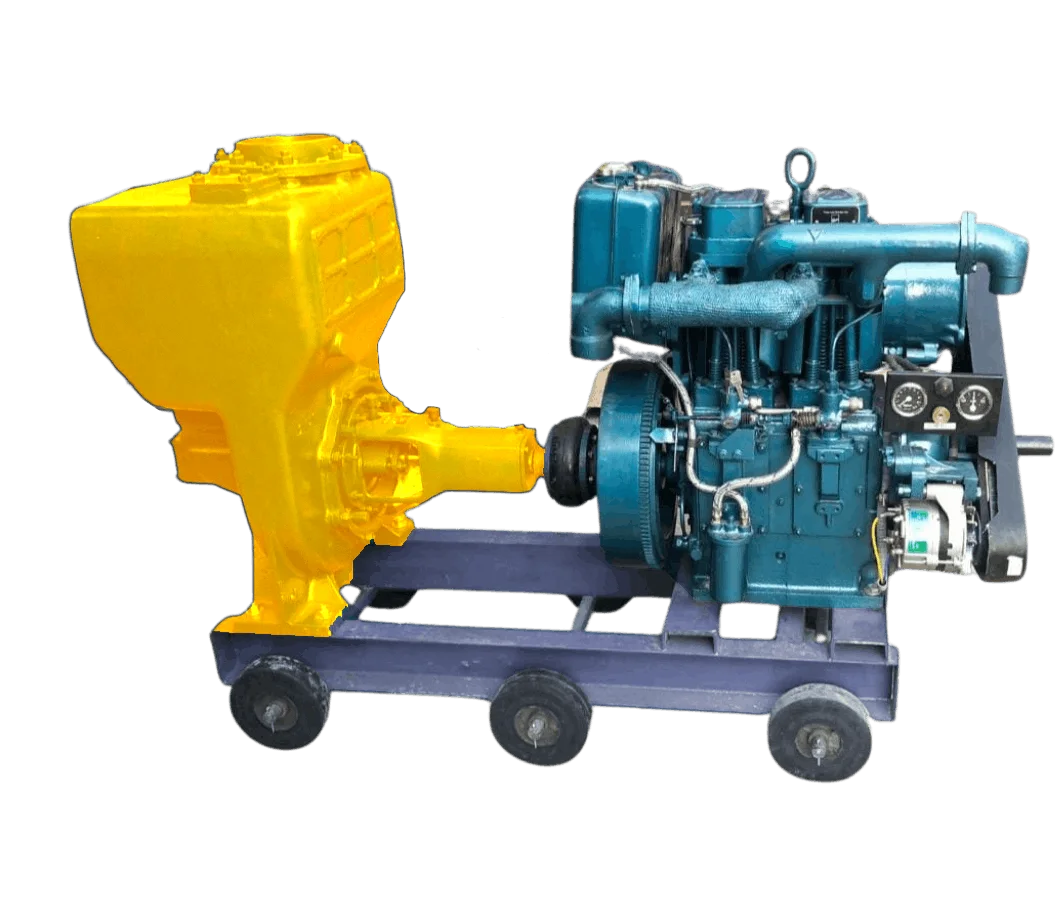
Self Priming Pump on small wheel CSP EW/MW
Details as follows:

Head
10-28 m

Flow
65-280 m3 /hr

HP
6-26

Prime Mover
Engine/Motor
Portable self-priming surface pump mounted on a small wheel trolley for 100 m to 1 km site-to-site portability. Available in electric motor (EW) and diesel engine (MW) drive variants. Head up to 28 M, flow up to 4,500 LPM, 6 HP to 30 HP. ISO & CE certified manufacturer, Faridabad, India.
| Parameter | Value |
|---|---|
| Shut-Off Head | Up to 28 M |
| Max Flow Rate | Up to 4,500 LPM (75 m³/h) |
| HP Range | 6 HP – 30 HP |
| Prime Mover — EW | Electric motor (grid or generator) |
| Prime Mover — MW | Diesel engine (air-cooled) |
| Suction Lift | Up to 9.8 M (self-priming) |
| Mounting | Small wheel trolley (100 m – 1 km portability) |
| Applications | Construction · Foundation dewatering · Flood response · Sewage/ash-water |
| Certifications | ISO 9001 & CE Approved |
Construction dewatering and flood response operations rarely stay in one place. A pump that was draining a foundation trench at Plot A this morning needs to be at the basement excavation at Plot B by afternoon. A pump system on a fixed base frame requires a crane lift, a truck, and a rigging crew. A pump on a small wheel trolley requires one operator and a flat surface.
The Cosmos CSP EW/MW Self-Priming Pump on Small Wheel is designed for this requirement. The CSP pump — a proven self-priming centrifugal surface pump capable of 28 M head and 4,500 LPM — is frame-mounted on a compact two-wheel trolley for rapid repositioning across construction sites, housing developments, and urban flood response operations covering areas from 100 m to 1 km.
The EW variant runs on an electric motor, powered by the site’s temporary construction power or a site generator. The MW variant runs on an air-cooled diesel engine — fully independent of the power supply, essential for flood response operations where mains power is disrupted or for remote construction sites without grid access.
WhatsApp +91 99333 22238 Download CSP Catalogue
CSP EW/MW Technical Specifications
| Parameter | Specification |
|---|---|
| Shut-Off Head | Up to 28 M |
| Max Flow Rate | Up to 4,500 LPM (75 m³/h) |
| HP Range | 6 HP – 30 HP |
| Suction Lift | Up to 9.8 M (self-priming; no foot valve required) |
| Prime Mover — EW | Electric motor (220V single-phase or 415V three-phase) |
| Prime Mover — MW | Air-cooled diesel engine |
| Solids Handling | Up to 15 mm (closed impeller) |
| Pump Type | Self-priming centrifugal surface pump |
| Mounting | Small wheel two-wheel trolley |
| Portability Range | 100 M – 1 KM site-to-site |
| Applications | Construction site dewatering · Foundation/trench dewatering · Flood water removal · Chemical effluents · Sewage & ash-water transfer |
| Certifications | ISO 9001, CE |
Available motor configurations: Single-phase 220V (EW, smaller HP), three-phase 415V (EW, larger HP), diesel engine options include KOEL and Eicher across the HP range.
Small Wheel vs Heavy Trolley: Which Mounting for Your Duty?
Cosmos manufactures the CSP self-priming pump on three mounting configurations: small wheel (EW/MW), heavy trolley, and base frame. Choosing the correct mounting for the application prevents either over-spending on unnecessary portability features or under-specifying portability and losing operational flexibility.
| Feature | CSP on Small Wheel (EW/MW) | CSP on Heavy Trolley | CSP on Base Frame |
|---|---|---|---|
| Portability range | 100 M – 1 KM | 1 KM – multi-site (rough terrain) | Fixed installation |
| Terrain | Prepared site surfaces, flat hardstanding | Rough roads, mine tracks, off-road | Concrete pad / pump room |
| Repositioning method | Manual push/pull — 1 operator | Tow vehicle (jeep/tractor) | Crane/forklift |
| Site type | Construction site, housing development, urban flood | Mining, quarry, remote rural, long haul | Permanent pump station |
| HP range typical | 6 – 30 HP | 30 – 125 HP+ | Any |
| Storage | Compact — fits in pickup bed | Trailer/compound | On-site permanent |
Choose the small wheel (EW/MW) when: you need to move the pump between multiple points on a single construction site or across nearby sites (within 1 km), on prepared surfaces, without heavy vehicle logistics. This is the right choice for housing developers, foundation contractors, and urban flood response teams who move pumps 2–5 times per week.
Choose the heavy trolley when: the pump must travel long distances on rough terrain — mining sites, rural flood control operations, or projects across multiple towns. The heavy trolley accommodates larger HP engines and is designed for tow-vehicle deployment.
Choose the base frame when: the pump is permanently installed at a fixed location — a pump room, a permanent dewatering sump, or a flood control gate structure.
Applications — Where the CSP EW/MW Operates
Construction Site Dewatering
High-rise residential and commercial construction projects in Indian cities require continuous dewatering of excavated basements, lift pits, and pile cap trenches during the monsoon and post-monsoon periods. A single housing development project may have 10–20 active dewatering points across a site spanning several hundred metres.
The CSP EW/MW’s small wheel trolley allows a single operator to wheel the pump from one dewatering sump to the next in under 5 minutes, without requiring a crane or vehicle. Electric (EW) variants run on the site’s temporary power distribution, while diesel (MW) variants remain operational when site power circuits are being reconfigured or extended.
At 28 M head and 4,500 LPM maximum flow, the CSP handles trench and basement dewatering duties typically requiring a 6–25 HP pump — the full working range of the EW/MW small wheel configuration.
Foundation and Trench Dewatering
Foundation engineers on pile cap, raft foundation, and basement construction specify self-priming surface pumps rather than submersible pumps for trench dewatering because the pump can remain above the water level — only the suction hose enters the trench. This protects the motor from continuous submergence and makes inspection and servicing easier on active construction sites.
The CSP’s self-priming capability — up to 9.8 M suction lift — means the pump can be positioned at grade and draw from a trench or sump up to 9.8 M below the pump centreline. No foot valve is required. The pump re-primes automatically after suction loss, reducing the need for operator attention during multi-hour pumping operations.
Flood Response and Water Logging Removal
Urban flash flooding and monsoon waterlogging events require rapid deployment of pumping capacity to multiple affected locations within a single day. Municipalities, RWAs (Resident Welfare Associations), and housing developers with on-site CSP EW/MW units can respond to waterlogging without waiting for a rental fleet.
The diesel MW variant is specifically valued in flood response because mains power is frequently disrupted during heavy rain events. An MW diesel unit operates independently of the power grid for as long as it has fuel — typically 8–12 hours per tank fill on a 10–15 HP engine.
Chemical Effluent and Sewage Transfer
The CSP’s self-priming impeller design handles wastewater containing solids up to 15 mm and limited chemical contamination — making it suitable for transferring construction site wash water, grey water from site facilities, and light sewage from temporary sanitation facilities to approved disposal points.
For sewage or effluent with solids exceeding 15 mm or SG above 1.2, the CSW sewage submersible pump range is the correct specification. For ash-water slurries, refer to the CSL slurry pump range.
EW vs MW: Electric or Diesel Drive?
The CSP EW (Electric, small Wheel) and CSP MW (diesel engine, small Wheel) are mechanically identical CSP pump heads on the same small wheel trolley frame. The only difference is the prime mover — electric motor (EW) or diesel engine (MW). The choice depends on power availability and operational requirements.
| Consideration | Choose EW (Electric) | Choose MW (Diesel) |
|---|---|---|
| Power supply | Grid or site generator available | No grid; remote or flood-hit site |
| Operating cost | Lower (electricity) | Higher (diesel fuel cost) |
| Runtime limit | Unlimited (while power available) | Fuel tank duration (8–12 hrs typical) |
| Start-up | Immediate — on/off switch | Engine start; cold weather warm-up |
| Noise | Lower (motor hum only) | Higher (engine exhaust) |
| Maintenance | Motor: low maintenance | Engine: air filter, oil change, fuel filter |
| Regulatory | Suitable for enclosed urban sites | Open-air sites; engine exhaust ventilation needed |
Practical rule of thumb: Use the EW on any construction site where 3-phase or single-phase power is available and reliable. Use the MW for flood response, remote rural operations, and temporary sites where the power supply is absent or unreliable.
How Self-Priming Works — and Why It Matters on Construction Sites
A standard centrifugal surface pump cannot lift water from below its pump centreline without first being manually primed — filling the pump casing and suction pipe with water before start-up. On a construction site where the pump is moved frequently, manual priming requires a bucket, a co-operator, and several minutes at each new position.
A self-priming pump solves this. The CSP uses a sealed pump casing design that retains a small quantity of water after each operation cycle. On the next start-up, the rotating impeller creates a partial vacuum that pulls air out of the suction pipe and draws liquid from below the pump — up to 9.8 M below. The pump primes itself in 20–60 seconds depending on suction pipe length and lift. No manual water filling is required.
On a construction site where the pump is moved 3–5 times per day between sumps, the time saving from self-priming vs manual priming is 15–30 minutes per day per pump — and eliminates the risk of dry-run damage when a manual prime is forgotten.
The CSP vs standard centrifugal pump for construction dewatering: A standard centrifugal pump requires the pump body to be submerged or manually primed at each position. The CSP can remain on the surface with only the suction hose entering the sump. This means the motor stays out of the water, making inspection easier, reducing motor failure risk from water ingress, and enabling faster repositioning.
Frequently Asked Questions
What is a self-priming pump?
A self-priming pump is a surface-mounted centrifugal pump that can evacuate air from its suction pipe and draw liquid upward from below its pump centreline — without requiring manual water filling (priming) before each start. The CSP retains residual water in the pump casing that enables automatic re-priming after each stop, making it ideal for applications where the pump is frequently repositioned.
What is the difference between a self-priming pump and an auto-priming pump?
A self-priming pump (like the CSP) uses its own impeller and residual casing water to create vacuum and draw the liquid up. An auto-priming pump (like the CAP) uses a separate priming tank and vacuum pump mechanism to achieve priming — typically faster initial prime and higher suction lift. The CSP is better suited to 6–30 HP portable applications on construction sites. The CAP handles larger duties (30 HP to 1,550+ HP) including mining, flood control, and oil & gas applications. Both can handle suction lifts up to 9.8 M.
What is the difference between CSP EW and CSP MW?
CSP EW uses an electric motor drive — runs on grid power or a site generator. CSP MW uses a diesel engine drive — fully independent of mains electricity. Both use the same CSP pump head on the same small wheel trolley. Choose EW where reliable power is available; choose MW for flood response, remote construction, or any site without dependable electrical supply.
What is the maximum suction lift of the CSP EW/MW?
Up to 9.8 M. This means the pump can be positioned at ground level and draw water from a sump or trench up to 9.8 M below. No foot valve is required in the suction line. Actual suction lift in the field depends on suction pipe length, bends, and atmospheric pressure at the installation altitude.
What solids can the CSP handle?
The CSP handles solids up to 15 mm in diameter with a closed impeller. For construction site grey water, trench water, and lightly contaminated surface water, this is sufficient. For sewage containing solids above 15 mm or wastewater with SG above 1.2, the CSW sewage submersible pump is the correct specification.
How far can I move the CSP on the small wheel trolley?
The small wheel trolley is designed for 100 m to 1 km repositioning on prepared site surfaces — hardstanding, concrete, or compacted earth. For repositioning over rough terrain, across multiple kilometres, or between sites requiring road transport, the heavy trolley (tow vehicle-mounted) is the correct choice.
Can the CSP diesel MW run overnight on a construction site?
Yes. Standard diesel engine tanks on 10–15 HP units provide 8–12 hours of runtime on a full fill. For overnight dewatering, ensure the tank is filled before the last supervised operating period. Auto-stop features can be configured via a float switch to prevent the pump from running dry if the sump empties.
What engine options are available for the CSP MW diesel variant?
Cosmos supplies the CSP MW with KOEL and Eicher diesel engines across the 6–30 HP range. These are well-supported Indian brands with widespread dealer and spare parts networks across North India and other regions, reducing service downtime risk on active projects.
Is the CSP EW/MW available on rental from Cosmos?
Self-priming pump units from the CSP range are available from the Cosmos Pumps rental fleet for short-term construction site dewatering, monsoon response, and emergency flood control deployments. Contact us with the site location, required duration, HP requirement, and power availability for rental pricing and availability.
Request a Quote — CSP EW/MW Self-Priming Pump on Small Wheel
Cosmos Pumps is an ISO & CE certified manufacturer of self-priming surface pumps based in Faridabad, NCR. The CSP EW/MW is part of our full self-priming and auto-priming product range, supported by a Pan India rental fleet, in-house EPEC services, and post-commissioning O&M support.
To receive a pump selection and quotation, contact us with:
- Required flow rate (LPM or m³/h)
- Required head (M)
- Power supply (grid/generator available? Single or three-phase voltage?)
- Site type and repositioning frequency
- Fluid type (construction runoff, grey water, flood water, other)
Download Catalogue: Self Priming Pump on small wheel CSP EW/MW