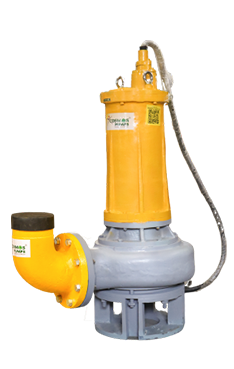
Sewage Pump CSW
Details as follows:

Low Head
1350-10800 LPM

Medium Head
4800-22000 LPM

High Head
NA
Cosmos Pumps CSW Series is a submersible sewage pump built for continuous-duty operation in raw sewage, municipal mains, and industrial effluent. The range spans 2 HP to 200 HP, delivers flow rates from 775 LPM to 33,000 LPM, and handles solids up to 100 mm in passage diameter. Shut-off head reaches 60 M. Specific gravity tolerance extends to 1.7, covering heavily loaded industrial effluent.
Municipal engineers, EPC contractors, and housing society facility managers specify the CSW where the fluid carries suspended solids, rags, fibrous material, and organics. This is not a clean-water pump repurposed for sewage. Every design parameter — impeller geometry, shaft material, mechanical seal configuration, motor insulation — is selected for sewage duty.
Cosmos Pumps is ISO-certified and CE-certified, manufacturing from Faridabad, NCR. The company has commissioned 250+ projects across India and exports CSW Series units to the UAE, Saudi Arabia, Qatar, Bahrain, Kuwait, Nigeria, South Africa, Kenya, Egypt, and 15 additional territories.
What Is a Submersible Sewage Pump?
A submersible sewage pump operates fully submerged in the fluid it is moving. The motor and pump hydraulics form a sealed unit. There is no suction pipe, no priming requirement, and no above-ground pump house for the wet-well installation.
Sewage is not water. Municipal raw sewage carries faecal solids, toilet paper, food waste, grit, and occasional non-flushable debris. Industrial sewage adds process chemicals, oils, and suspended particulates. Specific gravity ranges from 1.01 for lightly loaded domestic sewage to 1.5–1.7 for concentrated industrial effluent. A pump specified only for clean water will clog, cavitate, or fail mechanically when exposed to these conditions.
How Sewage Pumps Differ From Dewatering Pumps
Dewatering pumps move groundwater with low suspended solids — typically construction site inflow or mine pit water. Their impellers use close-clearance vane geometry optimised for head and efficiency in relatively clean fluid. Solids passage is limited: typically 5–15 mm.
Sewage pumps are designed around solids passage as the primary hydraulic constraint. The CSW passes solids up to 100 mm. The impeller geometry is open or semi-open to prevent clogging. The volute is oversized relative to hydraulic efficiency to provide the passage cross-section. The shaft and mechanical seal system are rated for fluid with abrasive and chemically aggressive components.
Deploying a dewatering pump in a sewage wet well is an engineering error. The pump will block within hours on 80 mm solids. Seals fail when SG exceeds 1.1. Impeller wear accelerates on grit and fibrous material.
Why Submersible Over Dry-Well Installation?
Dry-well installations require a separate pump room adjacent to the wet well, shaft seals on the drive shaft penetrating the wall, suction piping, and a mechanical room that must be ventilated and classified for H2S exposure. Capital cost is substantially higher. Maintenance access requires confined-space entry to the pump room under gas-monitoring protocols.
Submersible installation uses auto-coupling guide rail systems. The pump is lowered by the SS316 lifting hook and chain, engages the coupling under its own weight, and is raised for service without personnel entering the wet well. Installation cost is lower. Service time is measured in minutes per pump, not hours per pump room.
CPHEEO (Central Public Health and Environmental Engineering Organisation) guidelines for sewage pumping stations, referenced in the Manual on Sewerage and Sewage Treatment Systems, acknowledge submersible pumps as the standard configuration for new municipal wet-well stations where space is constrained or H2S risk is present.
CSW Series: Technical Specifications
| Parameter | Specification |
|—|—|
| Model Series | CSW — Submersible Sewage Pump |
| Power Range | 2 HP – 200 HP |
| Flow Rate | 775 LPM – 33,000 LPM |
| Shut-Off Head | 5 M – 60 M |
| Solids Passage | 20 mm – 100 mm (model-dependent) |
| Fluid Specific Gravity | Up to 1.7 |
| Motor Insulation | Class F (155°C standard); Class H (optional) |
| Thermal Protection | Thermal sensor integrated in motor winding |
| Bearings | Angular / Radial / Taper ball bearings; high-temperature grease |
| Mechanical Seal | Dual TC vs TC (tungsten carbide) + oil seal |
| Optional Sensors | Moisture sensor; temperature sensor |
| Shaft Material | SS410 (high torsional strength) |
| Impeller Options | Stainless Steel or Cast Iron |
| Lifting Hook | SS316 |
| Certification | ISO, CE |
| Manufacturing Origin | Faridabad, NCR, India |
Impeller and Hydraulic Notes
The CSW impeller is available in stainless steel (standard for corrosive industrial effluent) or cast iron (cost-effective for municipal domestic sewage with low chemical load). Both configurations are balanced to IS 9137 dynamic balancing tolerances to suppress vibration at the guide rail coupling.
The dual mechanical seal — TC vs TC faces — provides primary containment. The oil seal provides secondary containment. The interstitial chamber between seals is filled with oil. The optional moisture sensor detects seal failure before fluid reaches the motor, triggering a pre-failure electrical alert and protecting the motor winding from damage.
The SS410 shaft (12% chromite martensitic stainless steel) is selected for its combination of corrosion resistance and torsional strength. In large sewage pumps driving through 5 m or more of shaft length, torsional deflection under startup torque is a common cause of seal misalignment and early bearing failure. SS410 addresses this without the cost premium of duplex stainless.
Why Solids-Passage Size Determines Your Sewage Pump Specification
When a municipal or industrial engineer issues a pump specification for a sewage application, the first parameter that narrows the field is solids passage diameter — not flow rate, not head, not power. Solids passage determines whether the pump physically works in the application.
20–40 mm Solids Passage: Residential and Light Commercial
Domestic sewage from a housing society or commercial complex contains solids that have passed through a standard WC pan (typically 80 mm bore) and through building drain pipework (100–150 mm nominal). By the time fluid reaches the collection sump, solids are softened organic material, paper, and small objects. A 20–40 mm solids passage pump handles this comfortably.
CSW models in the 2–10 HP range with 20–40 mm passage cover basement sump lift stations in residential towers, shopping mall sewage pits, and hotel basements. These are typically single-pump or duty/standby two-pump installations.
50–80 mm Solids Passage: Intermediate Municipal and Industrial
At the main sewage pumping station level — collecting from 500 to 5,000 households — the sewage load includes solids that aggregate in the collection main. Rags, bundled material, and small objects that slip through individual building traps appear at this stage. IS 2373 (centrifugal pump code) recommends solids passage of not less than 50 mm for pumps installed on sewage mains of this scale.
CSW mid-range models in the 15–75 HP band cover this tier. They are the standard specification for township-level pumping stations, industrial park common collection points, and intermediate lift stations on gravity sewer networks.
80–100 mm Solids Passage: Municipal Main Pumping Stations
At the primary municipal pumping station — the final lift before the STP — the sewage has aggregated from the entire catchment. Solids at this stage include construction material, footwear, fabric, and occasional larger objects that have evaded upstream screening. CPHEEO recommends primary screens at 50–75 mm clear spacing upstream of main station pumps, but pumps must still handle material that passes the screen.
CSW high-capacity models in the 100–200 HP range with 80–100 mm passage are specified for primary municipal stations. At 33,000 LPM maximum flow, the CSW covers daily sewage generation from populations of 50,000 or more at standard per-capita generation rates (135 LPCD per CPHEEO norms, peak factor 2.5–3.0).
Special Case: SG 1.7 Industrial Effluent
Specific gravity above 1.4 places hydraulic loads on the impeller, shaft, and bearings that exceed what a standard sewage pump handles. Effluent from paper mills (high fibre content), food processing plants (high organic suspended solids), tanneries, and textile dyeing operations can reach SG 1.5–1.7.
The CSW is rated to SG 1.7. Shaft deflection, bearing load rating, and mechanical seal face pressure are all verified at this specific gravity. Standard sewage pumps are typically rated to SG 1.1–1.2.
Four Applications Where the CSW Is the Engineer’s Choice
1. Municipal Sewage Pumping Stations
Municipal corporations and urban local bodies operate sewage pumping stations at every lift point in the gravity sewer network. In flat terrain — the Indo-Gangetic Plain, coastal cities, deltaic zones — pumping stations are required every 1–3 km along major trunk sewers. A medium-sized city of 500,000 population may operate 50–150 pumping stations.
The standard configuration per CPHEEO guidelines is duty/standby: two pumps sized for peak flow, one running, one on auto-standby with automatic changeover. Both pumps connect to a common delivery manifold with isolation valves and non-return valves per IS 778.
The CSW auto-couples to a standard guide rail system. The SS316 lifting hook allows single-technician maintenance — the operator lowers a chain, hooks on, raises the pump without entering the wet well. No confined-space permit is required for routine service. This matters operationally when a corporation is managing 80 pumping stations on a small maintenance team.
Cosmos Pumps has supplied CSW Series units to municipal corporation projects in Uttar Pradesh, Haryana, Rajasthan, and export markets including Nigeria and Kenya, where urban sewage infrastructure investment is scaling rapidly.
2. STP and ETP Installations
Sewage Treatment Plants receive raw sewage from the collection network and require pumps at multiple duty points: inlet lift, sludge transfer, recirculation, and treated effluent transfer. Effluent Treatment Plants handling industrial wastewater present the most demanding conditions.
At the inlet lift station of an STP serving a municipality of 50,000–200,000 population, the design flow rate ranges from 5,000 LPM to 25,000 LPM at peak. The CSW 100–200 HP range covers this duty point with a single pump per duty/standby pair.
At an ETP for a textile park, paper mill, or chemical manufacturing zone, the effluent SG can reach 1.5–1.7. Standard sewage pumps fail on bearing load. The CSW, rated to SG 1.7, is the correct specification for industrial ETP inlet and transfer duty.
The dual TC mechanical seal handles the chemical exposure typical of industrial effluent — caustic, acidic pH swings, solvent contamination. The oil-seal secondary containment prevents motor flooding in the event of primary seal failure during unattended overnight operation.
Cosmos Pumps supports STP/ETP installations with hydraulic system design review: confirming pump curve intersection with the system curve at design flow, verifying NPSH margin, and specifying impeller trim where required to avoid excessive power draw at low-head operating points.
3. Residential and Commercial Sewage Lift
A 20-storey residential tower with a basement parking level generates sewage from below the municipal sewer invert. Gravity drainage is not possible. A sewage lift station in the basement plant room raises sewage from the collection sump to the municipal sewer connection at ground level or above.
The design flow for a 200-unit tower at peak morning usage is approximately 400–800 LPM. A CSW 5–10 HP unit covers this comfortably, with head determined by the elevation difference to the sewer invert. Most basement installations require 8–15 M head.
For a shopping mall, the sewage load is larger — food courts, toilets, and waste-food disposal generate higher solids loads including food waste. A 200,000 sq ft mall requires 800–1,500 LPM peak with 20–40 mm solids passage. CSW 10–20 HP covers this tier.
The residential and commercial tier is also the largest rental market. Cosmos Pumps operates a rental fleet of 500+ submersible pumps for construction-phase sewage management — when a housing project is under construction, the temporary sanitation infrastructure (contractor camp sewage, site welfare blocks) requires the same pumping capability as the permanent installation. Rental on a monthly basis avoids capital purchase for a 12–18 month construction phase.
4. Sewage Bypass During Sewer Rehabilitation
When a municipality or EPC contractor undertakes sewer relining, pipe replacement, or manhole rehabilitation, the active sewer flow must be diverted around the work zone. This is sewage bypass pumping — a temporary, emergency-response application requiring rapid mobilisation and reliable continuous operation.
The CSW is deployed on bypass in configuration: upstream manhole isolation, hose or flanged pipe connecting the pump inlet to the live manhole, pump positioned on the surface or on a pontoon/frame over the manhole, delivery hose bypassing the work zone to a downstream manhole. Pumps run continuously for the duration of the rehabilitation — typically 48–120 hours.
Bypass failures have serious consequences: sewage backing up into properties upstream, potential collapse of undermined trench walls, regulatory penalty under the Environment Protection Act. The CSW’s F-class thermal protection and dual mechanical seal are the engineering margin between a routine bypass and an emergency shutdown.
Cosmos Pumps supplies CSW units on short-notice rental for bypass operations across the NCR and export markets. Bypass pumps are equipped with motor thermal protection and moisture sensor wiring — if motor temperature rises above threshold or primary seal fails, the thermal sensor disconnects the pump before motor damage occurs. On-site supervision at defined intervals is recommended for continuous bypass operations.
CSW vs CNC: Which Pump for Sewage Applications?
Cosmos Pumps manufactures both the CSW (sewage) and CNC (dewatering/slurry) series. Engineers occasionally query which model applies to borderline applications. This table resolves the specification question.
| Parameter | CSW Sewage Pump | CNC Dewatering/Slurry Pump |
|—|—|—|
| Solids Passage | 20–100 mm | 5–25 mm |
| Specific Gravity | Up to 1.7 | Up to 1.4 (slurry variants) |
| Fluid Type | Raw sewage, municipal effluent, industrial wastewater | Groundwater, mine pit water, construction dewatering, light slurry |
| Impeller Type | Open/semi-open, anti-clog | Closed/semi-open, wear-optimised |
| Head Range | 5 M – 60 M | 5 M – 85 M (model dependent) |
| Power Range | 2 HP – 200 HP | 5 HP – 300 HP |
| Installation | Wet-well auto-coupling, guide rail | Portable, frame-mounted, submersible wet well |
| Mechanical Seal | Dual TC + oil seal | Single or dual, application-matched |
| IS Standard Reference | Suitable to IS 2373 sewage pump parameters | Suitable to IS 9079 dewatering parameters |
| Primary Use Case | Municipal SPS, STP inlet, residential lift | Construction dewatering, mine dewatering, quarry |
| Sewage Bypass | Yes — primary application | Not recommended |
**Decision rule:** If the fluid contains organic sewage solids, SG above 1.2, or fibrous/rag material — specify CSW. If the fluid is groundwater or process water with light suspended solids — specify CNC. When in doubt, the application engineering team at Cosmos Pumps will review your duty conditions and confirm.
How to Size a Sewage Pump for a Municipal Station — Engineer’s Checklist
Pump sizing for a municipal sewage pumping station involves more variables than a simple flow-rate match. This checklist covers the key parameters.
**Step 1: Establish Design Flow**
Calculate peak hourly flow from the catchment. CPHEEO norms: 135 LPCD per capita water supply as the basis for sewage generation (80% return factor). Apply peak factor of 2.5–3.0 for pumping station design. For a population of 10,000, design flow = 10,000 × 135 × 0.8 × 3.0 / 60 ≈ 5,400 LPM.
**Step 2: Determine System Head**
System head = static head (invert of delivery manhole minus invert of wet well) + friction losses in delivery main. Calculate friction losses using Hazen-Williams formula (C = 100 for aged CI pipe, C = 130 for new DI pipe). Add fitting losses (non-return valve: 1.5–2.0 M equivalent, isolation valve: 0.3–0.5 M equivalent).
**Step 3: Select Pump Curve Intersection Point**
Plot the system curve. Select a CSW model whose pump curve crosses the system curve at 85–90% of design flow — not at the exact design flow. This provides a margin for wet-well level variation and rising main condition changes over the project life.
**Step 4: Verify NPSH Margin**
Net Positive Suction Head Available (NPSHa) at the pump inlet must exceed NPSHr (manufacturer’s required) by a minimum 0.5 M per IS 9137. For submersible pumps operating with the inlet submerged, NPSHa is typically adequate, but verify at minimum wet-well level (alarm level).
**Step 5: Specify Solids Passage**
Confirm solids passage against the upstream screen clear opening. For a primary station without screening, specify 80–100 mm passage. For a station downstream of a 25 mm bar screen, 40–50 mm passage is sufficient.
**Step 6: Confirm Motor Rating at Peak Conditions**
At maximum flow on the pump curve, shaft power draw increases. Verify the motor is not overloaded — motor rated HP must exceed shaft power at maximum flow by at least 15% safety margin.
**Step 7: Specify Duty/Standby and Controls**
Two pumps minimum per CPHEEO. Specify automatic alternation and auto-changeover on pump failure. Level-based control: lead pump starts at high level, standby starts at high-high level, both stop at low level. Specify dry-run protection.
**Step 8: Specify Controls and Monitoring Panel**
For multi-station municipal projects, specify a SCADA-compatible control panel with level-based automatic start/stop, duty/standby alternation, dry-run protection, and motor thermal alarm output. Run-hour counters at each panel support maintenance scheduling. For remote sites, a GSM-based alarm dialler provides fault notification without a full SCADA installation.
Frequently Asked Questions — Sewage Submersible Pump
**Q1: What is a sewage pump and how does it differ from a water pump?**
A sewage pump is a submersible pump designed to move raw sewage containing suspended solids, organic material, and fibrous debris. Unlike a standard water pump, a sewage pump has an open or semi-open impeller with solids passage of 20–100 mm, a shaft rated for abrasive fluid, and a mechanical seal system (typically dual TC configuration) resistant to sewage chemistry. Specific gravity tolerance reaches 1.7. A standard water pump will clog, cavitate, and fail mechanically in sewage service within hours of deployment.
**Q2: What does 100 mm solids passage mean in practice?**
It means the pump can pass solid objects up to 100 mm in their largest cross-sectional dimension through the impeller and volute without blocking. At a primary municipal pumping station, 100 mm passage covers most material that passes upstream screening at 75 mm clear spacing. At 20 mm passage, only softened organic solids pass — suitable for residential basement sumps where sewage arrives via 100 mm building drain.
**Q3: Why is dual mechanical seal important for sewage pumps?**
Sewage contains abrasive grit and chemical compounds that degrade seal faces. A single mechanical seal, when it fails, allows sewage to enter the motor housing — destroying windings and requiring motor rewind or replacement. The dual TC vs TC configuration in the CSW provides a primary seal (TC hard face) and a secondary containment seal, with an oil-filled interstitial chamber. The optional moisture sensor in the interstitial chamber detects primary seal failure and triggers a service alert before motor damage occurs.
**Q4: Can the CSW be used for STP inlet duty with industrial effluent at SG 1.5?**
Yes. The CSW is rated to specific gravity 1.7, which covers all standard industrial effluent streams including paper mill effluent, textile wastewater, and food processing effluent. The shaft (SS410), bearings (rated for increased hydraulic radial load at high SG), and mechanical seal are verified for SG up to 1.7. Specify the SS impeller option for corrosive effluent streams. Share duty conditions — flow, head, SG, solids type, pH range — with the Cosmos Pumps application engineering team for configuration confirmation.
**Q5: Does the CSW comply with CPHEEO requirements for municipal sewage pumping stations?**
The CSW is designed to align with CPHEEO Manual on Sewerage and Sewage Treatment Systems parameters: submersible configuration, auto-coupling guide rail installation, duty/standby arrangement compatibility, solids passage up to 100 mm, and level-based automatic control compatibility. CPHEEO does not certify individual pump models — municipal engineers should verify the pump curve against station design parameters and confirm the installation configuration meets the manual’s requirements. Cosmos Pumps provides hydraulic verification documentation on request.
**Q6: What is Class F insulation and why does it matter for sewage pump motors?**
Class F insulation (IEC 60085 thermal classification) is rated for continuous operation at winding temperatures up to 155°C. In a submersible sewage pump, the motor runs in the sewage — the fluid provides cooling. In conditions where the sewage level drops near or below the motor (low wet-well level), cooling diminishes and winding temperature rises. Class F insulation provides the thermal margin for these transient conditions. The thermal sensor integrated in the CSW motor winding disconnects the pump before winding damage occurs. Class H insulation (180°C) is available as an option for installations with high ambient sewage temperatures or frequent low-level operation.
**Q7: How is a submersible sewage pump installed and maintained?**
Installation uses a guide rail system fixed to the wet-well floor and top frame. The pump is lowered by the SS316 lifting hook and chain, slides down the guide rails, and engages the auto-coupling at the bottom under its own weight. The delivery flange connects to the rising main via the coupling — no personnel in the wet well, no bolting required. Maintenance reversal: hook on chain, raise pump, service on surface. Routine maintenance covers mechanical seal inspection (every 200–250 operating hours), bearing grease check (1,000 hours), impeller clearance check, and cable gland inspection. Run-hour counters on the control panel track actual operating time and support maintenance scheduling at the correct interval.
**Q8: What is the lead time and availability for CSW Series pumps?**
Standard CSW models in the 2–75 HP range are available ex-stock or within 2–4 weeks from Faridabad manufacturing. Models in the 100–200 HP range are manufactured to order with typical lead times of 4–8 weeks depending on motor and impeller material specifications. Rental units from the Cosmos Pumps fleet (500+ submersible pumps) are available for emergency and project deployment within 24–72 hours across NCR and on short notice for other regions. For international export orders, contact the Cosmos Pumps export desk for lead time and shipping confirmation by destination.
Get a Quote for the CSW Sewage Pump
Submit your duty conditions to receive a model recommendation, pump curve, and project pricing within 24 hours.
**Required information:**
– Application type (municipal SPS / STP inlet / ETP / residential / bypass)
– Design flow rate (LPM or m³/hr)
– System head (M)
– Solids passage required (mm)
– Specific gravity
– Power supply (kW/voltage/phase/frequency)
– Quantity (duty + standby)
– Installation type (wet-well auto-coupling / portable)
– Project timeline
**Request a Quote** | **Download CSW Catalogue** | **WhatsApp: +91-XXXXXXXXXX**
Cosmos Pumps application engineers respond to technical queries within 4 business hours. For urgent bypass or emergency deployment requirements, call direct.
Why Choose Cosmos Pumps for Sewage Applications
Cosmos Pumps is an ISO and CE certified manufacturer operating from Faridabad, NCR, India since 2013, with manufacturing established in 2021. The company has commissioned 250+ projects across municipal, industrial, and infrastructure sectors.
The management team — Mr. Ankit Jain (CEO), Mr. Nishant Jain (COO), and Mr. Gaurav Barnwal (CGO) — has built a vertically integrated manufacturing and service operation. Manufacturing in India controls lead time, customisation, and spares availability — constraints that affect project timelines when overseas-sourced pumps require 12–16 week replacement parts.
**For municipal engineers:** CPHEEO-aligned configurations, hydraulic verification documentation, SCADA-compatible control panels, and annual maintenance contracts. Single vendor for supply, commissioning, and ongoing service.
**For EPC contractors:** Competitive lead times, project-specific hydraulic design support, and rental fleet availability for construction-phase sewage management before permanent systems are commissioned.
**For industrial facility managers:** SG 1.7 capability, SS impeller options, dual mechanical seal with moisture detection — and a local service team for rapid response when an ETP pump fails during production.
**Export track record:** CSW Series pumps are operating in municipal and industrial applications across UAE, Saudi Arabia, Qatar, Bahrain, Kuwait, Nigeria, South Africa, Kenya, Egypt, Libya, Tanzania, Algeria, Angola, DRC, Zimbabwe, Zambia, Bangladesh, Bhutan, Nepal, and Australia. Export documentation, CE compliance, and local standard adaptation (BS, DIN) available on request.
Cosmos Sewage Pumps
Design and Construction
The CSW Series is engineered for sewage duty from the ground up. The open/semi-open impeller geometry provides the solids passage cross-section while maintaining hydraulic efficiency across the operating range. The SS410 shaft transmits torque from the motor to the impeller at high torsional loads — common at startup against a closed delivery valve — without deflection that would misalign the mechanical seal.
The dual TC vs TC mechanical seal (tungsten carbide vs tungsten carbide hard faces) provides long service life in abrasive, chemically loaded sewage. TC face hardness (1,500–1,600 HV) resists the grit and silica particles present in sewage at a level that softer seal face materials (ceramic, carbon) do not match. The oil-seal secondary barrier and optional moisture sensor provide defence-in-depth against motor flooding.
Angular, radial, and taper ball bearings are specified per load zone. High-temperature grease (rated above 155°C) ensures bearing lubrication under thermal loading. F-class motor insulation with integrated thermal sensor provides continuous winding protection. The SS316 lifting hook is not a detail — it is the field service interface, handling the full wet weight of a 200 HP submersible pump repeatedly over a 15–20 year installation life.
Applications Covered
The CSW Series covers the full sewage application spectrum: municipal sewage pumping stations (primary and intermediate), STP inlet lift stations, ETP transfer and recirculation, residential tower basement sumps, commercial complex sewage lift, industrial facility wastewater collection, and sewage bypass for sewer rehabilitation. The 2–200 HP range means a single product family from a 200-unit apartment block to a primary municipal station serving 100,000 population.
Maintenance and Service Life
Correct specification extends service life significantly. An oversized pump running at low flow operates far right on its curve — high velocity, high internal recirculation, accelerated wear. An undersized pump operates at high head, reduced flow, and may hunt on level controls. The Cosmos Pumps application engineering team sizes pumps to the best efficiency point (BEP) range for the duty condition. Maintenance intervals tied to actual operating hours — tracked via the control panel run-hour counter — extend seal and bearing life and reduce unnecessary maintenance cost compared to fixed calendar-based schedules.
Spares — mechanical seals, impellers, shaft assemblies, bearings — are stocked at the Faridabad facility and available for next-day dispatch across India. For export markets, recommended spare kits (one-year operational stock) are shipped with new equipment.
Countries and Markets
Cosmos Pumps CSW Series sewage pumps serve municipal, industrial, and infrastructure customers across India and in export markets spanning the Middle East (UAE, Saudi Arabia, Bahrain, Qatar, Kuwait), Africa (Nigeria, South Africa, Kenya, Egypt, Libya, Tanzania, Algeria, Angola, DRC, Zimbabwe, Zambia), South Asia (Bangladesh, Bhutan, Nepal), and Australia. In each export market, the CSW is supplied with CE certification and — where required — local standard compliance documentation.
The company’s export growth reflects a consistent position: an ISO/CE certified, technically credible manufacturer offering municipal-grade sewage pumps at a competitive cost of ownership, with local manufacturing lead times and a service capability that overseas brands cannot match from their Indian sales offices.
*Cosmos Pumps Pvt. Ltd. | Faridabad, NCR, India | ISO Certified | CE Certified | Founded 2013*
*Email: [sales@cosmospumps.com] | WhatsApp: [+91-XXXXXXXXXX] | cosmospumps.com*
Download Catalogue: Sewage Pump CSW