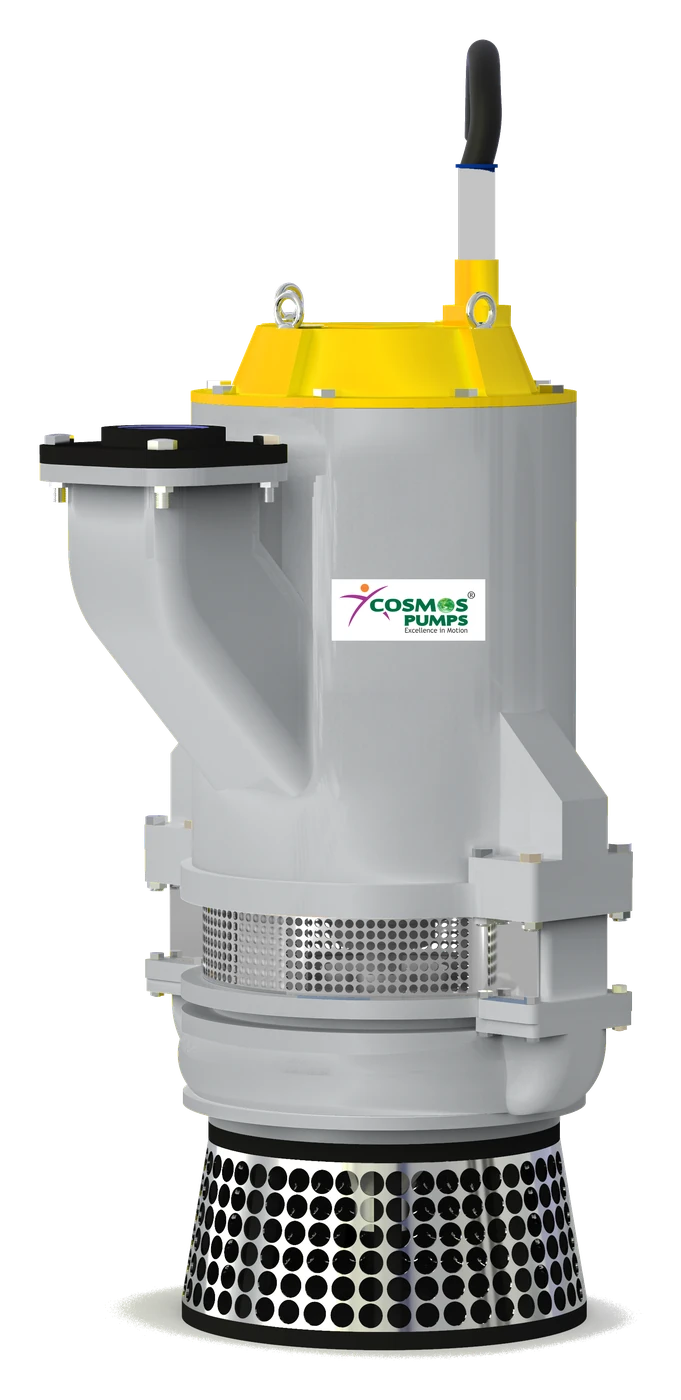
CSL-TV Twin Volute Slurry Pump
Details as follows:

Low Head
NA

Medium Head
1583-5831 LPM

Low Head
NA
Submersible twin-volute slurry pump for 24/7 ash transfer, mine tailings, and continuous heavy-duty industrial slurry circuits. 27% hi-chrome MOC. Extended bearing life via hydraulic load balancing. ISO & CE certified.
Quick Specs — CSL-TV Series
| Parameter | Value |
|---|---|
| Shut-Off Head | 27.5 M – 52.5 M |
| Flow Rate | 1,584 – 5,834 LPM (26.4 – 97.2 m³/h) |
| Motor HP | Up to 100 HP |
| Material of Construction | 27% Hi-Chrome White Iron (ASTM A532 Class III) |
| Max Specific Gravity | 2.1 |
| Max Solids Concentration | 70% by weight |
| Casing Type | Twin Volute |
| Duty Rating | 24/7 continuous |
| Certifications | ISO 9001 & CE Approved |
When a slurry pump operates continuously at high flow rates and high specific gravity — fly ash transfer to an ash pond, mine tailings to a settling dam, mill scale circuit at a steel plant — the mechanical failure mode is almost always the same: premature bearing failure driven by the net radial load a single-volute casing imposes on the shaft.
The Cosmos Pumps CSL-TV (Twin Volute) is the engineering answer to that failure mode. It uses a twin-volute casing to eliminate the unbalanced radial hydraulic force that degrades bearings in single-volute designs, while retaining the same 27% hi-chrome wetted parts, SG 2.1 rating, and 70% solids-by-weight capacity as the standard CSL.
The result is a submersible slurry pump that can sustain 24/7 continuous operation — reaching bearing rated service life rather than failing prematurely — in the most abrasive slurry duties in India’s power and mining sectors.
This page is for: Thermal power plant O&M engineers, mining operations managers, EPC procurement teams specifying continuous-duty slurry handling equipment, and project engineers running 24/7 ash or tailings circuits.
The Radial Load Problem in Single-Volute Slurry Pumps
Understanding why bearing failure is the dominant failure mode in continuous-duty slurry pump service requires understanding how a standard single-volute pump casing generates radial force.
In a single-volute design, hydraulic pressure builds asymmetrically around the impeller as the liquid accelerates from the impeller periphery into the volute passage. This pressure is not equal on all sides of the impeller — it peaks at the volute tongue and falls off toward the discharge. The result is a net radial force acting on the impeller, transmitted directly through the shaft to the bearings.
In a clean-water pump operating near its best efficiency point (BEP), this radial force is relatively small and well within bearing design parameters. In slurry service, three factors make it destructive:
1. Operating off-BEP is normal, not exceptional. Slurry specific gravity and solids loading vary continuously as sump levels change and process conditions fluctuate. Pumps frequently run at flow rates well above or below BEP, where radial forces in a single-volute design are significantly amplified compared to the BEP condition.
2. High SG and high flow amplify the force. Radial force in a centrifugal pump scales with fluid density and with the square of impeller speed. At SG 1.6–1.9 — typical for fly ash transfer and coal tailings — the radial force on the shaft is proportionally greater than in a water application at the same operating point.
3. Vibration and shaft deflection damage seals. The radial force deflects the shaft, changing the running clearance between impeller and wear ring. Shaft deflection also generates vibration that accelerates wear on mechanical seal faces — the second most common failure mode after bearings in continuous slurry service.
The practical outcome: on 24/7 ash transfer and mine tailings circuits, single-volute slurry pumps routinely experience bearing failures at 250–500 operating hours — a fraction of their rated bearing design life (typically 4,000–8,000 hours under load). Each unscheduled bearing failure means process shutdown, emergency maintenance mobilisation, and lost production.
How Twin-Volute Design Resolves This
The CSL-TV uses a twin-volute casing with two symmetrically positioned volute passages, spaced 180° apart around the impeller circumference.
Where a single-volute casing produces one pressure build-up zone (at the volute tongue), the twin-volute casing produces two — diametrically opposite. The hydraulic forces these generate are equal in magnitude and act in opposing directions across the shaft diameter. They cancel each other.
The result is that net radial load approaches zero across the full operating flow range — not only at BEP. Whether the pump is running at 60%, 100%, or 130% of design flow, the twin-volute geometry maintains hydraulic balance. This is the critical difference from single-volute designs, where radial force rises steeply as flow diverges from BEP.
Operational benefits:
- Extended bearing life — bearings reach rated service life rather than failing prematurely under peak radial load. On continuous ash and mine tailings duty, this means thousands of operating hours between planned bearing replacements rather than hundreds of hours between emergency replacements.
- Predictable maintenance scheduling — when bearings run to their rated life on a consistent schedule, maintenance can be planned around plant outage windows rather than triggered by failure alarms. For remote mine sites and thermal power stations, this is a significant operational and cost advantage.
- Reduced shaft deflection — maintained running clearances preserve hydraulic efficiency over time. Pump curve performance remains close to the original factory curve throughout the service life of the wear parts.
- Lower vibration — mechanical stability reduces wear on mechanical seal faces, extending seal life in parallel with bearing life. Reduced vibration also matters for pump installations on elevated platforms or flexible pipework systems.
- Consistent performance at variable flow — because radial balance is maintained across the full flow range (not only at BEP), the CSL-TV performs reliably even as sump levels change and slurry concentration varies through a shift.
The ANSI/HI 12.1-12.6 standard for centrifugal slurry pumps published by the Hydraulic Institute addresses radial load as a key design parameter for continuous heavy-duty slurry service. Twin-volute casing is the standard engineering response to radial load in high-duty slurry pump applications.
CSL-TV Full Technical Specifications
| Parameter | CSL-TV |
|---|---|
| Pump Type | Twin-Volute Submersible Centrifugal Slurry Pump |
| Shut-Off Head | 27.5 M – 52.5 M |
| Flow Rate | 1,584 – 5,834 LPM (26.4 – 97.2 m³/h) |
| Motor HP Range | Up to 100 HP |
| Casing Design | Twin Volute — two 180°-opposed volute passages |
| Material of Construction (Wetted Parts) | 27% Hi-Chrome White Iron, ASTM A532 Class III |
| Specific Gravity (max) | 2.1 |
| Solids Concentration (max) | 70% by weight |
| Duty Rating | 24/7 continuous |
| Installation | Submersible (fully immersed in sump) |
| Agitator Option | Yes — available for sumps with settled coarse solids |
| Certifications | ISO 9001 & CE Approved |
Applications — 24/7 Heavy-Duty Slurry Service
Thermal Power Stations — Fly Ash Transfer
Continuous fly ash transfer from electrostatic precipitators (ESPs) to ash ponds is the definitive CSL-TV application. Fly ash slurry runs at SG 1.6–1.9 at transfer concentration, with fine particle abrasivity comparable to quartzite. Transfer circuits at large thermal stations operate 22–24 hours per day, 365 days per year — the highest-duty slurry pump requirement in India’s power sector.
India’s Central Electricity Authority publishes technical guidelines for ash handling and ash pond management, which address pump material selection and maintenance requirements for fly ash duty. The CSL-TV’s hi-chrome metallurgy and extended bearing life are directly aligned with the continuous availability requirements in these guidelines.
Bottom ash hopper emptying — typically intermittent duty with higher particle size — is more commonly served by the standard CSL. For circuits requiring one pump to handle both fly ash (continuous) and bottom ash (intermittent) duties, contact Cosmos Pumps technical sales for configuration guidance.
Mining — Coal Tailings and Mine Waste
Active coal mine pits produce slurry sumps at multiple extraction stages: coal fines with process water (SG 1.4–1.7, 40–60% solids), pit dewatering sump catchment (mixed overburden and coal, SG 1.5–1.8), and washing plant reject circuits (fine coal/clay mixture). Metalliferous mine operations — iron ore, copper, zinc — typically run higher SG (1.8–2.0) at lower solids concentration.
The critical operational challenge in mining slurry service is site remoteness. Unscheduled bearing failure at a remote mine site in Jharkhand, Rajasthan, or Chhattisgarh requires emergency procurement and logistics — downtime per incident can reach 48–72 hours. The CSL-TV’s extended bearing life converts this risk from an operational planning problem into a scheduled maintenance event.
For companion high-head groundwater dewatering — clean water at depths requiring 90–200 M total dynamic head — the CDW Ultra High Head submersible pump is the complementary product. See the Cosmos Pumps Mining Segment page for the full mine dewatering capability overview.
Steel Plants — Slag and Scale Circuits
Blast furnace slag granulation involves continuous pumping of slag-water slurry at SG 1.5–2.0, with hard, angular slag granules that are highly abrasive. Rolling mill scale pits handle dense scale fines. Both circuits require continuous operation matched to the steelmaking cycle — stoppages in slag granulation cannot be accommodated without disrupting the blast furnace process.
The CSL-TV’s 24/7 duty rating and extended bearing life make it the correct specification for continuous slag and scale circuit service, where the cost of an unscheduled pump failure is measured in terms of blast furnace disruption rather than just pump replacement.
Harbour and Channel Dredging — Sustained Operation
Capital dredging contracts — harbour berth deepening, approach channel maintenance, port basin clearing — often require sustained pumping operations over days or weeks to complete the dredging scope. Slurry SG typically ranges 1.4–1.7 for marine silt and sand; coarser gravel material reaches SG 1.6–1.8.
The CSL-TV is appropriate for dredging operations where daily running hours are high and the schedule penalty for a pump failure (mobilisation of replacement equipment to a floating dredger) is significant.
CSL-TV vs CSL: Which to Specify?
Both variants use identical 27% hi-chrome wetted parts, the same hydraulic range, and the same motor HP envelope. The selection criterion is duty cycle, flow rate, and site maintenance economics.
| Duty Condition | Correct Specification |
|---|---|
| Flow < 3,000 LPM at SG ≤ 1.5, intermittent | CSL Standard |
| Bottom ash hopper emptying, batch cycle | CSL Standard |
| Flow > 3,000 LPM or SG > 1.5, any duty | CSL-TV |
| Fly ash transfer — 22+ hrs/day | CSL-TV |
| Mine tailings — continuous | CSL-TV |
| Remote site — high downtime cost per failure | CSL-TV |
| Previous single-volute spec: premature bearing failures | CSL-TV |
| Slag granulation circuit — continuous | CSL-TV |
| Capital dredging — sustained daily operation | CSL-TV |
Decision rule: If the pump will run more than 12 hours per day, or if the slurry SG exceeds 1.5 at any sustained operating point, specify CSL-TV. The incremental cost of the twin-volute casing is recovered in the first avoided bearing replacement.
For the standard intermittent-duty CSL specification — mine sump batch dewatering, bottom ash hopper service, variable-schedule dredging — see the CSL Slurry Pump page.
Project Spotlight — Thermal Power Station, Continuous Fly Ash Transfer
Challenge: A 500 MW thermal power station required replacement of the fly ash transfer pump train on the ESP-to-ash pond circuit. Transfer distance: 1.1 km. Average slurry SG: 1.65 at full transfer concentration. Required duty: 22 hours per day. Previous specification: single-volute hi-chrome slurry pump (surface-mounted horizontal centrifugal type). Bearing failures at 250–300 operating hours — every 2–3 weeks under continuous duty. Each failure required 18–24 hours of unplanned downtime.
Solution specified: Three CSL-TV units in a 2-running/1-standby submersible arrangement. Twin-volute configuration selected to address the radial load-driven bearing failure pattern. Hi-chrome impellers and volute liners specified for fly ash abrasivity. Submersible installation eliminated surface priming equipment and reduced the sump station footprint.
Outcome: First scheduled wear-part inspection at 1,800 operating hours: impeller wear within acceptable limits. Bearing service reached 3,500+ hours — aligning with the station’s planned quarterly overhaul schedule. Unscheduled downtime on the ash transfer circuit: zero incidents over 12 months of continuous operation. Pump train availability: 99.1%.
Project details are representative of typical CSL-TV continuous ash transfer deployments. Documented references available on request to qualified buyers and tendering project engineers.
Frequently Asked Questions
What is a twin volute slurry pump and how does it differ from a standard single-volute design?
A twin-volute slurry pump uses a casing with two volute passages positioned 180° apart around the impeller circumference. Where a single-volute casing creates asymmetric hydraulic pressure around the impeller — producing a net radial force on the shaft — the twin-volute casing produces two equal and opposing pressure zones that cancel each other. Net radial shaft load approaches zero across the full operating flow range. This eliminates the primary cause of premature bearing failure in continuous-duty slurry pump service at high flow rates and high specific gravity.
When should I specify twin volute over single volute for a slurry pump?
Specify twin volute (CSL-TV) when: (1) the pump will run continuously at high flow rates (above 3,000 LPM) or at slurry SG above 1.5; (2) the duty is 24/7 or close to it (more than 12 hours per day); (3) the site is remote and bearing replacement downtime is operationally or economically significant; or (4) a previous single-volute specification has experienced premature bearing failures on the same duty. Single-volute (CSL standard) is appropriate for intermittent duty, batch operations, or lower SG applications where radial load does not drive bearing life.
What is the maximum specific gravity the CSL-TV can handle?
The CSL-TV is rated to SG 2.1 — the same as the standard CSL. For reference: fly ash at transfer concentration runs SG 1.6–1.9; coal tailings run SG 1.4–1.7; iron ore processing slurry runs SG 1.8–2.0; blast furnace slag slurry can reach SG 2.0. The SG 2.1 rating provides engineering headroom above the maximum expected operational density in most ash and mine tailings applications.
What is the maximum solids concentration the CSL-TV can handle?
The CSL-TV is rated for solids up to 70% by weight — the same specification as the standard CSL. This covers all standard ash, coal tailings, iron ore, and slag circuit requirements in Indian power and mining operations.
What is 27% hi-chrome and why is it specified for ash and mine slurry pumps?
Hi-chrome white iron with approximately 27% chromium by weight produces a microstructure of chromium carbides in a hardened martensitic matrix, resulting in Brinell hardness of 600–700 HB — classified under ASTM A532 Class III. This hardness resists abrasive wear from fly ash, coal, quartzite, and mineral fines at rates 5–10× greater than standard grey cast iron. In fly ash transfer and mine waste pumping, 27% hi-chrome is the standard material specification for wetted parts on continuous abrasive duty circuits.
Is the CSL-TV submersible or surface-mounted?
The CSL-TV is a submersible slurry pump — designed to operate fully immersed in the slurry sump. Submersible installation eliminates priming requirements, reduces sump station footprint, and maintains continuous liquid supply to the mechanical seal. Optional agitators are available for sumps where settled coarse solids require re-suspension.
What is the expected bearing life improvement with the CSL-TV versus a single-volute slurry pump?
The bearing life improvement is application-specific, depending on operating flow rate, slurry SG, and how far off BEP the pump typically runs. In continuous fly ash transfer and mine tailings applications where single-volute designs experience bearing failures at 250–500 hours, CSL-TV installations have demonstrated bearing life exceeding 3,000–3,500 hours to first scheduled maintenance. The improvement is most pronounced in applications running consistently above 3,000 LPM at SG above 1.5 — the conditions under which radial force is highest in a single-volute design.
Can the CSL-TV run dry or start against a full discharge head?
Like all submersible centrifugal slurry pumps, the CSL-TV requires slurry in the sump to supply the mechanical seal and provide cooling to the motor. It should not be run dry for extended periods. For sumps that empty between batch cycles, the pump should be set with a low-level shutdown interlocked to the sump level sensor. Cosmos Pumps technical sales can advise on control panel configuration for automatic level control.
Does Cosmos Pumps offer CSL-TV units for rental on large project requirements?
Cosmos Pumps operates a dedicated rental division with submersible pump fleet across India for dewatering and slurry projects. For project-specific CSL-TV rental requirements — including mine startup dewatering, construction site slurry management, or emergency replacement — contact our EPEC team via WhatsApp (+91 99333 22238) to discuss availability and site logistics.
Request a CSL-TV Quotation
Cosmos Pumps supplies the CSL-TV directly to EPC contractors, thermal power operators, mining companies, steel plants, and harbour authorities across India and internationally.
To receive a technical quotation and CSL-TV catalogue, provide:
- Required flow rate (LPM or m³/h)
- Total dynamic head (M)
- Slurry SG (average and peak) and solids concentration (% by weight)
- Particle size range and material (if known)
- Duty hours per day and annual operating schedule
- Sump dimensions and installation geometry
- Site location and project timeline
WhatsApp / Call: +91 99333 22238
Download CSL-TV Catalogue — Request via WhatsApp
Cosmos Pumps Pvt. Ltd. is an ISO 9001 & CE certified manufacturer operating a 25,000 sq. ft. manufacturing facility in Faridabad, Haryana, with supply to 30+ countries. For the standard CSL single-volute specification, see the CSL Slurry Pump page. For the complete submersible pump range, see the submersible pump catalogue.
Download Catalogue: CSL-TV Twin Volute Slurry Pump