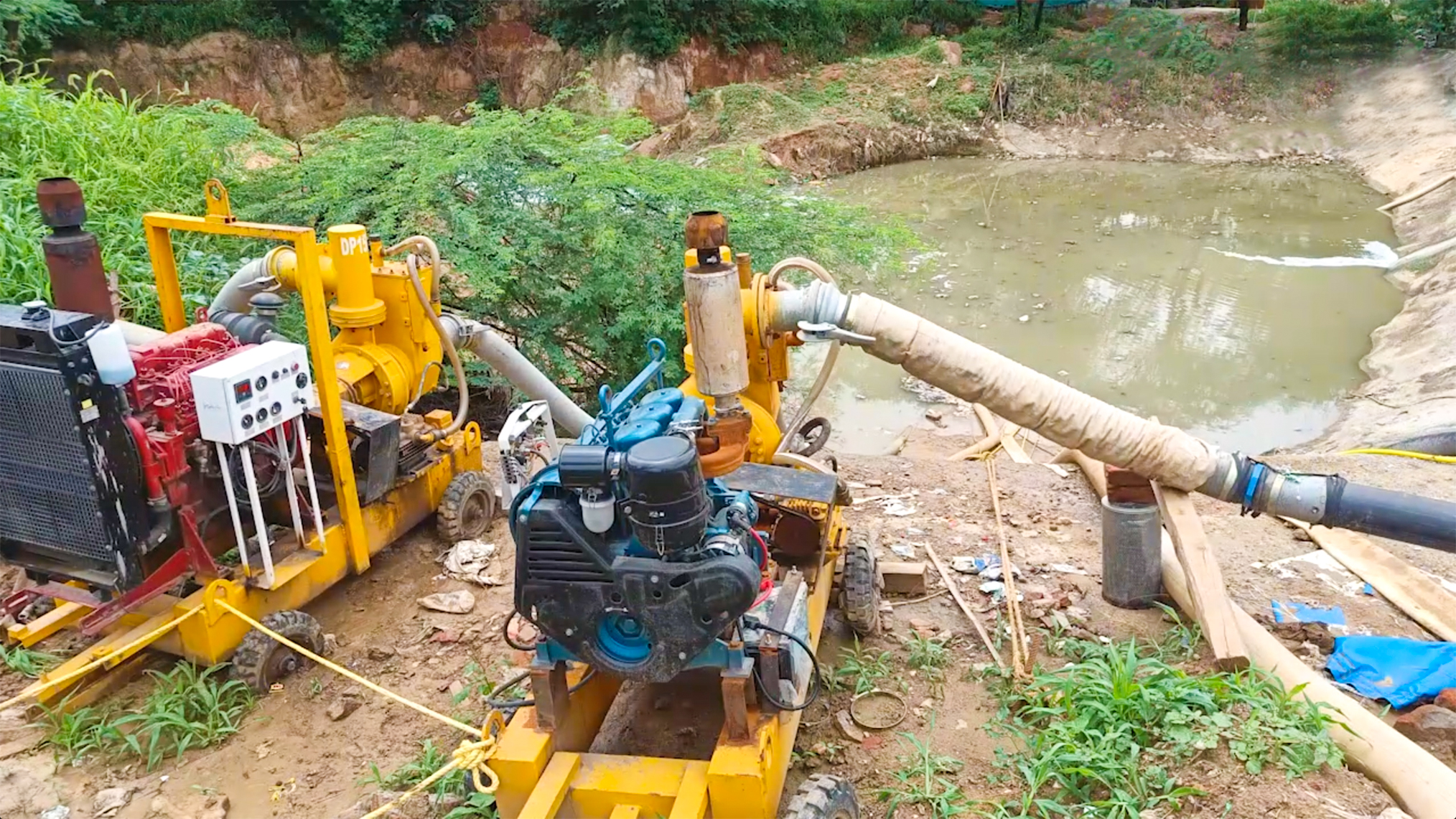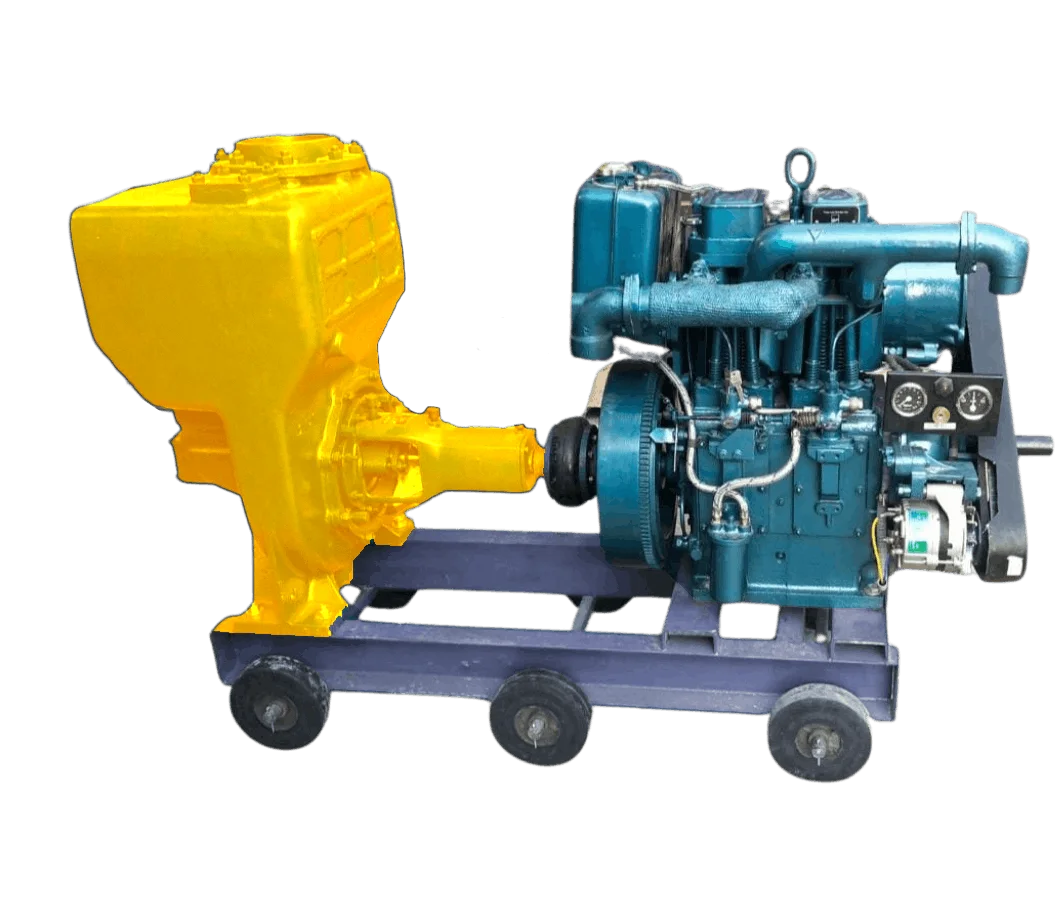
A self-priming pump is a centrifugal pump that can evacuate air from its own suction line before starting liquid transfer — eliminating the need for manual priming, foot valves, or a priming tank. Unlike a standard centrifugal pump, which loses prime if the suction pipe runs dry, a self-priming pump re-establishes prime automatically whenever the liquid level drops or air enters the suction side.
This ability to handle air-liquid mixtures makes the self-priming pump a preferred choice wherever the pump must sit above the water source — construction site dewatering, basement sump drainage, chemical transfer, and sewage bypass pumping.
What Is a Self-Priming Pump?
A self-priming pump is a surface-mounted centrifugal pump designed to operate when its suction pipe extends down to a fluid level that is below the pump itself. The key difference from a conventional centrifugal pump is a water-retention reservoir, or priming chamber, built into the pump casing.
When the pump starts, it draws the residual liquid from this chamber through the impeller, generating a partial vacuum. This vacuum pulls air out of the suction pipe and draws liquid up from the source — a process called suction lift. Once liquid reaches the impeller, normal centrifugal pumping action takes over.
A standard centrifugal pump cannot do this. Fill its casing with air and it spins without pumping — a condition called loss of prime. The self-priming pump’s sealed casing and retained liquid reserve prevents this from happening.
Key Self-Priming Pump Terminology
| Term | Meaning |
|---|---|
| Suction lift | Vertical height from the water surface to the pump inlet — typically 6–9 metres for self-priming pumps |
| Priming time | Time taken to evacuate air and establish flow from a dry suction line — typically 30–120 seconds |
| Priming chamber | Integral reservoir that retains liquid between pump cycles to re-prime on restart |
| Self-priming cycle | The sequence of air evacuation, vacuum creation, and liquid draw-up that restores prime automatically |
How Does a Self-Priming Pump Work?
The working principle of a self-priming pump involves a two-phase cycle: the priming phase and the normal pumping phase.
Phase 1 — Priming
When the pump starts with air in the suction line:
- Residual liquid in the priming chamber is drawn into the impeller eye.
- The rotating impeller throws this liquid outward by centrifugal force, creating a low-pressure zone (partial vacuum) at the impeller eye.
- This vacuum draws air from the suction pipe into the impeller.
- The impeller mixes the air with the recirculating liquid in the casing. The air separates and vents through the discharge port; the liquid recirculates back into the priming chamber.
- The cycle repeats, progressively pulling more air out of the suction line and lowering the pressure in the pipe.
- Once the vacuum is sufficient, atmospheric pressure pushes liquid up the suction line and into the pump.
Phase 2 — Normal Pumping
Once liquid reaches the impeller, the pump transitions to standard centrifugal pumping:
- Liquid enters the impeller eye continuously.
- Centrifugal force accelerates it outward through the volute casing.
- Velocity converts to pressure at the discharge.
- Flow continues as long as the suction source remains above the practical suction lift limit.
If the suction runs dry mid-operation (for example, a sump empties), the self-priming pump retains enough liquid in the priming chamber to re-prime automatically when liquid returns — no operator intervention required.
Self-Priming Pump vs Centrifugal Pump: Key Differences
The self-priming centrifugal pump is a sub-type of the broader centrifugal pump family. Understanding the distinction matters for selection:
| Feature | Standard Centrifugal Pump | Self-Priming Centrifugal Pump |
|---|---|---|
| Priming requirement | Must be manually primed before start — casing filled with liquid | Primes automatically from retained chamber liquid |
| Suction lift capability | Near zero — cannot handle air in suction | 6–9 m practical suction lift |
| Foot valve required | Yes — to maintain prime between starts | No — priming chamber retains liquid |
| Installation position | At or below liquid level, or requires external priming system | Above liquid level, up to suction lift limit |
| Air handling | Loss of prime if air enters suction | Re-primes automatically; handles air-liquid mix |
| Complexity | Simpler pump construction | Larger casing (priming chamber adds volume and weight) |
| Best for | Closed-system circulation, booster duty, submerged installations | Surface-mounted dewatering, sump drainage, portable site pumps |
For most construction dewatering, foundation drainage, and surface pumping applications where the pump cannot be submerged, a self-priming pump is the correct choice. Standard centrifugal pumps serve recirculation and pressurised system applications where air entry is controlled.
Types of Self-Priming Pumps
Self-priming pumps come in several configurations depending on drive type, impeller design, and application requirements.
By Drive Type
Motor-driven self-priming pumps use an electric motor and are preferred where grid power is available. They offer consistent speed, lower running cost, and are suited to fixed or semi-permanent dewatering installations.
Diesel engine self-priming pumps couple the pump to a diesel engine — ideal for remote construction sites, emergency flood response, and any application without reliable power supply. Engine-driven self-priming pumps on a trolley or skid are a standard tool in construction dewatering fleets across India and the GCC.
By Impeller Type
Closed impeller self-priming pumps handle relatively clean water with small suspended solids (up to 15 mm). They deliver higher efficiency and head, making them appropriate for foundation dewatering, basement drainage, and chemical transfer where liquid is mostly clear.
Open impeller self-priming pumps handle larger solids and semi-solid material. They are more suited to sewage bypass, sludge drainage, and ash water pumping where the liquid carries significant particulate load.
Vortex impeller self-priming pumps are used for highly viscous fluids or liquids with fibrous content where the impeller should not contact the fluid directly.
By Construction Material
| Construction | Application |
|---|---|
| Cast iron body + SS impeller | General construction dewatering, sewage, ash water |
| SS304/316 body + SS impeller | Chemical effluents, seawater/coastal dewatering, food processing |
| Rubber-lined / Hi-chrome | Abrasive slurries, mine water with silica content |
Self-Priming Pump Applications
Self-priming pumps are used wherever a surface pump must draw liquid from below its own level. Common applications include:

Construction Site Dewatering
Foundation pits, basement excavations, trenches, and road cuttings frequently require pumping from sumps dug below grade. A self-priming pump positioned on the surface — rather than lowered into the water — is faster to deploy, relocate, and service than a submersible pump in many construction dewatering situations. Suction lift of 6–9 m covers most sump depth requirements on typical construction sites.
Sewage Bypass Pumping
During sewer maintenance, rehabilitation, or emergency repairs, sewage must be bypassed around the blocked section. A self-priming sewage pump handles raw sewage — solids, fibrous material, and viscous liquid — without blocking, making it the standard choice for municipal bypass operations.
Chemical and Industrial Transfer
Chemical plants, effluent treatment plants (ETPs), and industrial facilities use self-priming pumps to transfer corrosive liquids, chemicals, and wastewater. Stainless steel or rubber-lined variants handle aggressive chemistry that would corrode a standard cast iron pump.
Flood Control and Dewatering
During monsoon flooding or emergency dewatering, self-priming pumps on trolleys are deployed rapidly to pump standing water from roads, underpasses, basements, and low-lying areas. The ability to re-prime automatically is critical in flood control — water levels fluctuate, and a pump that loses prime on drawdown is a liability in emergency operations.
Foundation and Basement Dewatering
For building construction, maintaining a dry working environment in deep foundations and basement levels requires continuous or on-demand dewatering. Self-priming pumps handle the variable water inflow from groundwater seepage without requiring an operator to monitor and reprime.
Ash Water Pumping (Thermal Power)
Fly ash and bottom ash handling at thermal power stations involves pumping dense, abrasive ash slurries. Specialised self-priming pumps with hi-chrome impellers and rubber-lined casings handle this duty in power plant ash management systems.
Self-Priming Pump vs Auto-Priming Pump: What’s the Difference?
The terms “self-priming” and “auto-priming” are sometimes used interchangeably, but in industrial dewatering practice they refer to distinct pump types with different capabilities.
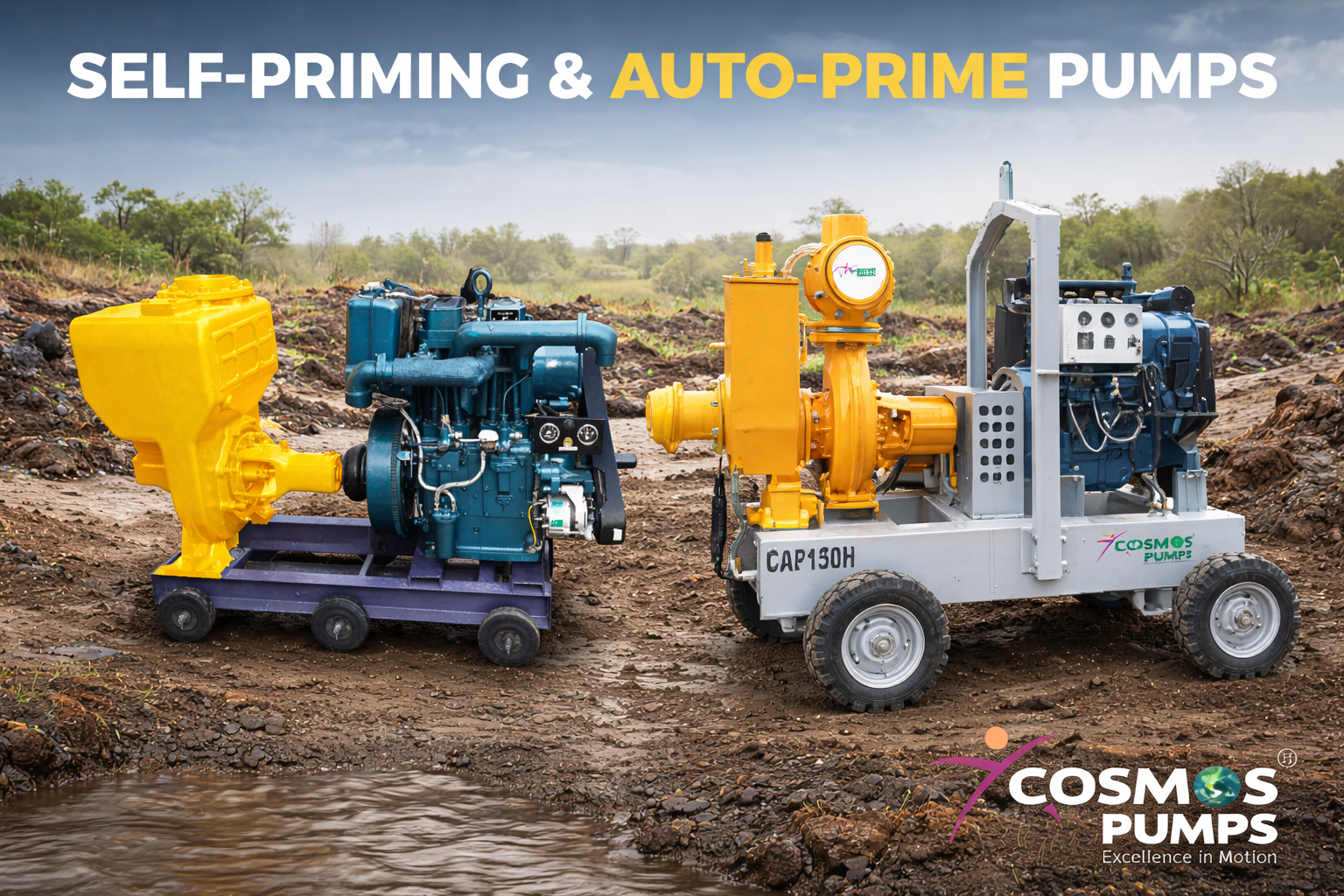
| Feature | Self-Priming Pump | Auto-Priming Pump (CAP Series) |
|---|---|---|
| Priming mechanism | Retained liquid in casing priming chamber | Separate vacuum priming system — no pre-fill required |
| Suction lift | 6–9 m practical maximum | Up to 9.8 m; handles air ingress during operation |
| Drive | Motor or diesel engine | Diesel engine (typically — for portability and off-grid use) |
| Dry-run capability | Limited — needs residual liquid in chamber | Runs dry without damage |
| Flow range | Moderate (up to 4,500 LPM for CSP models) | Very high (up to 74,483 LPM for large CAP models) |
| Power range | Up to 30 HP (motor, CSP) | Up to 1,550+ HP (diesel, CAP) |
| Portability | Trolley or base frame | Small trolley, heavy trolley, skid, canopy variants |
| Best for | Site dewatering, sewage bypass, chemical transfer | Large-scale flood control, mining, mega-project dewatering |
In summary: A self-priming pump is the right tool for site-level dewatering, sewage bypass, and chemical transfer up to moderate flow rates. An auto-priming pump is designed for large-scale, engine-driven dewatering where very high flow rates, extreme suction lift, and tolerance for dry-running are required.
Cosmos Pumps manufactures both: the CSP self-priming pump (up to 30 HP, 4,500 LPM, 28 m head) and the CAP auto-prime pump (up to 1,550+ HP, 74,483 LPM, 169 m head). For help selecting between them, see our self-priming pump product page.
Cosmos CSP Self-Priming Pump — Technical Specifications
The Cosmos CSP Series is a surface-mounted self-priming centrifugal pump built for construction, infrastructure, and industrial dewatering duty.
| Parameter | CSP Specification |
|---|---|
| Shut-Off Head | 28 M |
| Flow Rate | Up to 4,500 LPM |
| HP Range | Up to 30 HP |
| Drive | Electric motor (diesel engine coupling on request) |
| Mounting | Base frame / trolley |
| Applications | Construction dewatering · Sewage bypass · Chemical effluents · Foundation dewatering · Trenches, pits, basements · Waterlogging / flood control · Ash water |
Key features:
- Self-priming from retained chamber liquid — no foot valve, no external priming
- Handles sewage, chemical effluents, and ash water — not limited to clean water
- Compact, portable base-frame mounting for fast site relocation
- Available in corrosion-resistant materials for chemical and saline applications
- ISO 9001 · CE certified
For detailed specifications, model selection, and quotation, visit the CSP self-priming pump product page.
How to Select a Self-Priming Pump
When specifying a self-priming pump, the critical parameters are:
- Flow rate (LPM or m³/h): Match to the required dewatering rate — how quickly must water be removed? Consider inflow rates and sump volume.
- Total head (metres): Sum of static lift, friction losses in the pipework, and any discharge head pressure. Must stay below the pump’s shut-off head.
- Suction lift: Vertical distance from water surface to the pump inlet. Self-priming pumps handle 6–9 m. If suction lift exceeds this, a submersible pump may be required.
- Fluid type: Is the liquid clean water, muddy water, sewage (with solids), chemical effluent, or slurry? Each requires different materials of construction and impeller type.
- Solids size: Open and vortex impellers handle larger solids. Closed impellers are for cleaner liquids with small particulate.
- Drive type: Electric motor for fixed power supply; diesel engine for remote or emergency applications.
- Duty cycle: Continuous duty (24/7 pumping) or intermittent duty (filling/emptying cycles). Continuous duty requires heavier-specification motors and seals.
Self-Priming Pump: Installation and Maintenance
Installation best practice:
- Keep suction pipe length as short and straight as possible — every metre of pipe and every bend adds friction loss.
- Use a suction strainer to protect the impeller from large debris.
- Ensure the priming chamber is filled with liquid before first start.
- Use flexible connections to reduce vibration transmission to pipework.
Maintenance checklist:
- Check mechanical seals regularly — self-priming pumps run with liquid in the casing chamber, so seal leaks appear as drips at the shaft.
- Inspect impeller for wear — abrasive liquids erode the impeller faster; worn impellers reduce flow and head.
- Clean the priming chamber if sludge or debris accumulates — blocked chambers extend priming time and reduce vacuum formation.
- Grease bearings at manufacturer-specified intervals.
- If the pump fails to prime, check suction pipe for air leaks, verify sufficient liquid in priming chamber, and confirm suction lift does not exceed rated limit.
Frequently Asked Questions: Self-Priming Pumps
What is a self-priming pump used for?
Self-priming pumps are used wherever a surface-mounted pump must draw liquid from a source below the pump level — construction site dewatering, basement and foundation drainage, sewage bypass, chemical transfer, flood control, and ash water pumping in power stations. They are preferred over standard centrifugal pumps when the pump cannot be submerged in the liquid.
How does a self-priming pump prime itself?
A self-priming pump retains a small amount of liquid in an internal priming chamber. When the pump starts with air in the suction line, the impeller draws this retained liquid through the casing, creating a partial vacuum. This vacuum pulls air out of the suction pipe and progressively draws liquid up until normal pumping begins. No external priming tank, foot valve, or operator action is required.
What is the maximum suction lift for a self-priming pump?
Practical suction lift for most self-priming pumps is 6–9 metres. Theoretical maximum is around 10 m (atmospheric pressure limit at sea level), but friction losses and vapour pressure typically reduce practical lift to 6–8 m in field conditions. Higher suction lifts require a vacuum-assisted priming system (auto-prime) or a submersible pump lowered into the liquid.
Is a self-priming pump the same as an auto-priming pump?
Not exactly. Both handle air in the suction line, but an auto-priming pump uses a dedicated vacuum priming system and typically runs dry without damage — making it suited to larger, diesel-driven, high-flow dewatering applications. A self-priming pump re-primes using retained liquid in its casing chamber and is typically motor-driven with moderate flow rates. For most construction and industrial site dewatering, a self-priming pump is sufficient. For large-scale flood control or mining dewatering with very high flow requirements, an auto-priming pump is preferred.
Can a self-priming pump handle sewage and solids?
Yes, with the right model. Open impeller and vortex impeller self-priming pumps are designed to handle sewage, solids, fibrous material, and semi-viscous liquids. Closed impeller models are better suited to cleaner water with small suspended particles. Always specify the maximum solids size and fluid type when selecting a self-priming pump for sewage or sludge applications.
What is the difference between a self-priming pump and a centrifugal pump?
A self-priming pump is a type of centrifugal pump — the difference lies in its ability to handle air. A standard centrifugal pump requires the casing to be full of liquid before starting and loses prime if air enters. A self-priming centrifugal pump re-primes automatically from retained liquid in its casing, enabling surface-mounted operation with a suction lift of 6–9 m. For above-ground pumping from a sump, pond, or pit, a self-priming centrifugal pump is required.
For product specifications, model selection, and pricing on request, visit our self-priming pump product page or contact Cosmos Pumps directly:
View CSP Product Page WhatsApp Us
Cosmos Pumps Pvt. Ltd. — ISO 9001 · CE Certified — Manufacturing self-priming and auto-prime dewatering pumps in Faridabad, India since 2021.