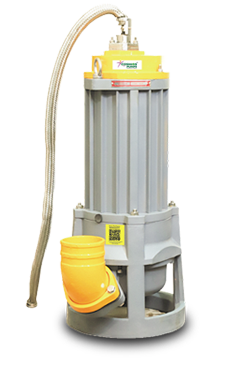
Non-Clog Submersible Pump Manufacturers in India
Details as follows:

Low Head
NA

Medium Head
1250-2115 LPM

High Head
NA
What Is a Non-Clog Submersible Pump?
A non-clog submersible pump is a bottom-discharge submersible pump with a vortex impeller designed to pass solids up to 70 mm in diameter without contact between the solid and the impeller. Unlike standard dewatering pumps that clog on raw sewage, thick sludge, or fibrous material, the non-clog design creates a vortex flow path that carries solids through the pump casing — eliminating the pump failures common on sewage bypass, manhole cleaning, and construction sump applications.
The Cosmos CNC Series is manufactured at our Faridabad facility (ISO & CE certified) and sized to fit through the 14-inch (350 mm) manhole access opening that is the standard dimension for Indian municipal sewer infrastructure. It is our highest-volume deployment in municipal desilting and sewage bypass contracts.
CNC Series: Technical Specifications
| Parameter | Specification |
|---|---|
| Shut-Off Head | 22 M – 30 M |
| Flow Rate | 1,250 – 1,500 LPM |
| Power Range | 6 – 20 HP |
| Maximum Solids Size | 70 mm |
| Discharge Type | Bottom discharge |
| Specific Gravity (SG) | Up to 1.2 |
| pH Range | 5 – 8 |
| Power Cable | 50 sq mm H07RNF rubber (10 m) |
| Motor Insulation | Class H (180°C) |
| Volute Material | SS-304 stainless steel |
| Impeller Material | Nitride-hardened SS-410 (HRC 52–55) |
| Mechanical Seal | Twin stainless steel seals |
| Housing | Aluminium alloy (lightweight) |
| Optional | Sacrificial zinc anode (saline environments) |
Why Bottom Discharge Solves the Clogging Problem
Standard centrifugal dewatering pumps use closed-channel impellers with top or side discharge. When the fluid carries raw sewage solids, rags, or construction debris above 12 mm, these solids compress against the impeller eye and choke the pump — often within a short period on a sewage bypass site.
The CNC Series eliminates this failure mode through bottom discharge with vortex-pattern flow: fluid and solids enter at the base of the pump, are accelerated outward by centrifugal action, and exit through the bottom outlet without passing through the impeller eye. Solids up to 70 mm pass clean. This design allows continuous unattended operation on raw sewage bypass where a standard pump would require repeated manual clearing.
The nitride-hardened SS-410 impeller (HRC 52–55) also provides superior abrasion resistance for mixed construction fluids — concrete washout, bentonite, fine aggregate — compared to standard cast-iron impellers used on lower-specification non-clog pumps.
Four Applications Where the CNC Series Is Specified
Sewage Bypass Pumping
Sewage bypass is required whenever a gravity sewer section is taken offline for repair, CIPP lining, inspection, or desiltation. The pump diverts live sewage around the repair section, typically for 8–24 hours at a stretch. The CNC Series is specified for bypass duty because its vortex impeller sustains continuous flow on raw sewage solids without choking, and its H07RNF rubber cable is rated for direct immersion in sewage environments — unlike the PVC cables used on standard dewatering pumps.
Per CPHEEO (Central Public Health and Environmental Engineering Organisation) Manual on Sewerage and Sewage Treatment guidelines for bypass pump sizing, the pump must handle the minimum dry-weather flow of the section being bypassed plus a safety factor. The CNC Series at 1,250–1,500 LPM covers 150–225 mm gravity sewers at design dry-weather flow for most urban catchments.
Manhole Cleaning (14-Inch Diameter Access)
The CNC Series is sized to fit through a 14-inch (350 mm) manhole opening — the standard municipal access dimension for Indian urban sewer manholes. Municipal desilting contractors lower the CNC pump into the manhole chamber, pump the settled sludge to the surface, and clear the chamber without excavation or access widening. This is the application that makes CNC Cosmos’s highest-volume municipal product: under Smart City Mission and AMRUT urban desilting contracts, the 14-inch access requirement is the specification filter that narrows the field to this pump class.
Construction Site Sump Dewatering
On active construction sites — building foundations, metro station excavations, highway cuts — sump water carries concrete washout, bentonite slurry, and fine silica aggregate. Specific gravity of these fluids ranges from 1.05 to 1.2. The CNC Series handles SG up to 1.2 continuously, where a standard CDW dewatering pump rated for SG 1.1 would cavitate or trip the motor on the same fluid.
For project-wide dewatering across multiple sumps on large construction sites, CNC is typically deployed alongside CDW range pumps for clean water drawdown. See Cosmos building construction dewatering solutions for full project-wide pump selection guidance including foundation, trench, and basement applications.
Tunnel and Infrastructure Dewatering
In tunnel headings — rail, highway, metro TBM drives — sumps accumulate groundwater combined with bentonite, grouting material, and drill cuttings. The confined space inside a TBM heading or cut-and-cover station makes pump weight and dimensions critical. The CNC’s aluminium alloy construction delivers low weight for two-man handling in restricted headings, while its 70 mm solids capability covers the full range of tunnel construction fluids.
For ultra-high-head tunnel dewatering above 30 M head or at higher specific gravities, the Cosmos CSL Slurry Pump series provides matched capability at SG up to 2.1 and 27% hi-chrome MOC for abrasion-intensive environments.
CNC vs CSW: Which Submersible Pump Should You Specify?
The CNC and CSW are both submersible pumps handling sewage-type fluids, but they are designed for different duty profiles. The comparison below helps specify the correct pump for your application.
| Specification | CNC — Non-Clog Series | CSW — Sewage Series |
|---|---|---|
| Primary application | Sewage bypass, manhole cleaning, site sludge | Permanent sewage station, STP/ETP lift well |
| Solids size | 70 mm (bottom discharge) | 20–100 mm |
| Specific gravity | Up to 1.2 | Up to 1.7 |
| Power range | 6–20 HP | 2–200 HP |
| Flow range | 1,250–1,500 LPM | 775–33,000 LPM |
| Installation | Portable, drop-in, contractor-deployed | Fixed auto-coupling or dry well |
| Cable type | H07RNF rubber (field/immersion rated) | PVC (permanent installation) |
| Fits 14-inch manhole | Yes | No (fixed installation only) |
| Specify when | Temporary bypass, contractor work, manhole access required | Permanent pumping station, STP lift station, residential complex |
Decision rule: If the pump must pass through a 14-inch manhole or if the duty is temporary bypass (hours to weeks), specify CNC. For permanent installation in a wet well or STP lift station with higher SG or larger flows, specify CSW.
How to Set Up Sewage Bypass Pumping — Step-by-Step
This procedure covers temporary sewage bypass using a Cosmos CNC non-clog submersible pump on a gravity sewer repair section.
Equipment required: Cosmos CNC non-clog pump · 150 mm bypass hose (length per site) · Inflatable sewer plug or bypass valve · Float switch or level probe · Generator or site electrical supply (6–20 HP motor)
Step 1 — Estimate bypass flow
Calculate peak dry-weather flow for the sewer section using pipe diameter and gradient. The CNC delivers 1,250–1,500 LPM — suitable for 150–225 mm gravity sewers. Apply a 1.5× safety factor per CPHEEO bypass sizing guidance.
Step 2 — Install upstream sewer plug
Insert an inflatable stopper or bypass valve at the upstream manhole. Pressure-test the plug seal before diverting flow. Post a spotter at this point for the duration of the bypass.
Step 3 — Lower CNC pump into upstream manhole
Lower the CNC through the 14-inch (350 mm) access opening. Connect the 50 sq mm H07RNF power cable to the generator or site supply. Attach the bypass discharge hose to the pump outlet.
Step 4 — Route discharge hose to downstream reinsertion point
Run the bypass hose to the downstream manhole. Secure all hose joints with clamps. Verify the bypass run distance does not require more than 30 M total head — if the bypass distance is greater, contact Cosmos for a two-pump series configuration.
Step 5 — Start pump and confirm steady-state bypass
Energise the pump. Verify the upstream level is stable or falling. Check all hose connections for leaks. Install the float switch for automatic level control during the maintenance window.
Step 6 — Execute repair and reinstate
On completion of the repair, deflate and remove the upstream sewer plug. Allow gravity flow to restore to the main line. Recover the pump and flush clean with fresh water before storage.
For project-level rental of CNC pumps on bypass or desilting contracts, see Cosmos dewatering pump rental services for fleet availability and coverage across Delhi NCR and North India.
Frequently Asked Questions — Non-Clog Submersible Pump
What is a non-clog pump?
A non-clog pump is a submersible pump with a vortex or recessed impeller that passes solids up to 70 mm in diameter without the solid contacting the impeller. Standard centrifugal pumps compress solids against the impeller eye and clog on raw sewage or thick sludge. Non-clog designs use bottom discharge to carry solids through the pump casing via centrifugal action, enabling continuous operation on fluids that would stall a standard dewatering pump.
What is the difference between a non-clog pump and a vortex pump?
The terms are used interchangeably. A vortex pump uses a recessed impeller that creates a rotating vortex in the volute — fluid and solids pass through without impeller contact. “Non-clog” is the functional description emphasising the outcome. The Cosmos CNC Series uses vortex-pattern flow with bottom discharge, combining both characteristics.
What size solids can the CNC Series pass?
The CNC Series passes solids up to 70 mm in diameter via bottom discharge. This covers the full range of municipal sewage solids (rags, fibrous matter, grit), construction debris (aggregate fragments, concrete pieces), and bentonite slurry particles encountered on site dewatering applications.
What is a non-clog pump used for in India?
In India, non-clog submersible pumps are primarily specified for: (1) sewage bypass during sewer repair, CIPP lining, or inspection under CPHEEO and urban local body specifications; (2) manhole desilting and cleaning under Smart City Mission and AMRUT contracts; (3) construction site sump dewatering where concrete washout, bentonite, or silt pushes SG above 1.1; and (4) tunnel heading dewatering on metro and highway projects.
Can a non-clog pump fit inside a 14-inch manhole?
Yes. The CNC Series is designed to fit through a 14-inch (350 mm) diameter manhole opening — the standard municipal access dimension for Indian urban sewer manholes. This access capability is the primary specification requirement that drives CNC selection for municipal manhole cleaning and desilting contracts.
What is the difference between the CNC and CSW pump?
CNC is designed for temporary, portable bypass and manhole cleaning: it fits a 14-inch manhole, handles SG up to 1.2 and 70 mm solids via bottom discharge, and uses an H07RNF rubber cable for field conditions. The CSW Sewage pump is for permanent wet well or STP installation: it handles SG up to 1.7, flows from 775 to 33,000 LPM across 2–200 HP, and installs on a fixed auto-coupling. Choose CNC for temporary bypass; choose CSW for permanent sewage infrastructure.
What HP non-clog pump do I need for sewage bypass?
The CNC Series ranges from 6 to 20 HP. For 150 mm gravity sewers at standard dry-weather flow (typically 600–900 LPM), 6–10 HP is sufficient. For 225–300 mm sewers or higher peak flows, specify 15–20 HP. Provide Cosmos with your sewer diameter, gradient, and catchment area for a free bypass configuration recommendation.
How is the CNC non-clog pump different from a standard dewatering pump?
A standard CDW dewatering pump uses a closed-channel impeller rated for clean to mildly turbid water — solids up to 12 mm, SG up to 1.1. On raw sewage or silt-heavy site fluids, a CDW will clog and require manual clearing. The CNC uses a vortex impeller with bottom discharge, handling thick sludge (SG 1.2) and solids up to 70 mm continuously — a different hydraulic design for a fundamentally different fluid type.
Get a Quote for the CNC Non-Clog Series
Cosmos Pumps Pvt. Ltd.
ISO & CE Certified | Faridabad, NCR | Manufacturing since 2021
📞 +91 99333 22238 | 📧 cosmos@cosmospumps.com | 💬 WhatsApp
Specify model, duty point, and site description — sewer diameter, bypass duration, manhole size, and SG estimate — for a same-day technical recommendation and price-on-request.
The CNC is part of the Cosmos submersible pump range — for dewatering applications without large solids, see the CDW series; for raw sewage, see the CSW series.
Download Catalogue: Non-Clog Submersible Pump Manufacturers in India