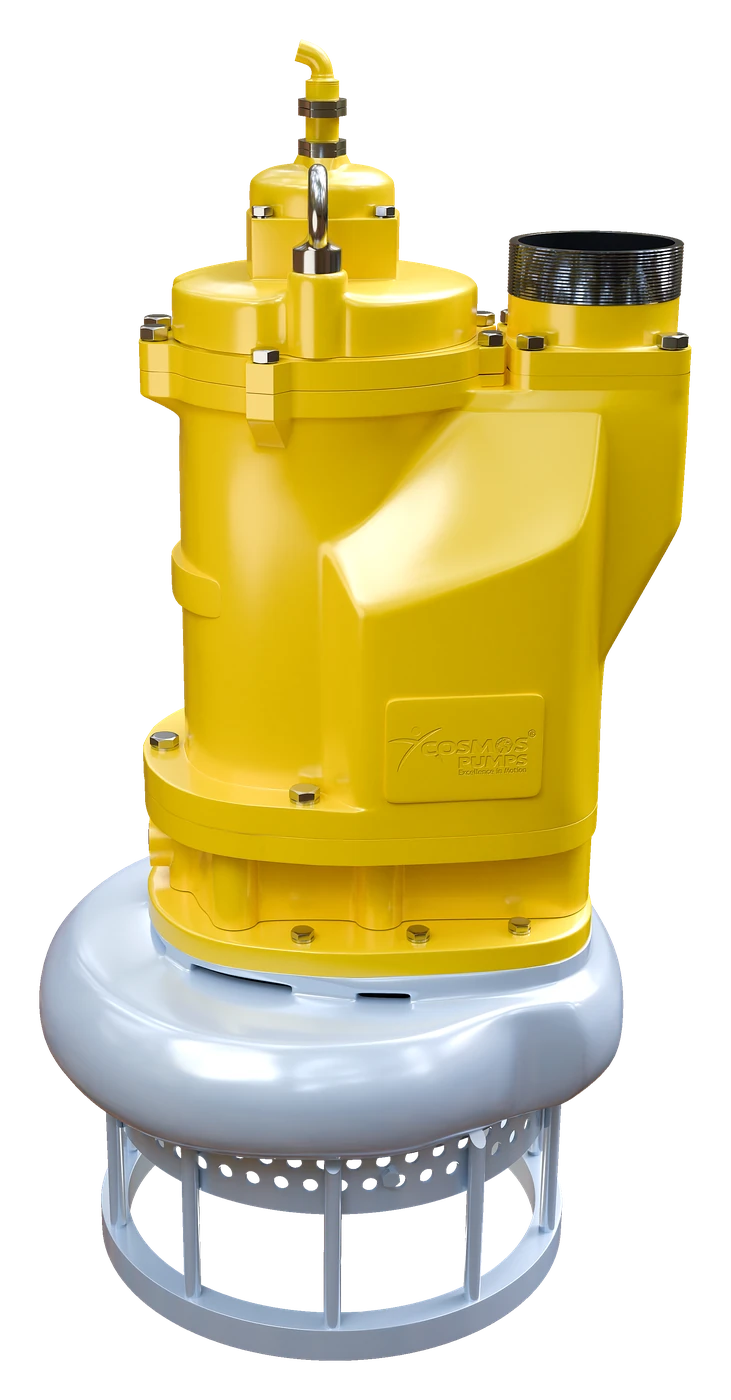
Slurry Pump CSL
Details as follows:

Low Head
NA

3100-8500 LPM

3100-8500 LPM
High Head
By Nishant Jain, COO & Chief Hydraulic Engineer, Cosmos Pumps Pvt. Ltd.
Technically reviewed by Nishant Jain, COO & Chief Hydraulic Engineer, Cosmos Pumps Pvt. Ltd.
Quick Specifications — CSL Slurry Pump Series
| Parameter | Value |
|---|---|
| Pump Type | Submersible Centrifugal Slurry Pump |
| Shut-Off Head | 27.5 M – 52.5 M |
| Flow Rate | 1,584 – 5,834 LPM (26.4 – 97.2 m³/h) |
| Motor HP Range | Up to 100 HP |
| Material of Construction (Wetted Parts) | 27% Hi-Chrome White Iron (ASTM A532 Class III) |
| Maximum Specific Gravity | 2.1 |
| Maximum Solids Concentration | 70% by weight |
| Installation Type | Submersible — fully immersed in slurry sump |
| Agitator Option | Available — for sumps with settled coarse solids |
| Certifications | ISO 9001:2015, CE, ZED Gold, NSIC, UL Compliance, EAC (6 certifications) |
Standard dewatering pumps and sewage pumps fail rapidly when slurry specific gravity exceeds 1.3 or solids concentrations climb above 25–30% by weight. Grey cast iron impellers — the material used in most general-purpose submersible pumps — erode to failure in under 500 operating hours under heavy abrasive slurry service. The wear rate is exponential: doubling the solids concentration does not double the erosion; it multiplies it.
The Cosmos Pumps CSL series is a purpose-built submersible slurry pump engineered for conditions that destroy standard dewatering equipment. Every wetted surface — impeller, volute liner, and backplate — is cast from 27% hi-chrome white iron (ASTM A532 Class III, 600–700 Brinell hardness), rated for slurry at specific gravity up to SG 2.1 and solids concentrations up to 70% by weight.
This page covers the CSL series in full: metallurgical specification, hydraulic range, application matrix, selection against the CSL-TV twin-volute variant, and technical FAQ. If you are tendering for a slurry pump for thermal power ash transfer, coal mine sump drainage, harbour silt removal, steel plant slag granulation, or industrial high-solids sludge circuits — this specification is written for your application.
Who this page is for: EPC project engineers, mining operations managers, thermal power plant O&M teams, harbour authority procurement, steel plant maintenance engineers, and project managers specifying slurry pumps across India and internationally.
Request a CSL Slurry Pump Quote →
Why 27% Hi-Chrome MOC Defines Slurry Pump Service Life
Wear is the dominant lifecycle cost in any slurry pump installation. Abrasive particles in pumped media — fly ash, coal fines, quartzite, iron ore tailings, mill scale, slag particles — erode impeller and casing geometry at rates that scale non-linearly with particle hardness, concentration, and velocity. In standard grey cast iron at 180–250 Brinell hardness, heavy abrasive slurry duty can reduce impeller geometry below acceptable tolerances in as few as 300–500 operating hours.
Hi-chrome white iron was developed specifically for high-wear abrasive pump applications. A chromium content of approximately 27% by weight in a white iron matrix produces a microstructure dominated by chromium carbides dispersed in a hardened martensitic matrix. This gives the alloy a Brinell hardness of 600–700 HB — classified under ASTM A532 Standard Specification for Abrasion-Resistant Cast Irons, Class III, which covers the most severe abrasive service category.
At 600–700 HB, the 27% hi-chrome alloy resists abrasive wear from quartzite, coal, fly ash, and mineral fines at 5–10× the rate of standard grey cast iron in standardised abrasion tests against relevant particle media. In Indian thermal power and mining operations — where pump impellers are regularly exposed to fly ash and coal slurry at 40–65% solids — this translates directly into wear-part replacement intervals measured in thousands of operating hours rather than hundreds.
Full surface coverage matters. A common engineering shortcut in budget slurry pump designs is to specify hi-chrome impellers while retaining grey iron casings. This simply relocates the failure point from impeller to casing — the volute liner erodes, loses profile, and hydraulic performance degrades. The Cosmos CSL uses 27% hi-chrome on every wetted surface: impeller, volute liner, and backplate. All three surfaces wear at the same rate and reach replacement threshold at the same scheduled maintenance interval.
The CSL’s SG 2.1 rating provides a meaningful engineering margin. Coal slurry at transfer concentration runs SG 1.4–1.7; fly ash slurry at full transfer runs SG 1.6–1.9; iron ore processing slurry runs SG 1.8–2.0; blast furnace slag can reach SG 2.0. The CSL’s SG 2.1 ceiling covers all of these within specification with headroom for density fluctuations. A direct competitor on the hi-chrome slurry pump specification publishes a maximum SG of 1.6 — the CSL’s SG 2.1 rating covers applications, including iron ore tailings and slag granulation circuits, that a SG 1.6 pump cannot serve.
CSL Slurry Pump — Full Technical Specifications
| Parameter | CSL Series |
|---|---|
| Pump Type | Submersible Centrifugal Slurry Pump |
| Shut-Off Head | 27.5 M – 52.5 M |
| Flow Rate | 1,584 – 5,834 LPM (26.4 – 97.2 m³/h) |
| Motor HP Range | Up to 100 HP |
| MOC — Wetted Parts | 27% Hi-Chrome White Iron, ASTM A532 Class III |
| Specific Gravity (Max) | 2.1 |
| Solids Concentration (Max) | 70% by weight |
| Installation | Submersible — fully immersed in slurry sump |
| Agitator Option | Available |
| Twin Volute Variant | CSL-TV — see selection guide below |
| Certifications | ISO 9001:2015, CE, ZED Gold, NSIC, UL Compliance, EAC |
The ANSI/HI 12.1-12.6 Rotodynamic Centrifugal Slurry Pumps Standard published by the Hydraulic Institute defines sizing, testing, and performance requirements for centrifugal slurry pumps. The CSL series is designed in alignment with the hydraulic performance and material selection intent of this standard. The CSL operates fully immersed in the slurry sump, eliminating priming requirements. Optional agitators are available for sumps where settled coarse solids require re-suspension.
Slurry Pump Applications — Industries and Duty Types
Thermal Power Stations — Fly Ash Transfer
Fly ash slurry transfer from electrostatic precipitators (ESPs) to ash ponds is among the most demanding abrasive pump duties in India’s power sector. Ash slurry SG at full transfer concentration typically runs 1.4–1.9; particle hardness is comparable to quartzite (Mohs 7); the circuit runs continuously, often 24/7. India’s Central Electricity Authority publishes technical standards for ash handling plant specifying minimum abrasion resistance thresholds — the CSL’s 600–700 HB hi-chrome specification exceeds these requirements. For 24/7 continuous ash transfer, the CSL-TV twin volute is the recommended variant; the CSL standard suits bottom ash hopper emptying and shorter intermittent duty cycles.
Mining — Coal Runoff, Metal Ore, Mine Waste
Active mine pits generate slurry sumps at multiple extraction stages. Coal runoff sump slurry runs SG 1.4–1.7 at 40–60% solids; metal ore processing slurry reaches SG 1.8–2.0. The CSL handles both within its full HP and head range. Mining season in India’s coal belt — Jharkhand, Odisha, Chhattisgarh, West Bengal — peaks from October through February, when post-monsoon pit water levels are highest and continuous slurry sump dewatering is a sustained operational requirement.
For companion clean groundwater mine dewatering at high heads (90–200 M), the CDW Ultra High Head submersible dewatering pump is the complementary specification. On large open-pit operations, CSL and CDW UHH units deploy in separate, complementary roles. For Cosmos Pumps’ full mining dewatering capability including EPEC contracting, see the Mining Segment page.
Harbour Construction and Capital Dredging
Harbour berth deepening and navigational channel maintenance involves removing accumulated silt, sand, and gravel from SG 1.2–1.4 (fine silt) to SG 1.5–1.8 (coarse sand/gravel). The CSL’s submersible configuration suits floating dredger platforms where priming a surface pump is impractical. The 70% by weight solids rating provides engineering margin for coarse bottom material during peak-concentration dredge lifts.
Steel Plants — Slag Granulation and Scale Pits
Blast furnace slag granulation circuits operate at SG 1.5–2.0; slag particles are dense and highly abrasive. Rolling mill scale pits handle dense scale fines at elevated temperature. The CSL’s SG 2.1 rating and 27% hi-chrome metallurgy cover both applications.
Sand and Gravel Quarry Operations
Sand and gravel pumping from quarry pits involves coarse material at variable solids loading. The CSL’s wide solids handling range (up to 70% by weight) and submersible configuration make it the practical specification where sumps cannot accommodate surface-mounted horizontal slurry pumps.
Industrial ETP and STP — High-Solids Sludge Transfer
For industrial ETP and STP sludge at concentrations beyond the capability of standard sewage submersible pumps, the CSL provides the required combination of abrasion resistance and solids handling range. For lighter sludge streams requiring larger solids passage (particles up to 70–100 mm), also see the Cosmos Pumps CNC Non-Clog Submersible Pump.
Submersible Slurry Pump — Why Submersible Installation Matters
The CSL is a submersible slurry pump — it operates fully immersed in the slurry sump, motor shaft oriented vertically, impeller at sump floor level. Submersible configuration delivers key operational advantages over surface-mounted horizontal slurry centrifugal pumps on industrial sites:
- No priming required. A submersible slurry pump self-primes on immersion and starts under load — significant operational advantage on intermittent multi-sump sites.
- Reduced surface footprint. Only the motor cable and discharge piping run to the surface — no pump house, suction pipework, or above-grade mechanical assembly.
- Continuous seal cooling. Motor and mechanical seal are cooled continuously by the pumped fluid, eliminating the seal failure mode associated with loss of prime in surface-mounted installations.
- Follows sump depth. The unit can be lowered to the active sump floor as the pit deepens, maintaining optimal suction conditions without extended pipework modifications.
High Chrome Slurry Pump — Material Standards and Selection
The term high chrome slurry pump (also written hi-chrome, 27% chrome) refers to slurry pumps with wetted parts manufactured from white iron alloy with approximately 27% chromium content by weight. The chromium percentage is the primary determinant of wear resistance in this alloy family.
Why 27% is the standard industrial specification: Chrome content below 20% produces insufficient carbide density for severe abrasive service. Above 30%, additional wear resistance gains are marginal and machinability for precision impeller casting is reduced. The 27% specification achieves the optimum balance of Brinell hardness (600–700 HB), toughness under hydraulic shock loading, and casting precision.
ASTM A532 Class III Type A is the classification applicable to CSL wetted parts — covering the most severe abrasive service category in this international standard. When specifying a high chrome slurry pump for a thermal power or mining project tender, request ASTM A532 Class III material certification and Brinell hardness test results as part of the supply documentation. Cosmos Pumps provides complete material certification documentation with CSL supply.
CSL vs CSL-TV — Selecting the Right Slurry Pump Variant
| Duty Condition | Recommended Variant |
|---|---|
| Intermittent duty — sump dewatered batch-wise per shift | CSL (Standard) |
| Flow < 3,000 LPM, SG ≤ 1.5, any duty cycle | CSL (Standard) |
| Bottom ash hopper emptying, periodic batch | CSL (Standard) |
| Harbour/dredging, variable flow profile | CSL or CSL-TV (review curve) |
| Flow > 3,000 LPM or SG > 1.5 at any duty | CSL-TV |
| 24/7 fly ash transfer at thermal power plant | CSL-TV |
| Continuous mine waste sump, remote/difficult-access site | CSL-TV |
| Extended bearing life is the primary specification | CSL-TV |
The CSL-TV uses a twin-volute casing to cancel the net radial hydraulic force that acts on the pump shaft in single-volute designs operating away from the best-efficiency point. Under high-flow, high-SG continuous duty, this radial force causes premature bearing failure — a leading cause of unplanned maintenance in ash transfer and continuous mine sump installations. The twin-volute casing eliminates the radial force imbalance, extending bearing service life in continuous-duty applications.
For full CSL-TV specification and engineering explanation of twin-volute hydraulic balance, visit the dedicated CSL-TV Twin Volute Slurry Pump page.
Project Reference — Mine Waste Sump Drainage, Eastern India Coal Belt
Duty: Open-pit coal operation, three active sump locations on pit floor. Slurry: coal fines and overburden material, SG 1.5–1.8, solids 50–65% by weight. Duty: intermittent — sumps dewatered batch-wise between extraction shifts. Prior specification: standard submersible dewatering pumps rated to SG 1.1 — impeller replacement every 90–120 operating hours.
Equipment deployed: CSL units, 40–60 HP, matched to site head and flow requirements. 27% hi-chrome impellers and volute liners against coal and overburden abrasivity.
Outcome: First scheduled wear-part inspection at 800 operating hours confirmed impeller geometry within acceptable dimensional tolerances. Lifecycle cost per cubic metre of slurry reduced approximately 60% compared to prior standard dewatering pump specification. Maintenance aligned with planned shutdown windows.
Project details are representative of typical CSL intermittent-duty mine sump deployments across the Eastern India coal belt. Documented project references available on request to qualified buyers and tendering engineers.
Frequently Asked Questions
What is a slurry pump and how is it different from a dewatering pump?
A slurry pump is a centrifugal pump purpose-built for fluids containing suspended abrasive solids above 15–20% by weight, or at specific gravities above 1.3. A standard dewatering pump uses grey cast iron impellers (180–250 HB) suited for lightly contaminated water. A slurry pump uses hardened metallurgy — hi-chrome alloy at 600–700 HB — with larger hydraulic passages, reinforced seals, and construction standards for continuous abrasive contact. Operating a standard dewatering pump in slurry duty above SG 1.3 rapidly erodes the impeller and casing, leading to failure within a few hundred operating hours.
What does 27% hi-chrome mean in a slurry pump specification?
Hi-chrome refers to white iron with approximately 27% chromium by weight. The chromium produces a microstructure of chromium carbides in a hardened martensitic matrix — Brinell hardness 600–700 HB — classified under ASTM A532 Class III. Wear resistance against quartzite, fly ash, coal, and mineral fines is 5–10× greater than standard grey cast iron. The 27% specification is the Indian industry standard for ash transfer and mine slurry duty.
What is the maximum specific gravity the CSL handles?
The Cosmos CSL is rated to SG 2.1. Coal slurry = SG 1.4–1.7; fly ash slurry = SG 1.6–1.9; iron ore slurry = SG 1.8–2.0; blast furnace slag = up to SG 2.0. The CSL’s SG 2.1 ceiling covers all standard Indian mining and power applications within specification, with engineering margin for peak-concentration fluctuations.
What is the maximum solids concentration the CSL can pump?
The CSL is rated for 70% solids by weight. Standard dewatering submersible pumps typically fail above 20–25% solids by weight due to rapid impeller erosion and seal degradation. The CSL’s hi-chrome metallurgy allows continuous operation at concentrations that destroy conventional dewatering equipment within hours.
Is the CSL a submersible or surface-mounted slurry pump?
The CSL is a submersible slurry pump — it operates fully immersed in the slurry sump. This eliminates priming requirements, reduces surface footprint, maintains continuous seal cooling, and allows the unit to follow sump depth. Optional agitators are available for re-suspending settled coarse solids.
When should I specify the CSL-TV instead of the CSL?
Specify the CSL-TV when the application involves: 24/7 continuous fly ash transfer; flow rates above 3,000 LPM at SG above 1.5; remote/difficult-access sites where bearing replacement carries high shutdown cost; or prior single-volute specifications with premature bearing failures on the same duty. The CSL-TV twin-volute casing cancels the net radial hydraulic force that causes bearing failure under high-flow, high-SG continuous duty. Full specification: CSL-TV Twin Volute page.
What industries use the CSL submersible slurry pump in India?
The CSL is primarily deployed in: thermal power stations (fly ash transfer, bottom ash hopper); coal and metal ore mines (pit sump waste drainage, tailings); harbour and waterway dredging (silt, sand, gravel); steel plants (slag granulation, scale pits); sand and gravel quarry operations; industrial ETP/STP high-solids sludge circuits.
Does Cosmos Pumps supply certified slurry pumps with material documentation?
Yes. Cosmos Pumps is certified to ISO 9001:2015 with full material certification capability. CSL supply documentation includes: ISO 9001:2015 and CE certificates, ASTM A532 Class III material certificate for wetted components, Brinell hardness test results, and dimensional inspection records. ZED Gold, NSIC, UL Compliance, and EAC certifications available on request. Complete documentation provided with tender and export orders.
Request a CSL Slurry Pump Quotation
Cosmos Pumps supplies the CSL and CSL-TV series directly to EPC contractors, mining companies, thermal power operators, harbour authorities, steel plants, and industrial project teams across India and internationally. Cosmos Pumps has served 2,500+ customers across 5,000+ completed projects and installations worldwide, across 22+ export countries including UAE, Saudi Arabia, Australia, South Africa, and Zambia.
To receive a technical quotation and CSL catalogue, provide:
- Required flow rate (LPM or m³/h)
- Total dynamic head (M)
- Slurry SG and solids concentration (% by weight)
- Particle size range and material type (if known)
- Duty cycle: intermittent / batch / continuous / 24/7
- Sump depth and installation geometry
- Site location and project timeline
WhatsApp / Call: +91 99333 22238
Email: cosmos@cosmospumps.com
Download CSL Product Catalogue: Request via WhatsApp or email
Cosmos Pumps Pvt. Ltd. is certified to ISO 9001:2015, CE, ZED Gold, NSIC, UL Compliance, and EAC — six independent certifications covering international quality management, European conformity, and Indian manufacturing excellence. Manufacturing facility: 25,000 sq. ft. Vertical Lean facility in Faridabad, Haryana, India.
For the full submersible pump range — CDW Dewatering, CNC Non-Clog, CSW Sewage, and CSL Slurry — visit the submersible pump catalogue page.
Download Catalogue: Slurry Pump CSL