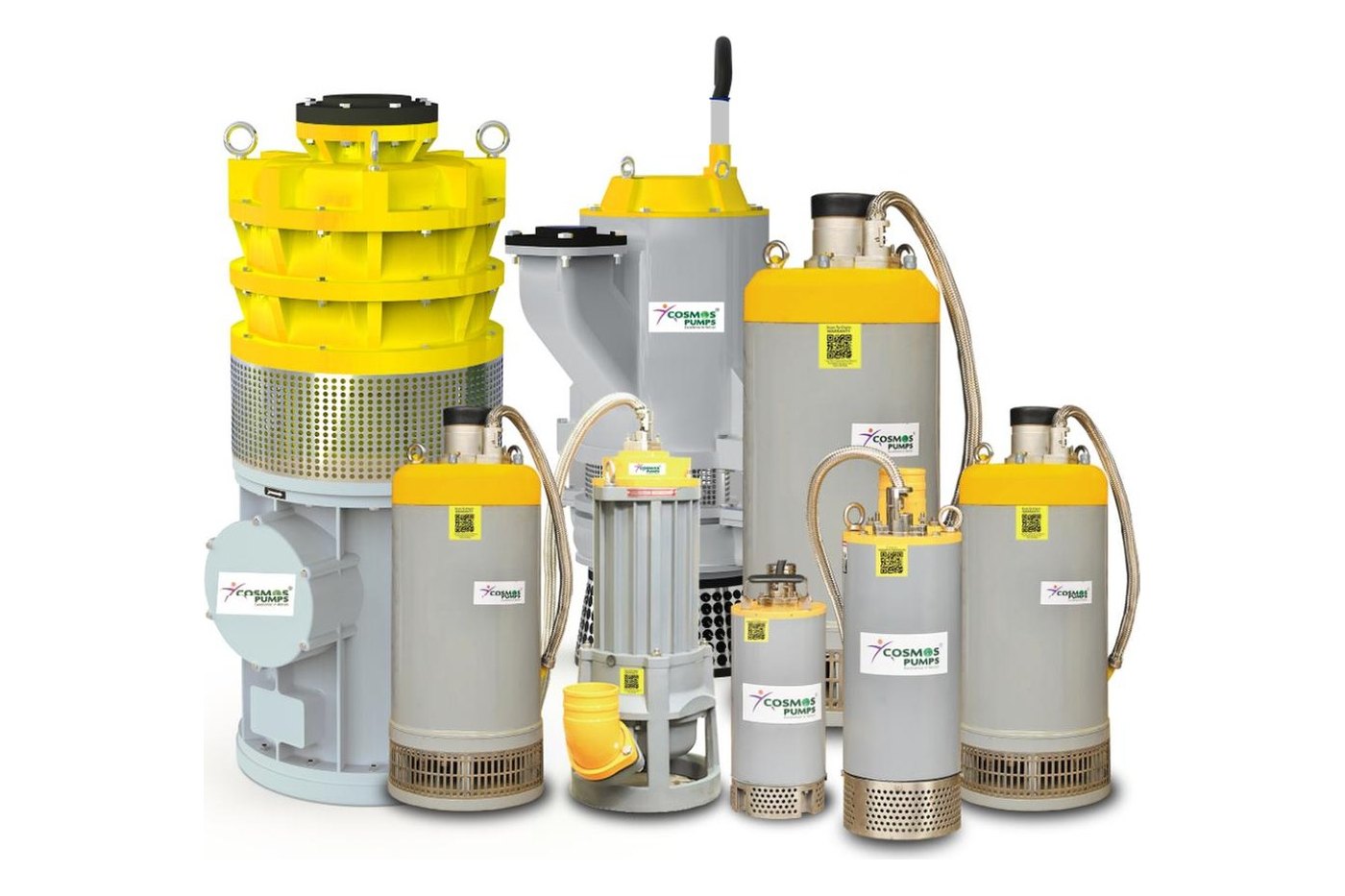
A dewatering pump is defined by its purpose: it removes water that has accumulated in unwanted locations — construction excavations, mine sumps, tunnels, and flood-affected areas. A submersible pump is defined by its installation method: the motor and pump unit are fully immersed in the liquid being pumped, eliminating the need for suction pipes or priming.
The two terms often overlap because most dewatering applications use submersible pumps. Three criteria distinguish specific products:
- Solids handling — Dewatering pumps (Cosmos CDW) are rated for dirty water and suspended solids up to 12 mm. Slurry and sewage submersible pumps (Cosmos CSL, CSW) handle solids from 20 to 100 mm.
- Head range — Dewatering submersibles span 15.5 M to 200 M head. Sewage submersibles (CSW) operate at 5–60 M.
- Fluid type — CDW for groundwater/dirty water (SG up to 1.1); CSL for slurry/mine tailings (SG up to 2.1); CSW for sewage (SG up to 1.7).
For most construction and infrastructure dewatering, the Cosmos CDW submersible dewatering pump is the standard specification.