On a construction site or mining project, the terms “mud pump,” “sludge pump,” and “slurry pump” are used loosely — sometimes interchangeably. But select the wrong pump type and you face impeller erosion, motor burnout, or simply a pump that cannot move the fluid at hand. Each pump type is engineered for a specific fluid profile: the solids concentration, particle size, specific gravity, and abrasivity of what you are pumping. This guide maps the three types to their correct duty and to the Cosmos Pumps product range that covers each.
What Is the Difference Between a Mud Pump, a Sludge Pump, and a Slurry Pump?
A dewatering mud pump moves muddy groundwater — water mixed with soft soil or drill cuttings, SG up to 1.1. A sludge pump handles thick settled sludge from ETP/STP sumps and manholes, with solids up to 70 mm, SG 1.1–1.3. A slurry pump manages highly concentrated, abrasive slurries — mine tailings, fly ash, sand — at SG up to 2.1 using hi-chrome or rubber-lined wetted parts. The fluid’s specific gravity and abrasivity determine which pump you need.
Mud (dewatering context): Muddy groundwater from construction excavations, foundation pits, tunnels, or drilling flush operations. The water carries suspended soil particles — silt, clay, soft sand — at low concentration. SG typically 1.05–1.1. Particles are 4–75 mm and not particularly abrasive. This is the domain of the dewatering mud pump: a surface auto-prime or submersible unit designed for high-flow, low-abrasion duty.
Sludge: Thick settled material from ETP/STP sludge sumps, septic tanks, manholes, or settling ponds. Sludge is characterised by high viscosity and the potential for large fibrous or solid particles up to 70 mm. SG 1.1–1.3. It requires a non-clog pump with a wide-passage impeller — a standard dewatering pump whose narrow impeller passages would bind on fibrous solids is the wrong tool.
Slurry: Fluid with high concentrations of hard, abrasive particles — fly ash, coal runoff, mine tailings, sand and gravel. SG 1.3–2.1. The abrasivity demands special metallurgy (typically 27% hi-chrome or rubber lining on all wetted parts). A standard impeller will erode within hours under true slurry duty.
Mud Pump vs Sludge Pump vs Slurry Pump: Quick Comparison
| Parameter | Dewatering Mud Pump | Sludge Pump | Slurry Pump |
|---|---|---|---|
| Fluid type | Muddy groundwater / drill flush water | Thick settled sludge (ETP/STP/septic) | Abrasive slurry (mining/ash/coal/dredging) |
| Suspended solids | 4–75 mm | Up to 70 mm (fibrous/solid) | Up to 70% by weight |
| Specific gravity (SG) | Up to 1.1 | 1.1–1.3 | 1.3–2.1 |
| Abrasivity | Low | Low–Medium | High (hi-chrome MOC required) |
| Installation | Surface auto-prime or submersible | Submersible | Submersible |
| Drive type | Diesel engine or electric | Electric (submersible motor) | Electric (submersible motor) |
| Cosmos product | CAP Auto-Prime | CNC Non-Clog | CSL Slurry |
Application Scenarios: Which Pump for Which Job?
Dewatering Mud Pump: Construction, Tunnelling, and Flood Control
The dewatering mud pump is the workhorse of construction sites, tunnelling projects, and foundation work. Where groundwater intersects with excavated soil — pile caps, basement excavations, road cuttings, trench drainage — the result is muddy water requiring continuous pumping.
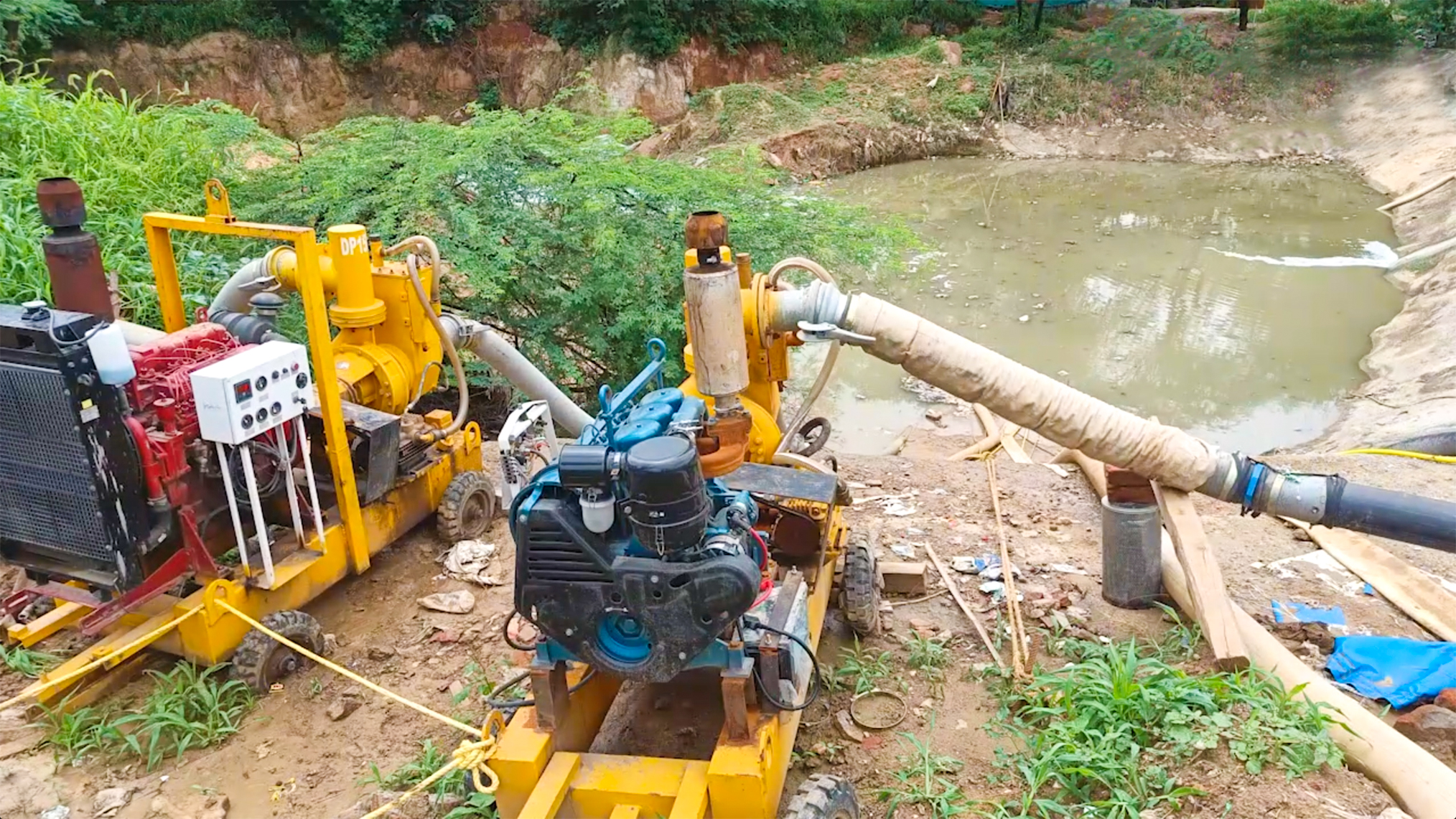
Foundation dewatering: Basement pits and pile caps accumulate silty water that cannot drain naturally. A diesel auto-prime mud pump placed at the surface draws from a sump without immersion — ideal where the pump cannot be lowered into a narrow excavation.
Tunnel dewatering: Tunnel face and sump water carries suspended clay and fine sand. Flow rates of 1,000–5,000 LPM are common; engine-driven units operate without grid power deep in tunnel interiors.
Drill flush water recovery: Rotary drilling on piling rigs and micro-piling projects generates bentonite- or polymer-laden flush water. Dewatering mud pumps recover this for treatment or disposal at volumes matched to the drilling rig throughput.
Flood control and monsoon dewatering: During monsoon events, flood water in low-lying industrial areas carries suspended silt and topsoil (SG 1.05–1.1). Auto-prime units deploy rapidly and clear multiple sites per season — Cosmos rental fleet covers 80+ flood control deployments per year.
Sludge Pump: ETP/STP, Manhole Desilting, and Sewage Bypass
Sludge pump duty is characterised by thick, viscous fluid that would choke a standard centrifugal pump. The non-clog design — wide impeller passages and bottom discharge — is the engineering solution.
ETP/STP sludge extraction: Activated sludge, digested sludge, and belt-press feed all require non-clog pumps rated for high solids and variable viscosity. Municipal STPs run these pumps continuously in the sludge thickening and transfer circuit.
Manhole desilting: Accumulated sediment in stormwater and sewage manholes combines fibrous debris, grit, and concentrated sludge with solids up to 70 mm. This is the CNC’s primary application in the Indian market — the 14-inch diameter fits standard manhole access and the bottom discharge clears solids completely from the chamber floor.
Sewage bypass pumping: During sewer maintenance or rehabilitation, flow must bypass the work zone. A non-clog pump on rapid-deployment trolleys handles raw sewage — including rag content — without blockage. The CPHEEO Manual on Sewerage and Sewage Treatment specifies bypass pump sizing at 1.5× peak daily flow for safety factor.
Settling pond drainage: Industrial ponds accumulate settled sludge from washwater and process effluent. Extraction at the end of a settling cycle requires a pump that handles the transition from clear supernatant to thick concentrated solids.
Slurry Pump: Mining, Ash Transfer, and Harbour Dredging
Slurry duty combines high solids concentration with abrasive particles. Standard pump metallurgy fails rapidly; 27% hi-chrome or rubber-lined construction is required by duty specifications set out in Hydraulic Institute Standard ANSI/HI 12.1–12.6 for slurry pump selection and application.
Fly ash transfer: Thermal power stations generate fly ash slurry (SG 1.4–1.8) from bottom ash sumps. Continuous pumping to ash ponds requires hi-chrome wetted parts rated for the abrasion levels of alumino-silicate fly ash particles.
Mine tailings discharge: Coal and iron ore washing plants produce tailings at SG 1.5–2.0. Pump wear rates in mine duty are 3–10× higher than in clean-water service, making metallurgy selection the dominant cost factor.
Sand and gravel extraction: Harbour construction and dredging operations pump sand slurry (SG 1.6–1.9) from seabed or riverbed excavations. The abrasive silica content requires hi-chrome impellers and volute casing for acceptable service intervals.
Silt removal from reservoirs: Monsoon-season silt accumulation in reservoirs has SG 1.3–1.5 and requires agitation plus slurry pumping for extraction — a combined CAP agitator + CSL slurry pump configuration is standard for reservoir desilting in India.
Cosmos Pumps Product Mapping: Mud, Sludge, and Slurry
| Application | Fluid Profile | Cosmos Pump | Key Specifications |
|---|---|---|---|
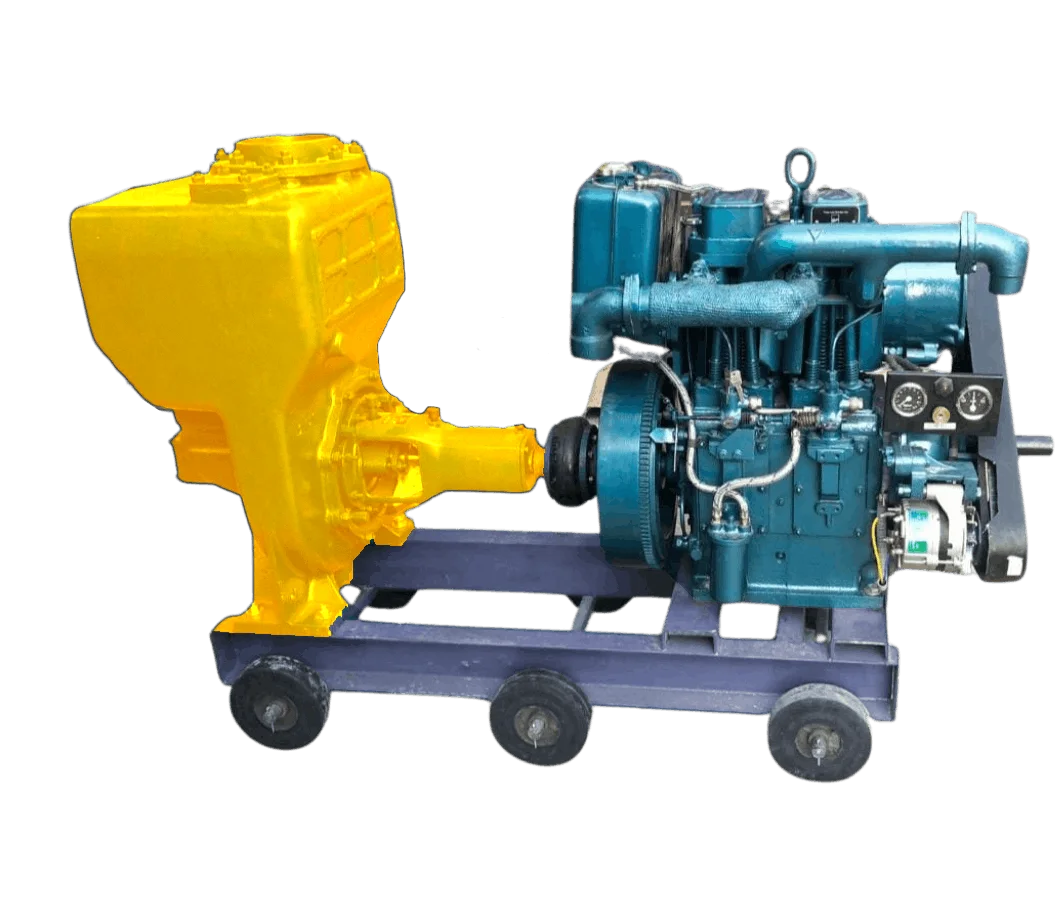
| Construction mud dewatering | Muddy groundwater, SG ≤1.1, solids 4–75 mm | CAP Auto-Prime (diesel or electric) | Up to 4,469 m³/h; open impeller 75 mm; KOEL/Eicher/Baudouin/CAT engines; suction lift 9.8 m; runs dry |
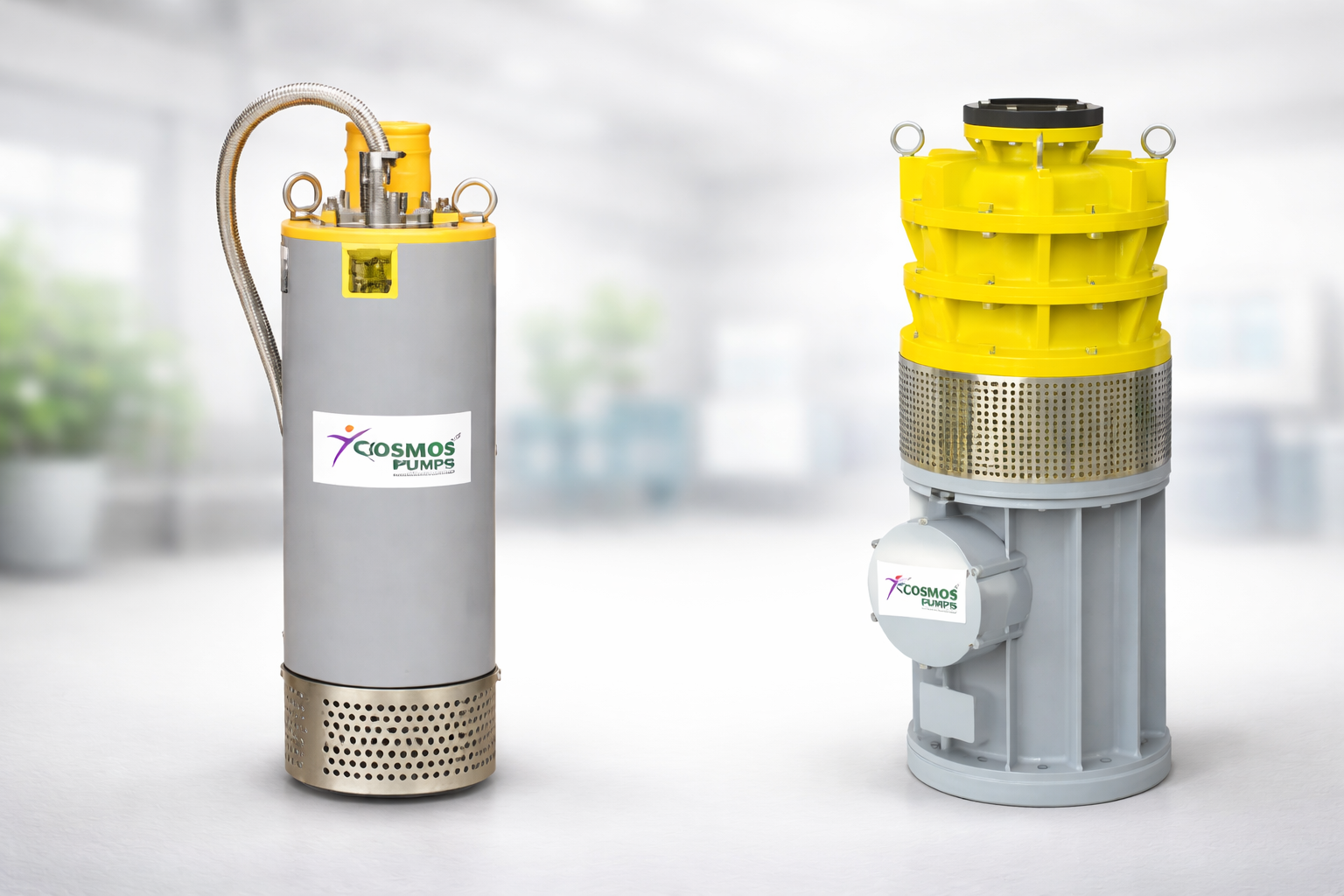
| Sludge extraction (ETP/STP/manhole) | Thick sludge, SG ≤1.2, solids up to 70 mm | CNC Non-Clog Submersible | 1,250–1,500 LPM; 70 mm bottom discharge; 6–20 HP; 14″ dia. for manhole access |
| Slurry transfer (mining/ash/dredging) | Abrasive slurry, SG ≤2.1, up to 70% solids by weight | CSL Slurry Submersible | 27% hi-chrome MOC; 1,584–5,834 LPM; up to 100 HP; CSL-TV twin-volute for 24/7 duty |
For an overview of CNC, CSW, and CSL across all sludge application types, see the Cosmos sludge pump range guide.
Common Pump Selection Mistakes
Using a dewatering pump in slurry duty: The most costly mistake on site. A standard CAP or CDW pump moving SG 1.5 mining slurry will erode its impeller in hours. Slurry abrasivity is not just a function of SG — quartz sand at SG 1.8 is far more destructive than clay-laden mud at the same SG. If grit or sand is present at SG >1.2, specify hi-chrome wetted parts.
Ignoring SG in power calculation: BIS IS 9137 — the Indian Standard for centrifugal pump acceptance testing — requires duty calculations adjusted for fluid SG. Specifying a pump motor for water (SG 1.0) and running it on sludge (SG 1.25) causes motor overload and thermal trips within the first duty cycle.
Using a slurry pump for sludge with large fibrous solids: Slurry pumps are designed for high solids concentration, not necessarily large individual particle passage. A non-clog pump with 70 mm bottom discharge handles fibrous sludge that would choke the tighter hydraulic passages of a slurry pump.
Dry-running submersible pumps: Both CNC and CSL motors are cooled by the surrounding fluid. Brief dry running damages motor windings. Where the sump may empty between cycles, the CAP auto-prime (which runs dry without damage) is the correct choice.
Frequently Asked Questions
Can a mud pump handle sludge?
A standard dewatering mud pump (CAP auto-prime or CDW submersible) is designed for muddy water with solids 4–12 mm and SG ≤1.1. It cannot handle thick sludge with large solids or high viscosity. Pumping dense sludge through a standard dewatering pump risks impeller binding, motor overload, and seal failure. Use a non-clog sludge pump (CNC series) for ETP/STP and manhole sludge applications.
What is a dewatering mud pump used for on a construction site?
A dewatering mud pump removes muddy groundwater from excavations, foundation pits, basement sumps, and tunnel faces. It handles water mixed with soft soil particles — clay, silt, fine sand — at SG up to 1.1. The CAP diesel auto-prime series is the most common dewatering mud pump for construction sites: it primes automatically from a sump, runs dry without damage, and requires no grid power connection.
What specific gravity can a slurry pump handle?
Slurry pumps are typically rated for SG 1.3–2.1 depending on the application. Fly ash slurry runs SG 1.4–1.8; mine tailings SG 1.5–2.0; sand and gravel dredging SG 1.6–1.9. The Cosmos CSL Slurry Submersible handles SG up to 2.1 with 27% hi-chrome metallurgy on all wetted parts for extended wear life.
Can I use a slurry pump instead of a sludge pump?
In most sludge applications, a slurry pump is the wrong tool. Slurry pumps have tighter hydraulic passages optimised for high-concentration abrasive service, not the large fibrous or solid particles found in ETP/STP sludge or manhole sediment. Use the CSL slurry pump only when abrasion is the dominant design factor — SG >1.2 and hard particles (grit, sand, ash, coal). For organic or fibrous sludge, the CNC non-clog pump provides the correct passage geometry.
How do I choose between CNC and CSL for a mixed sludge-slurry application?
The deciding factor is specific gravity and particle hardness. For SG ≤1.2 with organic or fibrous solids (ETP digested sludge, septic tank content, manhole sediment), use the CNC Non-Clog. For SG >1.2 with hard abrasive particles (grit, sand, ash, coal fines), specify the CSL with hi-chrome wetted parts. For mixed-character fluids such as grit chamber drainage from an STP, contact Cosmos for application-specific pump selection — flow rate, SG, solids profile, and duty hours per day all factor into the correct recommendation.
What is the difference between a mud pump in drilling vs. construction dewatering?
In oil and gas drilling, a “mud pump” is a positive-displacement triplex or duplex pump that circulates drilling fluid under high pressure to cool the drill bit and carry cuttings to surface — a completely different product category from a centrifugal pump. In construction dewatering, “mud pump” refers to a centrifugal pump (auto-prime or submersible) that removes muddy groundwater from excavations. This article addresses construction dewatering applications only.