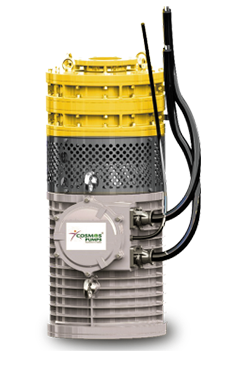
High Head Dewatering Pump — CDW Series | 40–140 M Head
Details as follows:

Low Head
NA

Medium Head
NA

High Head
2000-3500 LPM
Dewatering Pump HP Selection Guide — 1.5 HP to 120 HP
Selecting the right motor HP for a submersible dewatering pump requires matching the site’s Total Dynamic Head (TDH) and flow rate to the correct CDW series. Cosmos Pumps manufactures three CDW series — Standard, High Head, and Ultra High Head — spanning 1.5 HP to 120 HP for depths from shallow construction basements to 200-metre underground mine sumps. The table below maps HP to the correct series and typical application.
The HP selection guide covers the full range most commonly searched: 1 HP, 1.5 HP, 2 HP, 3 HP, 5 HP, 7.5 HP, 10 HP, 15 HP, 20 HP, 25 HP, 30 HP, 40 HP, 50 HP, 60 HP, 75 HP, and 100–120 HP. If you need a specific HP, use the table to identify the correct series, then consult the series specification page for detailed pump curves.
| HP Range | CDW Series | Max Head (M) | Max Flow (LPM) | Typical Application |
|---|---|---|---|---|
| 1.5 HP – 3 HP | CDW Standard | Up to 35 M | 450 – 1,200 LPM | Small construction sumps, building basements, shallow trench dewatering, municipal utility trenches (TDH < 30 M) |
| 5 HP – 10 HP | CDW Standard or CDW High Head | 40 M (Std) / 65 M (HH) | 1,500 – 3,500 LPM | CDW Standard for TDH < 40 M (infrastructure, roads, building). CDW High Head for TDH 40–65 M (quarry pits, deep basements, mine approach sumps) |
| 15 HP – 20 HP | CDW Standard or CDW High Head | 86.5 M (Std) / 90 M (HH) | 4,000 – 6,500 LPM | CDW Standard for high-flow shallow sites (highways, drainage, municipalities). CDW High Head for moderate mine pits and railway tunnel approach sumps (TDH 65–90 M) |
| 25 HP – 50 HP | CDW Standard or CDW High Head | 86.5 M (Std) / 125 M (HH) | 5,000 – 8,500 LPM (Std) / 1,950 LPM (HH) | CDW Standard (up to 50 HP) for very high flow at shallow heads — flood control, large open excavations. CDW High Head for high-head mine and tunnel dewatering (TDH 90–125 M) |
| 60 HP – 75 HP | CDW High Head | 132 M – 140 M | 2,100 – 2,200 LPM | Primary pump for deep open-cast mines, metro tunnels, hydro-power project shafts (TDH 110–140 M) |
| 50 HP – 75 HP | CDW Ultra High Head | 90 M – 150 M | 833 – 2,000 LPM | Transition zone: when TDH exceeds CDW HH range or very high pressure in confined underground sumps |
| 100 HP – 120 HP | CDW Ultra High Head | Up to 200 M | Up to 3,333 LPM | Deep underground mines (>140 M), hydroelectric power shafts, long-distance tunnel drainage |
Decision rule:
- TDH < 40 M and flow > 3,000 LPM: CDW Standard (1.5–50 HP) — optimised for high flow at moderate head
- TDH 40–140 M: CDW High Head (5–75 HP) — 2-stage impeller for sustained pressure at depth
- TDH > 140 M or very high-pressure confined sumps: CDW Ultra High Head (50–120 HP) — engineered for the deepest mine and tunnel applications
For the complete CDW High Head range specifications and pump curve data, see the CDW Ultra High Head selection guide for above-140 M applications, or the full submersible dewatering pump range for all series. The dewatering pump selection guide covers the complete hierarchy from standard head through ultra-high head models.
*Technically reviewed by Nishant Barnwal, COO & Chief Hydraulic Engineer, Cosmos Pumps Pvt. Ltd.
What is a CDW High Head Dewatering Pump?
The CDW High Head is a submersible dewatering pump rated 5–75 HP with shut-off heads of 40–140 M and flow rates of 350–2,200 LPM. It is designed for mine dewatering, tunnel construction, and high-head building projects where the standard CDW series (max 86.5 M) is insufficient.
Where a conventional submersible dewatering pump reaches its pressure limit at moderate pit depths, the CDW High Head’s 2-stage impeller design sustains discharge pressure across significantly deeper sumps — making it the correct selection for open-cast mines, hydro-civil tunnels, and deep basement excavations that exceed 80 M depth. For a complete overview of the full submersible dewatering pump range, see the category page.
The CDW High Head is engineered and manufactured by Cosmos Pumps — India’s ISO 9001:2015 certified dewatering pump manufacturer.
CDW High Head — At a Glance
| Parameter | Specification |
|---|---|
| HP Range | 5 HP – 75 HP |
| Shut-Off Head Range | 40 M – 140 M |
| Flow Rate Range | 350 LPM – 2,200 LPM |
| Water Type | Dirty/muddy water; suspended solids 4–12 mm; SG up to 1.1; pH 5–8 |
| Power Cable | 20 m (heavy-duty, submersible-rated) |
| Impeller | 2-stage SS316 (high-pressure design) |
Where CDW High Head Fits in the Submersible Dewatering Range
The CDW series is structured as three distinct head bands to allow precise motor sizing without over-specifying for shallow sites:
- CDW Standard (1.5–50 HP, up to 86.5 M): General construction, basements, and infrastructure sites where TDH does not exceed 80 M.
- CDW High Head (5–75 HP, 40–140 M): Mine pits, railway tunnels, highway underpasses, and high-head civil structures where TDH falls between 80 M and 140 M.
- CDW Ultra High Head (50–120 HP, 90–200 M): Very deep underground mines, hydroelectric shafts, and long-run tunnel drainage where TDH exceeds 140 M.
Specifying the correct band prevents the two most common site failures: under-specifying head (causing the pump to dead-head and overheat) and over-specifying HP (inflating power costs and reducing flow-curve efficiency at normal operating points). The CDW High Head is the correct selection when the site TDH falls reliably above the standard CDW’s 86.5 M ceiling.
The CDW High Head is part of the broader dewatering pump guide which covers the complete selection hierarchy from standard head through to ultra high head models.
CDW High Head HP Selection — Complete Range
The table below covers the full CDW High Head range from 5 HP to 75 HP. Select the model whose maximum head comfortably exceeds your calculated Total Dynamic Head (TDH) — see the calculation guide in the next section.
| Model | HP | Max Head (M) | Max Flow (LPM) | Cable Length | Best Application |
|---|---|---|---|---|---|
| CDW HH 5 | 5 HP | 40 M | 500 LPM | 10 m | Shallow mine sumps, deep basements (30–35 M) |
| CDW HH 7.5 | 7.5 HP | 55 M | 620 LPM | 10 m | Quarry pit dewatering, building basement excavation |
| CDW HH 10 | 10 HP | 65 M | 750 LPM | 20 m | Road underpass construction, open-cast mine drainage |
| CDW HH 15 | 15 HP | 80 M | 980 LPM | 20 m | Railway tunnel construction, mid-depth mine sump |
| CDW HH 20 | 20 HP | 90 M | 1,150 LPM | 20 m | Hydro-civil project dewatering, highway tunnels |
| CDW HH 30 | 30 HP | 105 M | 1,500 LPM | 20 m | Metro rail tunnels, deep open-cast mine drainage |
| CDW HH 40 | 40 HP | 115 M | 1,750 LPM | 20 m | Deep mine dewatering, hydro power project shafts |
| CDW HH 50 | 50 HP | 125 M | 1,950 LPM | 20 m | Primary pump for 80–100 M mine pits, tunnel de-sump |
| CDW HH 60 | 60 HP | 132 M | 2,100 LPM | 20 m | High-volume underground mine sumps, long tunnel runs |
| CDW HH 75 | 75 HP | 140 M | 2,200 LPM | 20 m | Maximum-depth application (110–120 M pits), hydro shafts |
Note: For dewatering heads above 140 M, the CDW Ultra High Head (50–120 HP, 90–200 M) is the correct upgrade path. Both series use SS316 impellers and CI FG 300 motor bodies for compatibility in abrasive site conditions.
How to Calculate Dewatering Head for Mine & Tunnel
Correct pump selection depends on calculating the Total Dynamic Head (TDH) before specifying motor HP. Under-sizing the head leads to pump overload and premature seal failure; over-sizing wastes capital and energy. The three-component TDH formula below aligns with the HowTo steps in the structured data for this page.
Step 1 — Calculate Total Dynamic Head (TDH)
The TDH formula for submersible mine and tunnel dewatering is:
TDH = Static Head + Friction Losses + Velocity Head
- Static Head: Vertical distance (metres) from the pump inlet (lowest sump level) to the discharge outlet at surface or drainage channel level.
- Friction Losses: Pressure drop due to pipe diameter, length, bends, and fittings. For 50–100 M discharge runs with 100–150 mm pipe, budget 15–20% of static head. Use the Darcy-Weisbach equation for precise projects.
- Velocity Head: Typically 1–3 M for submersible dewatering applications. Use 2 M as a conservative default.
Step 2 — Estimate Peak Inflow Rate
Head alone does not determine pump selection — the dewatering pump must also move sufficient volume to keep pace with groundwater inflow. Calculate peak inflow Q (litres per minute) using the rational method:
Q = C × I × A / 6
- C — Runoff coefficient (dimensionless): 0.9 for hard rock mine floor; 0.6–0.7 for fractured rock or exposed clay; 0.3–0.5 for stable overburden
- I — Rainfall intensity (mm/hour): Use 50-year return period for permanent dewatering sumps; 10-year for temporary construction
- A — Catchment area (hectares): The plan area draining to the sump, including open pit benches and any surface runoff paths
- The factor 6 converts the result from m³/hour to LPM (× 1,000 / 6)
Select a CDW High Head model with a rated flow at the required TDH that is ≥ 110% of peak inflow Q. The 10% buffer accounts for impeller wear over a 12-month operating cycle and minor calculation uncertainty. For mines with multiple independent sump levels, calculate Q per sump and size each pump individually — do not aggregate catchment areas across separate drainage zones.
Step 3 — Apply Safety Factor to TDH
Always multiply the calculated TDH by a safety factor of 1.10–1.15 to account for:
- Sediment accumulation reducing effective pipe bore over time
- Variation in peak inflow during monsoon or high-water events
- Actual pump curve deviation from rated performance at elevated temperatures
- Future bench deepening or tunnel extension increasing static head mid-contract
Step 3 — Select HP from the CDW High Head Range
Match the safety-factored TDH and required flow rate to the CDW High Head table. Select the model whose rated maximum head exceeds your TDH by at least 10–15 M to keep the pump operating in the efficient mid-curve zone rather than near shut-off.
Worked Example: 80 M Open-Cast Mine Pit
| TDH Component | Value | Basis |
|---|---|---|
| Static Head | 80 M | Measured pit depth to surface discharge |
| Friction Losses | 12 M | 15% × 80 M (80 m run, 100 mm pipe) |
| Velocity Head | 2 M | Default for submersible mine application |
| Sub-Total TDH | 94 M | Static + Friction + Velocity |
| Safety Factor | × 1.15 | Monsoon peak inflow allowance |
| Design TDH | 108 M | TDH after safety factor |
Selection outcome: At 108 M design TDH, the CDW HH 50 HP (max head 125 M) is the correct selection — it covers the required head with a 17 M operating margin, keeping the pump well within its efficient curve range. If peak inflow exceeds 1,800 LPM, deploy two CDW HH 40 HP units in parallel to match flow without compromising head capacity.
For deeper dewatering above 140 M TDH, see the CDW Ultra High Head (90–200 M).
CDW High Head vs CDW Ultra High Head — When to Use Each
Both series are submersible dewatering pumps engineered for demanding mine and tunnel conditions, but they serve distinct depth and flow envelopes. Use the table below to determine the correct series for your project TDH.
| Criteria | CDW High Head (CDW HH) | CDW Ultra High Head (CDW UH) |
|---|---|---|
| HP Range | 5 HP – 75 HP | 50 HP – 120 HP |
| Head Range | 40 M – 140 M | 90 M – 200 M |
| Flow Range | 350 LPM – 2,200 LPM | 50 m³/h – 200 m³/h (833–3,333 LPM) |
| Impeller Type | 2-stage SS316 high-pressure | 2-stage SS316 ultra-high-pressure |
| Power Cable | 20 m standard | 20 m standard |
| Typical Application | Open-cast mines, railway tunnels, highway underpasses, hydro-civil shafts up to 120 M depth | Deep underground mines, hydro-power penstocks, long-run tunnel drainage where TDH exceeds 140 M |
Decision rule: If your design TDH falls between 40 M and 140 M, specify the CDW High Head. If TDH exceeds 140 M or your project requires flows above 2,200 LPM at high head, the CDW Ultra High Head (90–200 M) is the appropriate upgrade. Both series use the same SS316 impeller material, CI FG 300 motor body, and SiC mechanical seals — reducing spare-part inventory complexity on multi-series sites.
CDW High Head Applications
The CDW High Head is deployed across a range of high-head civil and industrial dewatering scenarios. The matrix below maps typical Total Dynamic Head requirements to recommended HP for each primary application sector. For detailed project-level support across mine dewatering applications, consult the application engineering team.
| Application | Typical TDH (M) | Recommended HP Range | Engineering Notes |
|---|---|---|---|
| Open-Cast Mine Dewatering | 50–130 M | 20–75 HP | Sump level varies with bench depth; allow for monsoon peak inflow × 1.5 when sizing. Recommend redundant standby unit. |
| Underground Tunnel Dewatering | 60–140 M | 30–75 HP | Continuous groundwater ingress; pump must run 24/7. SS431 shaft and Class H insulation critical for sustained operation. |
| High-Rise Basement Dewatering | 40–70 M | 5–20 HP | Dewatering during excavation and post-construction drainage. Multiple pumps in series sumps for large footprints. |
| Hydro Power Project | 80–140 M | 40–75 HP | Penstock and powerhouse dewatering during commissioning. High flow variation; select model rated at mid-curve operating point. |
| Road Underpass Construction | 45–80 M | 10–30 HP | Restricted installation space; horizontal installation capability is an advantage. Short-duration high-flow pumping during excavation. |
For rental deployment across mine and tunnel projects, the CDW High Head is available through the dewatering pump rental fleet — covering short-duration mobilisations, standby hire, and emergency response deployments.
CDW High Head Technical Features
The CDW High Head is engineered to sustain continuous operation in abrasive, high-pressure dewatering environments. Each specification below directly addresses a failure mode common in under-specified high-head submersible pumps.
Hydraulic Assembly
- 2-Stage SS316 Impeller: Dual-stage impeller stack generates the pressure differential required for 40–140 M head without cavitation at operating point. SS316 grade resists abrasion from suspended solids (4–12 mm) and mild saline groundwater.
- Anti-Corrosive SS316 Strainer: Prevents oversized solids from entering the impeller while resisting chemical attack in acidic mine water (pH 5–8).
Motor & Mechanical Construction
- CI FG 300 Motor Body & Wetted Parts: High-grade cast iron provides structural rigidity and thermal mass for sustained deep-submersion operation.
- SS431 High-Torsional-Strength Shaft: Designed to transmit the elevated torque loads generated by 2-stage impellers at 50–75 HP without shaft deflection or fatigue failure during surges.
- Class H Insulation (180°C rated): Motor windings tolerate the elevated temperatures generated during continuous high-head pumping, with thermal sensor for overload protection.
- Naturally Cooled Motor: The motor is cooled by the surrounding pumped fluid, eliminating the need for an external cooling jacket and simplifying installation in confined sumps.
Sealing System
- Dual SiC vs SiC Mechanical Seals: Silicon carbide face seals on both primary and secondary positions provide superior abrasion resistance compared to TC vs TC seals in mineral-laden water. Dual arrangement ensures motor protection if the primary seal is compromised.
- Viton Rubber Parts: Fluoroelastomer O-rings and gaskets tolerate saline groundwater, mild chemical contamination, and coastal construction environments where standard EPDM rubber degrades.
Installation & Connectivity
- 20 m Power Cable: Heavy-duty submersible-rated cable provides sufficient reach for typical mine sump configurations without requiring cable extensions that introduce connection risk.
- Vertical + Horizontal Installation: The motor’s natural cooling design and balanced shaft assembly support both vertical and horizontal mounting — critical for inclined tunnel floors and restricted-geometry sumps.
Pre-Start Commissioning Checklist
The following site checks should be completed before starting any CDW High Head unit for the first time or after extended storage:
- Megger test motor insulation resistance — Must read ≥ 1 MΩ at 500 V DC before energising. Values below 0.5 MΩ indicate moisture ingress or damaged cable insulation; dry out or replace before use.
- Check rotation direction — Momentarily start the pump and verify impeller rotation matches the direction arrow cast on the motor body. Reversed rotation reduces head by approximately 30% and causes premature bearing load.
- Verify sump depth > 0.5 m above pump inlet — Minimum submersion prevents air entrainment and vortexing, which destabilises pressure at the 2-stage impeller. For high-sediment sumps, raise pump 0.3 m off the floor using the discharge stand.
- Confirm cable entry gland integrity — Visually inspect the cable gland compression ring before lowering. A weeping gland is the primary cause of motor winding failure in submersible dewatering pumps on long-duration mine sites.
- Record baseline amperage — Log full-load current at start-up against the nameplate full-load amps (FLA). A reading > 10% above FLA indicates pump deadheading against closed valve, excess head, or blocked strainer.
For planned maintenance schedules and spare-part kits (seal kit, wear part kit, instant service pack), contact the application engineering team or request through the dewatering pump rental service desk.
Size Your CDW High Head Pump with iDEWA
iDEWA is an AI-powered dewatering advisor that takes your project parameters — pit depth, inflow rate, pipe layout, and water type — and returns a validated CDW High Head model recommendation with TDH calculation and sizing rationale. It is available at no cost for qualifying infrastructure, mining, and tunnelling projects.
CDW 5 HP Submersible Dewatering Pump
The CDW High Head 5 HP delivers a maximum shut-off head of 40 M at a flow rate of up to 500 LPM. It is the entry-level CDW High Head model — selected when the site Total Dynamic Head (TDH) exceeds the 35–38 M practical ceiling of a standard CDW 5 HP but stays within the 40 M ceiling of this model.
Typical applications for the 5 HP CDW High Head include deep basement excavations (30–35 M depth), quarry sump access roads, and construction pits where the standard CDW’s maximum head is insufficient. For shallower sites with TDH under 30 M and high flow requirements, the CDW Standard 5 HP (up to 86.5 M head with higher flow capacity) is the more cost-effective choice.
| Spec | Value |
|---|---|
| Motor HP | 5 HP |
| Max Shut-Off Head | 40 M |
| Max Flow Rate | 500 LPM |
| Recommended TDH | Up to 35 M (with 10–15 M operating margin) |
| Best For | Deep basement excavation, quarry approach sumps (30–35 M depth) |
CDW 10 HP Submersible Dewatering Pump
The CDW High Head 10 HP reaches a maximum shut-off head of 65 M with a flow rate of up to 750 LPM. It is the most widely deployed CDW High Head model for construction-site dewatering in the 40–60 M depth range — covering road underpasses, highway cutting excavations, and foundation pits for high-rise buildings with basement levels at 35–50 M depth.
At 10 HP, the CDW High Head generates sufficient pressure to discharge from open-cast mine benches at 40–55 M below the surface, while maintaining 650–700 LPM at mid-curve operating point. This makes it the standard specification for single-sump open-cast mine sections that have outgrown the CDW Standard 10 HP range.
| Spec | Value |
|---|---|
| Motor HP | 10 HP |
| Max Shut-Off Head | 65 M |
| Max Flow Rate | 750 LPM |
| Recommended TDH | 40–55 M |
| Best For | Road underpass construction, open-cast mine approach sumps, deep high-rise foundations |
CDW 15 HP Submersible Dewatering Pump
The CDW High Head 15 HP provides a maximum shut-off head of 80 M at up to 980 LPM. It is selected for railway tunnel construction and mid-depth mine sumps in the 55–70 M TDH range — where the 10 HP model’s 65 M ceiling is insufficient and the 20 HP model’s additional capacity is not yet required.
Railway tunnels typically require sustained pumping at 60–75 M TDH for 6–18 months through the excavation cycle. The CDW High Head 15 HP’s Class H insulated motor (180°C rated) and dual SiC mechanical seals support this continuous-operation profile without scheduled seal replacement during the construction phase.
| Spec | Value |
|---|---|
| Motor HP | 15 HP |
| Max Shut-Off Head | 80 M |
| Max Flow Rate | 980 LPM |
| Recommended TDH | 55–70 M |
| Best For | Railway tunnel construction, mid-depth open-cast mine sumps, hydro-civil excavations |
CDW 20 HP Submersible Dewatering Pump
The CDW High Head 20 HP reaches a maximum shut-off head of 90 M at up to 1,150 LPM. This model covers hydro-civil project dewatering and highway tunnels in the 70–80 M TDH band — the most common range for National Highway and state highway underpasses excavated in hard rock or high water-table zones.
At 20 HP, the CDW High Head can maintain 1,000–1,100 LPM at 80 M operating head — sufficient to clear typical monsoon groundwater ingress in a 150 m² tunnel cross-section excavated to 65 M depth. For sites where inflow peaks above 1,000 LPM, two CDW High Head 20 HP units operating in parallel are the preferred configuration.
| Spec | Value |
|---|---|
| Motor HP | 20 HP |
| Max Shut-Off Head | 90 M |
| Max Flow Rate | 1,150 LPM |
| Recommended TDH | 70–80 M |
| Best For | Hydro-power project dewatering, highway tunnel construction, deep open-cast mine drainage |
CDW 30 HP Submersible Dewatering Pump
The CDW High Head 30 HP delivers a maximum shut-off head of 105 M at up to 1,500 LPM. It is the standard specification for metro rail tunnels and deep open-cast mine drainage in the 80–95 M TDH range — where head requirements exceed the 20 HP ceiling but the high-flow 50 HP model is not yet needed.
Metro rail projects typically specify the 30 HP CDW High Head for sump sections at 70–85 M depth below city ground level, combined with a 20 HP standby unit for maintenance window dewatering. The SS431 shaft and naturally cooled motor are particularly important for metro applications, where pumps run continuously with limited surface-access servicing intervals.
| Spec | Value |
|---|---|
| Motor HP | 30 HP |
| Max Shut-Off Head | 105 M |
| Max Flow Rate | 1,500 LPM |
| Recommended TDH | 80–95 M |
| Best For | Metro rail tunnel dewatering, deep open-cast mine sumps, long-run tunnel drainage systems |
CDW 50 HP Submersible Dewatering Pump
The CDW High Head 50 HP provides a maximum shut-off head of 125 M at up to 1,950 LPM. It is the primary pump for 80–100 M mine pits and de-sump operations in the 95–115 M TDH range — where both head and flow requirements are substantial.
At 50 HP, this model serves as the main dewatering unit for open-cast coal mines at 70–90 M bench depth during the monsoon season, handling combined groundwater and rainfall inflow at peak rates. It also serves as the primary pump in hydroelectric project shafts during excavation and commissioning phases. For heads above 125 M, the CDW High Head 75 HP (140 M) or the CDW Ultra High Head (90–200 M) is required.
| Spec | Value |
|---|---|
| Motor HP | 50 HP |
| Max Shut-Off Head | 125 M |
| Max Flow Rate | 1,950 LPM |
| Recommended TDH | 95–115 M |
| Best For | Deep open-cast mine pits (70–90 M), hydro-power shaft dewatering, high-volume tunnel de-sump |
CDW 75 HP Submersible Dewatering Pump
The CDW High Head 75 HP is the maximum-capacity model in the CDW High Head series, reaching a shut-off head of 140 M at up to 2,200 LPM. It is specified for the deepest open-cast mine pits (100–120 M depth) and high-volume underground mine sumps in the 115–130 M TDH range.
At 75 HP, the CDW High Head 75 delivers 2,000–2,100 LPM at 120–130 M operating head — the highest combination of head and flow in the CDW High Head range. It is the correct choice for Gondwana coalfield open-cast mines at the deeper levels, hydro-power project penstock galleries, and underground mine sections approaching the CDW High Head’s depth ceiling. For applications requiring heads above 140 M, the CDW Ultra High Head series (50–120 HP, 90–200 M) provides the correct upgrade path — using the same SS316 impeller and CI FG 300 motor body for spare-part compatibility.
| Spec | Value |
|---|---|
| Motor HP | 75 HP |
| Max Shut-Off Head | 140 M |
| Max Flow Rate | 2,200 LPM |
| Recommended TDH | 115–130 M |
| Best For | Maximum-depth open-cast mines (100–120 M), hydro-power shafts, underground mine sumps up to 120 M |
For heads exceeding 140 M, see the CDW Ultra High Head (90–200 M) — the correct next step above 75 HP CDW High Head range.
*Technically reviewed by Nishant Barnwal, COO & Chief Hydraulic Engineer, Cosmos Pumps Pvt. Ltd.* (Author profile)
Frequently Asked Questions
What is the maximum head for the CDW High Head pump?
The CDW High Head series reaches a shut-off head of 140 M at 75 HP, compared to 86.5 M for the standard CDW series. For dewatering depths above 140 M, the CDW Ultra High Head (90–200 M) is the correct choice.
Can CDW High Head pumps be used for mine dewatering?
Yes. The CDW High Head is specifically engineered for mine dewatering pits up to approximately 120 M deep. It handles dirty, muddy water with suspended solids up to 12 mm at specific gravities up to 1.1, which covers most open-cast and underground mine sumps. For comprehensive information on mine-specific applications, see mine dewatering applications.
What is the difference between CDW and CDW High Head?
The standard CDW covers 1.5–50 HP with max head of 86.5 M. The CDW High Head covers 5–75 HP with max head of 140 M. Both handle the same water types (dirty, muddy, SG ≤ 1.1, solids ≤ 12 mm), but the CDW High Head uses a higher-pressure 2-stage impeller design for deeper applications. Use the standard CDW for construction sites and basements where TDH is below 80 M; upgrade to the CDW High Head where TDH exceeds 80 M.
How deep can the CDW High Head pump from a mine pit?
With a maximum shut-off head of 140 M (at 75 HP), the CDW High Head suits mines and tunnels up to approximately 120 M deep, accounting for friction losses and safety margins in the TDH calculation. For pits exceeding 120 M effective depth, the CDW Ultra High Head (max 200 M) is recommended.
Does the CDW High Head work for tunnel dewatering?
Yes. Tunnel dewatering typically requires 60–140 M TDH depending on tunnel depth and pipe routing. The CDW High Head range (40–140 M, 5–75 HP) covers most road, railway, and metro tunnel dewatering applications. The 2-stage impeller and SS431 shaft provide the sustained pressure required for continuous tunnel pumping over multi-month construction schedules.
Is the CDW High Head suitable for saline groundwater?
The CDW High Head uses SS316 impellers, Viton rubber parts, and an anti-corrosive SS316 strainer, making it suitable for mildly saline groundwater encountered in coastal construction sites, land reclamation projects, and near-shore tunnels. For highly corrosive or chemical-bearing effluents, contact the application engineering team for material-of-construction recommendations.
For indicative CDW price ranges by HP rating and head class, see our dewatering pump price guide.
Download Catalogue: High Head Dewatering Pump — CDW Series | 40–140 M Head