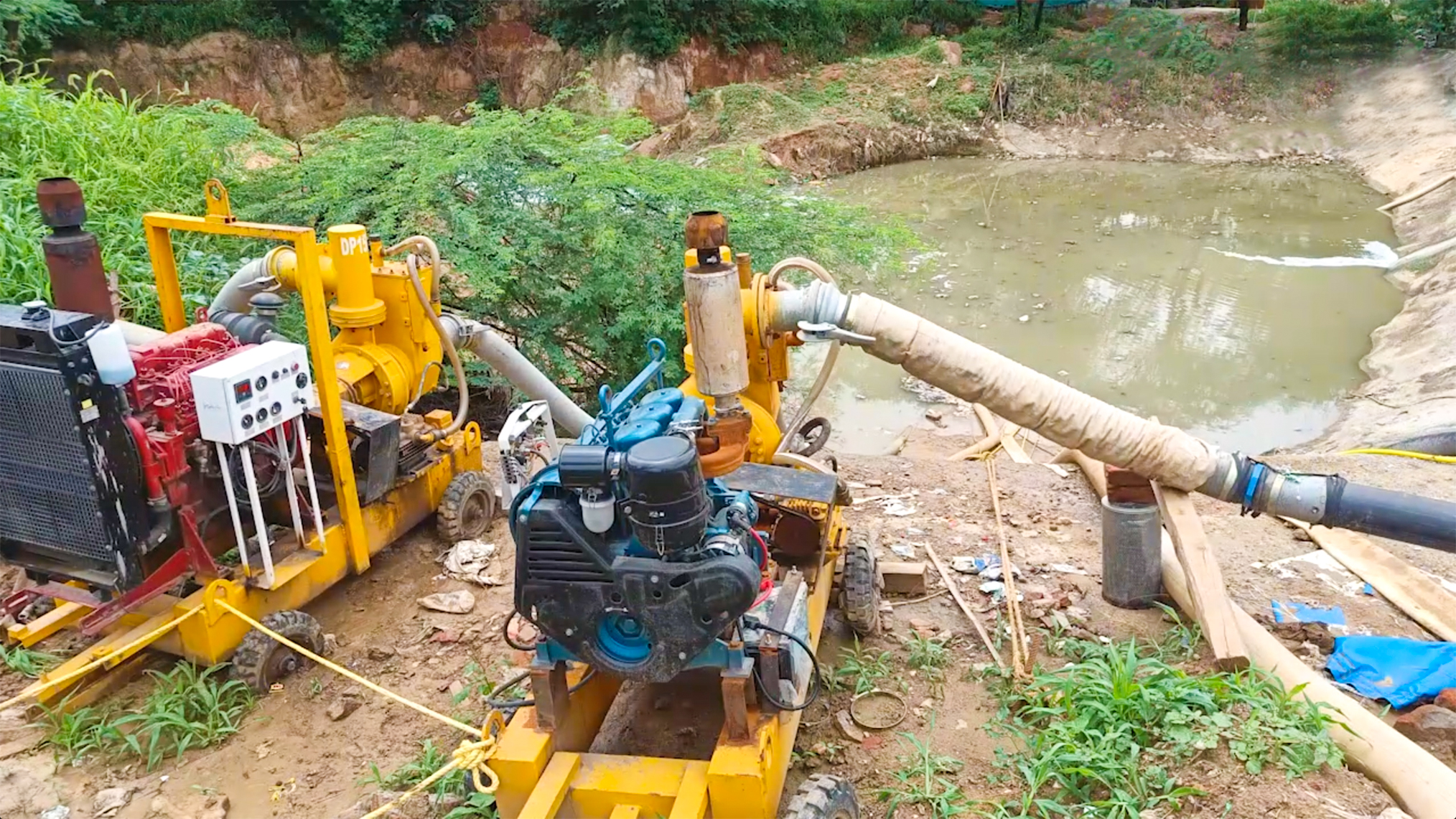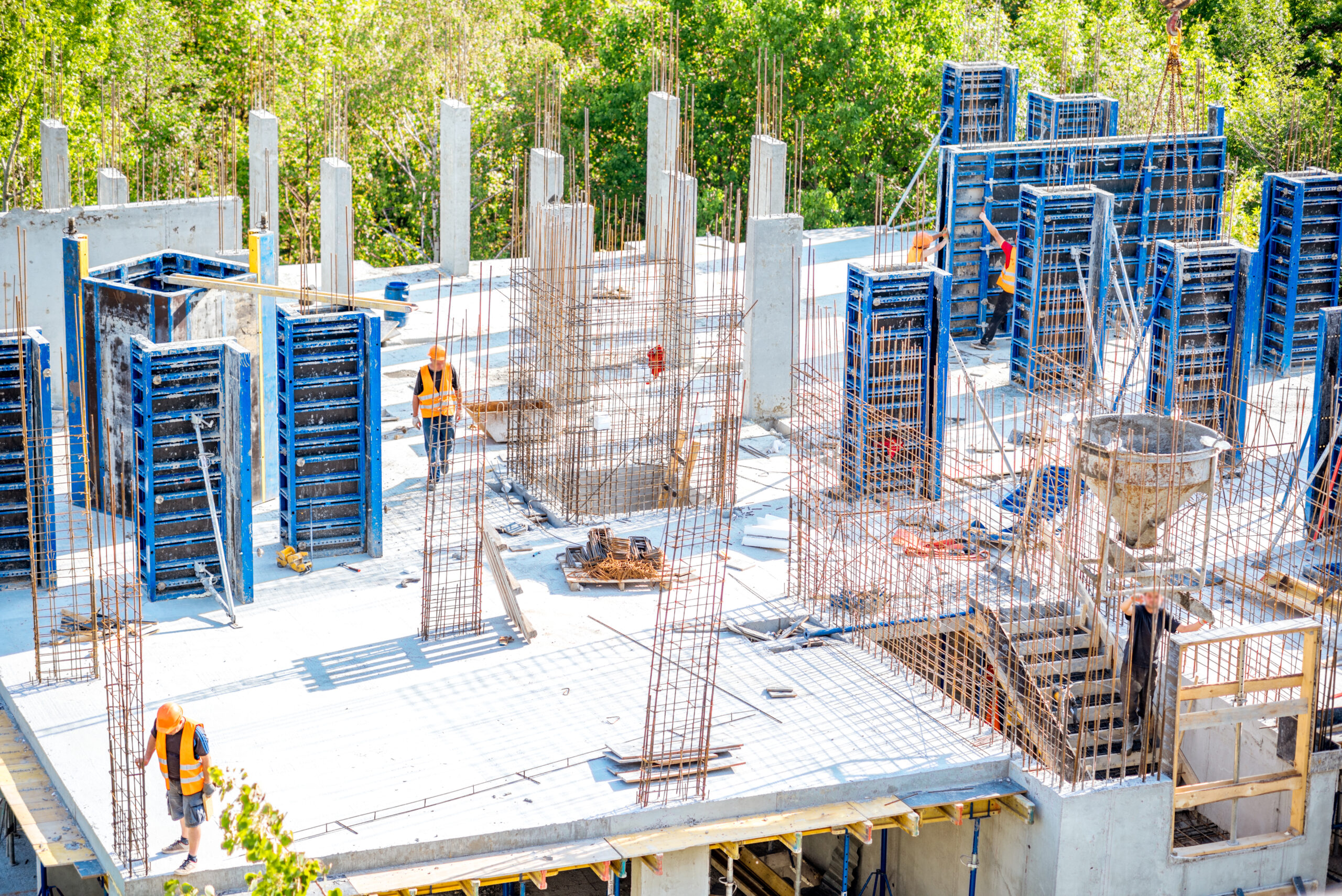
Dewatering is the controlled removal of groundwater, surface water, or process water from a construction excavation, mine, tunnel, or industrial site to make the working area safe and dry enough for planned construction activities. It is a core site management function — not an optional precaution — and is mandated under IS 5942 (Code of Practice for Dewatering During Construction) for any excavation that intersects the natural water table.
In practice, dewatering ranges from placing a submersible pump in a flooded trench to installing a multi-stage wellpoint system that lowers the regional water table by 5 metres around a metro station excavation. The method you choose — and the pump you pair with it — directly determines whether the site stays productive or falls behind schedule.
This guide covers every major dewatering method used on Indian construction and infrastructure projects, explains how to select the right pump for each, and provides a site planning checklist and monsoon-specific guidance for EPC engineers, project managers, and site supervisors.
Why Construction Dewatering Cannot Be Skipped
Water in an excavation is not an inconvenience — it is a cascading risk. Standing or seeping water:
- Destabilises soil: Saturated cohesionless soils (sandy or silty) lose shear strength rapidly, increasing slope failure and trench collapse risk.
- Compromises concrete: Water dilutes the water-cement ratio of freshly poured concrete, reducing compressive strength below specified values.
- Corrodes reinforcement: Prolonged contact between standing water and exposed rebar accelerates corrosion, shortening structural service life.
- Prevents compaction: Subgrade and fill material cannot be compacted to the required density when saturated, leading to post-construction settlement.
- Creates safety hazards: Wet excavations are a leading cause of BOCW Act non-compliances and fatal accidents on Indian construction sites.
The financial case is equally clear. A 48-hour flooding event on a deep foundation excavation can cost ₹5–20 lakh in pump-out time, rework, delays to follow-on trades, and equipment recovery — far exceeding the rental cost of a properly sized dewatering system for the entire project duration.
The Four Main Dewatering Methods
Selecting the right dewatering method depends on four site variables: excavation depth, soil permeability, proximity to adjacent structures, and the volume of water that must be managed. The four methods below cover nearly every construction and civil engineering scenario encountered on Indian sites.
1. Open Pumping (Sump Pumping)
Open pumping is the most widely used dewatering method in India. Water is allowed to seep into the excavation naturally and collect in one or more low-points called sumps, from which it is continuously pumped out and discharged to an approved collection point.
Best suited for: Shallow excavations (0–5 m depth), granular soils (gravel and coarse sand), low to moderate groundwater tables, and sites where the volume of seepage is manageable relative to pump capacity.
How it works: One or more sumps — typically 600 mm × 600 mm × 600 mm deep pits — are cut at the lowest point of the excavation floor. Submersible dewatering pumps are placed in each sump and discharge water through rising main pipes or lay-flat hose to a collection point a minimum of 15 m from the excavation perimeter (to prevent re-infiltration). The pumps run continuously on float switches or are manually operated by the site dewatering crew.
Limitations: Open pumping is unsuitable where: (a) the rate of water ingress exceeds what the pump can extract before floor heave occurs; (b) fine silty or clayey soils would be mobilised by the seepage gradient (piping failure risk); or (c) drawdown of the water table would cause settlement beneath adjacent structures. In such cases, move to wellpoint or deep well methods.
Pump selection: Cosmos CDW Submersible Dewatering Pump (Standard Series) is the benchmark specification for open pumping across Indian construction sites. Covering 450–8,500 LPM and 15.5–86.5 M shut-off head, with the ability to handle dirty and muddy water carrying 4–12 mm suspended solids, the CDW handles everything from a small basement sump to a large highway cutting.
2. Wellpoint Dewatering
Wellpoint dewatering is an active groundwater interception method. A series of small-diameter pipes (wellpoints) are installed along the perimeter of the excavation and connected via a collector header pipe to a centralised surface vacuum pump. The system creates a negative pressure gradient that draws groundwater to the wellpoints before it can enter the work area, lowering the local water table.
Best suited for: Groundwater tables 1–6 m below ground level, fine to medium sand or silty sand soils, linear excavations (trenches, drainage channels, pipeline routes), and situations where the seepage gradient from open pumping alone would cause slope instability.
How it works: Wellpoints — typically 50 mm diameter, 1.5–2 m length — are jetted or driven to a depth 500 mm below the formation level, spaced 0.75–1.5 m apart around the excavation perimeter. A 150 mm–200 mm diameter header manifold connects all wellpoints to a vacuum pump or auto-prime surface pump located on the surface. The system runs continuously, typically lowering the water table by 4–6 m in a single installation stage.
Multi-stage wellpointing: Excavations deeper than 6 m require staged installation. The first ring of wellpoints lowers the water table to approximately 4–5 m depth. A second ring is then installed at the new formation level to achieve further drawdown. Three stages can achieve drawdown of 12–15 m without resorting to deep well methods.
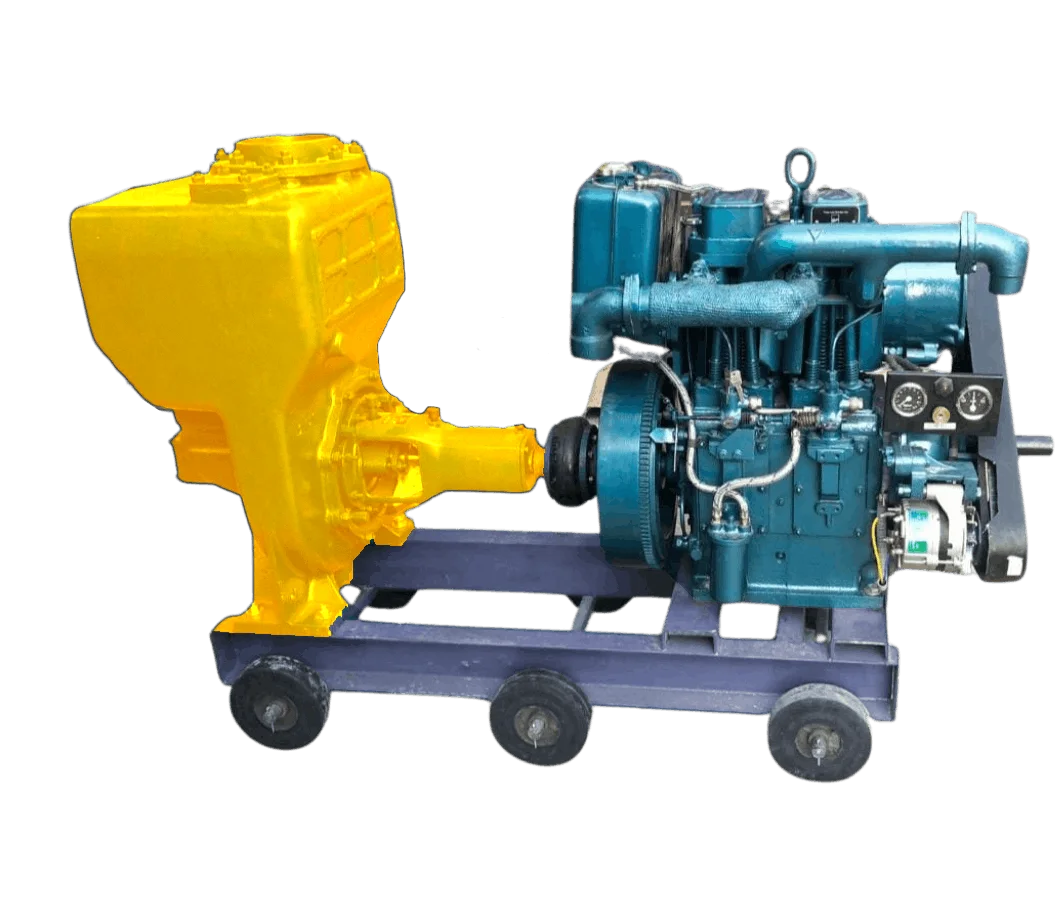
Pump selection: The Cosmos CAP Auto-Prime Surface Pump is the dominant choice for wellpoint dewatering in India. With flow rates up to 74,483 LPM (4,469 m³/h), 9.8 m suction lift, dry-run capability, and engine options including KOEL, Eicher, Baudouin, and CAT, the CAP handles wellpoint header suction across all scales of project from a 50 m residential plot trench to a 2 km metro tunnel alignment. Critically, its auto-prime function restarts without operator intervention after any power interruption — a vital property for overnight unattended wellpoint operation.
3. Sheet Pile Cutoff Walls
Sheet piling is a groundwater exclusion method rather than an active pumping method. Interlocking steel, precast concrete, or timber sections are driven into the ground around the excavation perimeter to form a continuous vertical barrier that prevents groundwater from entering the workspace.
Best suited for: Deep excavations adjacent to existing structures and foundations (where drawdown of the water table could cause damaging settlement), sites with very fine soils that would be mobilised by seepage (piping risk), and marine or riverfront excavations where the source of water is a river or tidal body.
Important note: Sheet piling reduces seepage significantly but does not eliminate it. Water still infiltrates through interlock joints and beneath the sheet pile toe. Open sump pumping with submersible pumps inside the piled enclosure is invariably combined with sheet piling to manage residual seepage.
Pump selection: Cosmos CDW submersible pumps are the standard specification for residual seepage pumping inside sheet-piled enclosures. In scenarios where fine silt, clay slurry, or contaminated water is mobilised and enters the enclosure with seepage, the CSW Sewage Submersible (for silty water with up to 100 mm solids) or CSL Slurry Submersible (for high-solids concentrations up to 70% by weight and SG up to 2.1) may be more appropriate, depending on the specific inflow conditions.
4. Deep Well Dewatering
Deep well dewatering installs large-diameter drilled wells (150–300 mm) at intervals around the excavation perimeter, each equipped with a submersible pump or electric submersible turbine. Unlike wellpoints — which rely on vacuum suction and are limited to approximately 6 m of drawdown per stage — deep well pumps are immersed in the borehole and push water up the discharge column, achieving water table drawdown of 15–30 m in a single installation.
Best suited for: Very deep excavations (metro station boxes, hydroelectric powerhouse pits, mine shafts, open-cut tunnels), high-yield aquifers (20+ m³/hr per well), and artesian conditions where groundwater is under pressure.
Pump selection: Cosmos CDW High Head Submersible (shut-off head 40–140 M, flow 350–2,200 LPM, 5–75 HP) and CDW Ultra High Head Submersible (shut-off head 90–200 M, flow 50–200 m³/h, 50–120 HP) are designed for permanent or semi-permanent installation in deep dewatering wells. Key features for deep well duty: Class H insulation (180°C) with thermal sensor, SS431 high-torsional-strength shaft, dual SiC vs SiC mechanical seals rated for continuous 24/7 operation, and naturally cooled motor design that does not require external water cooling.
Cosmos Dewatering Pump Range — Method & Application Match
The table below provides a consolidated pump selection guide matching dewatering method and site type to the appropriate Cosmos product, with key performance parameters.
| Dewatering Method | Site / Application | Cosmos Pump | Flow Rate | Head Range | HP |
|---|---|---|---|---|---|
| Open pumping — sump | Shallow excavation, construction pit | CDW Standard | 450–8,500 LPM | 15.5–86.5 M | 1.5–50 |
| Open pumping — high head | Tunnel, mine, deep trench | CDW High Head | 350–2,200 LPM | 40–140 M | 5–75 |
| Open pumping — ultra deep | Metro station, HEP pit, mine shaft | CDW Ultra High Head | 50–200 m³/h | 90–200 M | 50–120 |
| Wellpoint dewatering | Fine sand / silt, 1–6 m drawdown | CAP Auto-Prime | Up to 74,483 LPM | 2–169 M | Up to 1,550 |
| Sheet pile — residual seepage | Adjacent structure excavation | CDW Standard | Per site calc | As required | Per site |
| Sewage / sanitary bypass | STP/ETP diversion, sanitation | CSW Sewage | 775–33,000 LPM | 5–60 M | 2–200 |
| Slurry / high-solids sites | Mining, power plant ash, harbour | CSL Slurry | 1,584–5,834 LPM | 27.5–52.5 M | Up to 100 |
Selection notes for site engineers:
- For mixed-character inflows (partly clear, partly silty), design for the worst-case solids concentration. Deploy CDW for established clean sumps and CSW/CSL where soil mobilisation or active slurry generation is occurring.
- An N+1 standby pump arrangement is mandatory on any excavation where flooding would cause significant rework, safety risk, or project delay. Two pumps at 50% duty each is more resilient than one pump at 100% duty.
- CAP Auto-Prime surface pumps are portable (trolley-mounted) and can be redeployed across multiple sumps or wellpoint headers as the excavation progresses. CDW submersibles can be deployed in parallel banks — 4 × 25% duty pumps, for example — for staged and controllable dewatering.
Site Dewatering Planning Checklist
A structured dewatering plan prepared before excavation begins dramatically reduces the risk of mid-project pump failures, environmental non-compliance, and site flooding. The following checklist is derived from IS 5942, BIS standard practice, and Cosmos Pumps’ experience across 250+ commissioned dewatering projects.
Pre-Excavation
- Hydrogeological survey: For any excavation deeper than 3 m, commission a site-specific survey or interpret existing bore logs to establish groundwater table depth, permeability (k value), and anticipated inflow rate.
- Inflow rate calculation: Use Darcy’s Law (Q = k × i × A) or a pumping test to calculate peak inflow. Apply a safety factor of 1.5–2× for design.
- Discharge point: Identify and obtain consent for a discharge point before excavation begins. Options include municipal drainage with SPCB NOC, a site settlement pond (minimum 3-stage sedimentation), or an approved watercourse under the Water (Prevention and Control of Pollution) Act.
- Contamination check: Test groundwater pH and conduct a basic screen for hydrocarbons and heavy metals. Contaminated groundwater requires treatment before discharge; standard sump pumping to a drain is not permissible.
- CGWB clearance: Sites abstracting more than 10 m³/day of groundwater typically require registration or NOC from the Central Ground Water Authority.
Pump Sizing
- Calculate design flow rate: Q (design) = peak inflow × safety factor (1.5–2×).
- Select pump model where the duty point (Q at H) falls within the pump curve, not at the extremes.
- Specify N+1 standby pump for each duty pump on critical excavations.
- Confirm power supply capacity. A Cosmos CDW 20 HP requires a 40A circuit; CAP engine-driven pumps are independent of grid power.
- Size discharge pipework to keep friction losses below 15% of total head at design flow.
During Excavation
- Monitor sump water level continuously. If rising faster than expected, reassess inflow calculation and add capacity.
- Inspect pump discharge hose or pipe for blockage daily — hose kinking is a common failure mode.
- Check submersible pump power cables for kinking, abrasion, or water ingress at the cable entry.
- For CAP wellpoint systems: monitor vacuum gauge and header manifold pressure weekly. Dropping vacuum indicates a wellpoint seal failure or clogged wellpoint screen.
- Log pump run hours. Schedule servicing at 500-hour intervals for CDW and CAP range.
Environmental Compliance During Operation
- Route all pump discharge through a silt trap or minimum 3-stage settlement pond before any watercourse discharge.
- Test discharge turbidity weekly on active excavations — target NTU < 50 for river discharge.
- Never discharge concrete washout, fuel spillage, or chemical additives through the dewatering discharge system.
Monsoon Dewatering — India-Specific Guidance
India’s southwest monsoon (June–September) and northeast monsoon (October–December, Tamil Nadu and coastal Andhra Pradesh) create conditions that can overwhelm a standard dewatering design within hours. Every construction site dewatering plan must be specifically reviewed and upgraded before the monsoon season.
Challenge 1: Sudden Inflow Spikes
A single intense rainfall event — defined by IMD as a cloudburst when >100 mm falls within 3 hours — can introduce 5–10× normal inflow into an open excavation. The dewatering system that managed March-April dry-season seepage will not manage July monsoon runoff unless it has been scaled up.
Recommendation: Increase dewatering pump capacity by a minimum 50% before June. Cosmos’s rental fleet of 500+ submersible pumps and 50+ auto-prime surface pumps provides Pan-India emergency backup, including same-day mobilisation in Delhi-NCR and major metro centres.
Challenge 2: Elevated Silt and Suspended Solids
Monsoon runoff carries fine silt into sumps at much higher concentrations than dry-season seepage. Standard CDW submersible pumps are rated for 4–12 mm solids at normal suspended solids concentrations — but monsoon-fed sumps receiving direct surface runoff can carry silt loads that approach the solids limits of standard dewatering pumps.
Recommendation: Install coarse screens (mesh size 5 mm) around sump perimeters. On heavily silt-laden sites, upgrade to CSW Sewage Submersible pumps (rated for 20–100 mm solids, SG up to 1.7) for monsoon-period sump duty. Reserve CDW for established, screened sumps.
Challenge 3: Power Interruptions
Lightning-associated grid power cuts occur frequently during Indian monsoon events, particularly in rural and semi-urban project areas. A power cut during the middle of the night on an active wellpoint system can flood a foundation excavation within 2–3 hours.
Recommendation: Engine-driven Cosmos CAP Auto-Prime pumps are the preferred solution for unattended overnight monsoon dewatering. They restart automatically after fuel interruption is resolved without requiring manual prime — unlike conventional centrifugal pumps that must be reprimed after every start.
Challenge 4: Remote Monitoring
Physical supervision of dewatering systems at night, during storms, and on weekends is impractical on most large sites. CosmoSmart™ IoT monitoring — installed on Cosmos rental fleet pumps and available for purchase on owned pumps — provides real-time run data, flow rate monitoring, sump level alerts, service reminders, and fuel consumption tracking via mobile app. It eliminates the need for a night-duty operator on site purely for pump supervision.
Enquire about monsoon dewatering rental and CosmoSmart monitoring: dewatering pump rentals or WhatsApp +91 99333 22238.
Dewatering Products from Cosmos Pumps
Cosmos Pumps has manufactured and supplied dewatering pumps since 2013, building from a rental and trading base into full-scale manufacturing in Faridabad, Haryana (ISO & CE certified). The product range covers every dewatering scenario from a small basement trench to a large-scale mine dewatering system:
- CDW Submersible Dewatering Pump — 1.5–50 HP, standard duty, dirty water with solids up to 12 mm. The workhorse for open pumping on construction sites across India.
- CDW High Head — 5–75 HP, up to 140 M head, for tunnels and mines requiring greater discharge elevation.
- CDW Ultra High Head — 50–120 HP, up to 200 M head, for deep wells in HEP projects, metro stations, and large-scale mining.
- CAP Auto-Prime Surface Pump — diesel engine-driven, up to 1,550 HP, up to 74,483 LPM, for wellpoint systems, flood control, and large-scale surface dewatering.
- CSW Sewage Submersible — 2–200 HP, for sewage bypass, STP/ETP dewatering, and silt-laden monsoon sumps.
- CSL Slurry Submersible — 27% hi-chrome construction, for mining, ash handling, and high-solids dewatering applications.
All Cosmos products come with ISO & CE certification, and are backed by a 25,000 sq. ft. manufacturing and service facility in Faridabad NCR. Rental fleet of 550+ pumps available Pan-India.
View the full product range Dewatering Pump Rentals Building Construction Solutions
Frequently Asked Questions — Dewatering
1. What is dewatering?
Dewatering is the process of removing groundwater, surface water, or accumulated water from a construction excavation, mine, tunnel, or industrial site to create dry working conditions. It includes both open pumping (collecting and pumping out water that enters the excavation) and groundwater control methods (intercepting groundwater before it enters, using wellpoints or deep wells). Under IS 5942, dewatering is mandatory for any excavation below the water table.
2. What are the main methods of dewatering in construction?
The four primary dewatering methods are: (1) Open pumping — sumps and submersible pumps collect and remove water from inside the excavation; (2) Wellpoint dewatering — a ring of small pipes connected to a surface vacuum pump lowers the water table around the excavation perimeter; (3) Sheet pile cutoff — interlocking piles form a barrier that excludes groundwater from the excavation zone; and (4) Deep well dewatering — borehole pumps lower the water table by 15–30 m for very deep or high-yield sites. Most large projects combine two or more methods.
3. Which pump is used for dewatering?
The pump type depends on the dewatering method and site conditions. Submersible dewatering pumps (Cosmos CDW series) are standard for open pumping — they sit inside the sump and discharge upward via a rising main. Auto-prime surface pumps (Cosmos CAP series) are used for wellpoint systems and high-flow surface dewatering — they draw water via suction from below and are suitable for engine-driven unattended operation. For sites with sewage, silt, or slurry, the CSW (sewage) or CSL (slurry) ranges are more appropriate than standard dewatering pumps.
4. What is wellpoint dewatering?
Wellpoint dewatering is a groundwater control method that installs small-diameter pipes (wellpoints) in a ring around the excavation perimeter, connected by a header manifold to a centralised vacuum pump. The system draws groundwater to the wellpoints before it can enter the excavation, lowering the water table by 4–6 m per installation stage. It is the preferred method for fine-grained soils (silty sand, fine sand) where open pumping alone would cause slope instability or piping failure. Multi-stage wellpointing can achieve 12–15 m of total drawdown.
5. What is open pumping or sump pumping in dewatering?
Open pumping (also called sump pumping) allows groundwater and seepage to naturally collect in low-points (sumps) within the excavation, from which it is continuously pumped out via submersible pumps. It is the simplest and lowest-cost dewatering method, suitable for shallow excavations in granular soils. The key limitation is that it does not lower the water table — it only removes water after it enters the excavation. In fine soils, the seepage flow can mobilise soil particles and cause instability, at which point wellpoint or cutoff methods are preferred.
6. How do I calculate the required pump size for site dewatering?
A simplified approach: estimate peak inflow rate Q using Q = k × i × A (Darcy’s Law), where k = soil hydraulic conductivity (m/s), i = hydraulic gradient, and A = seepage area. Multiply Q by a safety factor of 1.5–2× to get the design pump flow rate. Then select a pump whose performance curve intersects the required flow rate at the design total head (static discharge elevation plus pipe friction losses). For complex or large sites, a hydrogeological pump test gives more accurate inflow data than Darcy’s Law. Cosmos Pumps’ technical team provides free pump sizing assistance for project enquiries.
7. What is the difference between dewatering and drainage?
Dewatering is the active removal of water from below or within a construction zone — primarily targeting groundwater or accumulated surface water in excavations. Drainage refers to the passive management of surface water runoff across a site, typically via graded channels, swales, and perimeter drains that direct water away from work areas. On most construction sites, both are required: drainage manages storm runoff at the surface, while dewatering manages groundwater infiltration into excavations. The two systems should be designed together to avoid drainage water re-entering dewatering sumps.
8. How do I manage site dewatering during India’s monsoon season?
The key monsoon-specific actions are: (1) Increase standby pump capacity by at least 50% before June — a system adequate for the dry season will not handle July monsoon inflow; (2) Switch to engine-driven CAP Auto-Prime pumps for unattended operation — they restart automatically after power cuts without manual priming; (3) Install coarse screens around sumps to manage elevated silt loads in monsoon runoff; (4) Install CosmoSmart IoT monitoring for real-time alerts on pump status and sump levels; (5) Establish a rental pump agreement for emergency backup — Cosmos Pumps maintains Pan-India fleet availability with same-day emergency response. For monsoon dewatering support, contact Cosmos Pumps on WhatsApp: +91 99333 22238.
Ready to Plan Your Dewatering System?
Whether you are in the design phase of a metro station excavation or facing a flooded construction pit during monsoon season, Cosmos Pumps has the product range, technical expertise, and rental fleet to meet your requirement.
Get a pump recommendation for your project:
- WhatsApp: +91 99333 22238 (fastest response for urgent site queries)
- Email: cosmos@cosmospumps.com
- Download the Cosmos Pumps product catalogue for full specifications on the CDW, CAP, CSW, and CSL ranges.
View Building Construction Solutions Dewatering Pump Rentals Back to Homepage