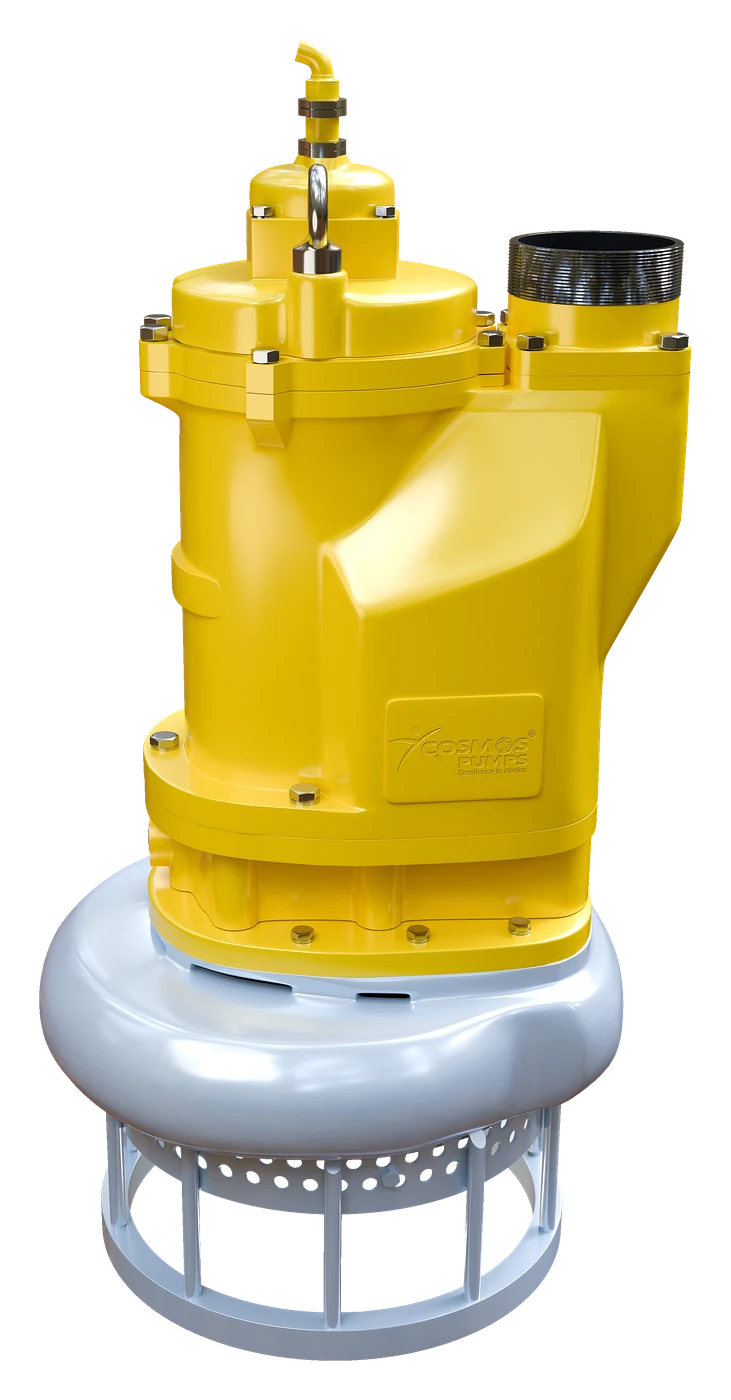
CSL Hi-Chrome Submersible Slurry Pump — Ash Pond, Mine Waste & Harbour Duty
Details as follows:

Low Head
NA

3100-8500 LPM

3100-8500 LPM
High Head
The Cosmos CSL is a submersible slurry pump built for the harshest abrasive duties — ash pond transfer, coal mine waste, harbour dredging, and sand & gravel extraction. Its 27% Hi-Chrome Material of Construction (MOC) makes it the only pump in the Cosmos range rated for specific gravities up to 2.1 and slurry concentrations up to 70% solids by weight.
CSL Slurry Pump — Technical Overview
The CSL submersible slurry pump is a fully immersed, hard-metal centrifugal pump engineered for continuous duty in abrasive mineral slurries — handling specific gravities up to 2.1 and solids concentrations up to 70% by weight, with wetted parts cast in 27% hi-chrome white iron (ASTM A532 Class III, 600–700 HB). When a site fluid contains coarse abrasive minerals — fly ash, coal fines, iron ore tailings, sand, or harbour silt — at SG above 1.3, the CSL delivers the wear life that grey cast iron dewatering pumps cannot, eliminating the premature impeller erosion that cuts standard pump life from thousands of hours to hundreds.
- 27% hi-chrome white iron (ASTM A532 Class III): 5–10× more wear-resistant than grey cast iron for mineral slurry duty
- Maximum specific gravity: 2.1 — covers coal slurry (1.4–1.7), fly ash (1.6–1.9), and iron ore (1.8–2.0)
- CSL-TV twin-volute variant cancels radial hydraulic force for 2–3× longer bearing life in 24/7 ash transfer duty
- Available from the submersible pump range with agitator options for settled solids disturbance
CSL & CSL-TV Technical Specifications
Both the CSL (single-volute) and CSL-TV (twin-volute) share the same hard-metal hydraulic end. The distinction lies in the volute casing geometry, which determines radial load bearing life at high flow rates and elevated SG.
| Parameter | CSL (Standard) | CSL-TV (Twin Volute) |
|---|---|---|
| Shut-Off Head | 27.5 M – 52.5 M | 27.5 M – 52.5 M |
| Flow Rate | 1,584 – 5,834 LPM (26.4 – 97.2 m³/h) | 1,584 – 5,834 LPM |
| Motor HP Range | Up to 100 HP | Up to 100 HP |
| Material of Construction | 27% Hi-Chrome White Iron (ASTM A532 Class III) | 27% Hi-Chrome White Iron (ASTM A532 Class III) |
| Brinell Hardness | 600–700 HB | 600–700 HB |
| Maximum Specific Gravity | 2.1 | 2.1 |
| Maximum Solids Concentration | 70% by weight | 70% by weight |
| Installation Type | Submersible — fully immersed | Submersible — fully immersed |
| Agitator Option | Available | Available |
| Hydraulic Balance | Single-volute | Twin-volute — cancels radial hydraulic force |
| Best For | General slurry duty, mine sumps, dredging | 24/7 ash transfer, high-SG continuous duty |
| Certifications | ISO 9001:2015, CE | ISO 9001:2015, CE |
Why the CSL-TV Twin Volute Matters for Continuous Duty
In a conventional single-volute pump, fluid pressure is not evenly distributed around the impeller circumference — particularly at off-BEP (best efficiency point) conditions. This asymmetric pressure creates a net radial force that acts on the impeller shaft, transmitting bending load to the bearing assembly. In clear-water dewatering, this force is manageable at intermittent duty cycles. In 24/7 slurry service at SG 1.6–1.9, the radial force scales proportionally with fluid density and causes premature bearing failure within weeks.
The CSL-TV twin-volute casing places two symmetrically opposed volute channels at 180° to each other, generating two pressure distributions that cancel the net radial vector. The result is a near-zero net radial bearing load regardless of operating point — delivering 2–3× longer bearing life in continuous high-SG duty, and a directly lower total cost of ownership for thermal power ash transfer, harbour dredging, and ore processing sumps where downtime is measured in production losses.
Why SG Rating Matters: CSL vs Standard Dewatering Pump
The specific gravity (SG) of the slurry determines which pump can handle it without premature wear. Standard submersible dewatering pumps are rated to SG 1.1 — for water with light suspended solids. Slurry applications routinely exceed SG 1.5, making a standard dewatering pump unsuitable. See our full submersible pump range to understand where the CSL sits in the lineup.
| Slurry Type | Typical SG | CDW Dewatering Pump (SG 1.1 max) | CSL Slurry Pump (SG 2.1 max) |
|---|---|---|---|
| Mine pit water (clear) | 1.0 – 1.1 | ✅ Suitable | ✅ Suitable |
| Silt / muddy runoff | 1.1 – 1.3 | ⚠️ Marginal — accelerated wear | ✅ Suitable |
| Sand & gravel slurry | 1.3 – 1.6 | ❌ Not rated — impeller failure risk | ✅ Suitable |
| Coal slurry / washery effluent | 1.4 – 1.7 | ❌ Not rated | ✅ Suitable |
| Fly ash slurry (wet disposal) | 1.6 – 1.9 | ❌ Not rated | ✅ Suitable |
| Bottom ash / dense ash slurry | 1.9 – 2.1 | ❌ Not rated | ✅ Rated to SG 2.1 |
CSL vs CDW vs CSW — Pump Selection Matrix
The three submersible pump families address fundamentally different fluid types. Selecting the wrong series for an abrasive slurry application is the most common cause of premature pump failure on industrial sites. This matrix defines the correct selection criteria.
| Criterion | CDW (Dewatering) | CSW (Sewage) | CSL (Slurry) |
|---|---|---|---|
| Fluid Type | Groundwater, muddy water, light contamination | Sewage, liquid waste up to SG 1.7 | Abrasive slurry, mine waste, ash, SG up to 2.1 |
| Solids Handling | Up to 12 mm particles | Up to 100 mm soft solids | Up to 70% solids by weight (mineral) |
| Impeller Material | Grey cast iron (180–250 HB) | Cast iron / stainless steel | 27% Hi-Chrome white iron (600–700 HB) |
| Typical Application | Construction dewatering, civil excavation | Municipal lift stations, residential sewage | Thermal power ash transfer, mining, dredging |
| Choose When | Site water has <20% solids by weight, non-abrasive | Fluid contains soft organic solids or sewage | Fluid has abrasive minerals, SG >1.3, or >20% solids by weight |
For high head dewatering duties where the fluid is clean (non-slurry), the CDW Ultra High Head dewatering pump provides heads up to 200 m — purpose-built for deep mine shafts and tunnel dewatering where the CSL’s slurry ratings are not required.
When NOT to Use a Standard Dewatering Pump in Slurry Duty
Grey cast iron impellers in CDW dewatering pumps operate at 180–250 Brinell hardness. When deployed in a sump where the fluid carries coarse quartz sand, fly ash, or coal fines at SG above 1.3, the abrasive mineral particles — many registering 6–7 Mohs hardness — erode the impeller vanes and wear ring surfaces at a rate that typically reduces the impeller to scrap within 200–500 operating hours. At that point, head and flow collapse, and the pump fails without delivering reliable duty. The same pump in a clean groundwater sump runs 5,000–8,000 hours between wear part changes. Specifying the CDW or a similar grey iron dewatering pump for slurry duty is not a cost-saving measure — it is a guaranteed accelerated replacement cycle. For mining applications, thermal power stations, harbour dredging, and any sump where the fluid exceeds SG 1.3 with abrasive content, the CSL is the correct selection from first principles.
27% Hi-Chrome vs 316SS vs Rubber-Lined — MOC Selection Framework
Material of construction is the primary engineering decision for any slurry pump specification. The three dominant MOC families for slurry duty each have a defined performance envelope; specifying outside that envelope leads to either premature wear failure or unnecessary capital cost.
| MOC | Best For | Limitations |
|---|---|---|
| 27% Hi-Chrome White Iron (ASTM A532 Class III, 600–700 HB) | Coarse abrasive minerals: fly ash, coal, iron ore, sand, gravel — SG 1.3–2.1 | Not suitable for strongly acidic fluids (pH <4); brittle under severe impact loads |
| 316 Stainless Steel | Mildly corrosive slurries: food processing, pharmaceuticals, mild acids | Lower abrasion resistance — not for mineral slurry above SG 1.5; cost-prohibitive for large bore pumps |
| Rubber-Lined | Large soft particles, fine rounded sands, low-SG slurry (SG <1.4) | Fails rapidly on coarse sharp minerals (fly ash, coal dust, quartz); temperature sensitive above 60°C |
MOC Decision Guidance for Indian Industrial Applications
27% hi-chrome white iron is the de facto standard MOC for Indian mining and thermal power plant ash applications. The 27% chromium content precipitates chromium carbides within a martensitic matrix during casting — producing a microstructure that resists the micro-cutting and micro-fatigue wear mechanisms generated by hard mineral particles. At 600–700 HB, the impeller surface is 5–10× more wear-resistant than grey cast iron for quartz-bearing slurries, and outlasts rubber-lined alternatives when the slurry contains particles above 5 Mohs hardness (quartz, feldspar, iron ore). The standard rule of thumb: if the particle hardness exceeds 5 Mohs, specify 27% hi-chrome. For soft, rounded particles such as fine alluvial sand at SG below 1.4, rubber-lining may offer marginally longer wear life and better noise performance. 316 stainless steel is specified only where corrosion is the primary failure mechanism — food processing waste, pharmaceutical process streams, or mildly acidic chemical effluent — and should not be selected for abrasive mineral slurry regardless of budget.
Submersible Slurry Pump for Ash Pond & Thermal Power Station Duty
Fly ash and bottom ash slurries from coal-fired thermal power stations rank among the most abrasive duties in Indian industry — specific gravities of 2.0–2.1 at solids concentrations up to 70% by weight are routine at major thermal power utilities, state gencos, and captive power plant ash ponds.
The CSL Hi-Chrome handles these conditions continuously because its wetted parts — volute, impeller, and wear plates — are cast in 27% hi-chrome white iron (ASTM A532 Class III, 600–700 Brinell). Standard grey iron or stainless-steel pumps fail rapidly in ash slurry; hi-chrome provides 3–5× the wear life under identical duty conditions.
Key CSL specifications for ash duty: SG up to 2.1 · Solids up to 70% by weight · Flow 1,584–5,834 LPM · Head 27.5–52.5 M · Up to 100 HP · 27% hi-chrome MOC throughout wetted path.
For high-volume continuous ash transfer at large thermal power stations, the CSL-TV twin-volute variant is recommended — the symmetrical volute eliminates radial thrust, extending bearing life and reducing maintenance shutdowns on 24×7 duty cycles.
CSL Hi-Chrome Slurry Pump for Mine Waste, Tailings & Coal Washery Duty
Mine dewatering with slurry handling — coal washery reject ponds, iron ore tailings dams, zinc/lead tailings (SG 1.6–2.0), and red mud/residue settling ponds at aluminium refineries — requires a pump that combines submersible capability with hard-metal abrasion resistance.
Standard dewatering pumps rated for SG 1.1 fail rapidly when exposed to mineral tailings. The CSL, with its 27% hi-chrome construction and SG 2.1 rating, handles coal washery slurry (SG 1.3–1.6), zinc tailings (SG 1.6–2.0), and aluminium red mud (SG 2.0–2.1) within a single product specification.
Typical mine waste applications:
- Coal washery reject pond recirculation and discharge
- Iron ore tailings pond management (SG 1.4–1.8)
- Zinc/lead tailings at hydrometallurgical refineries (SG 1.6–2.0)
- Aluminium red mud settling pond transfer (SG 2.0–2.1)
- Bauxite residue disposal system pumping
Submersible Slurry Pump for Silt Removal & Pond Cleaning
Irrigation canal desilting, reservoir silt management, industrial settling pond cleaning, and municipal drainage sump clearance all involve slurries with high silt concentrations that clog standard dewatering pumps.
The CSL handles silt slurries at solids concentrations up to 70% by weight — far beyond the 4–12 mm solids and SG 1.1 ceiling of standard CDW dewatering pumps. Its fully submersible design allows direct sump-floor deployment without suction pipe priming, making CSL the preferred tool for canal desiltation, check dam maintenance, and industrial pond rehabilitation.
For intermittent silt removal duties (less than 8 hours/day), the standard CSL variant is recommended. For continuous 24-hour silt transfer, specify the CSL-TV twin-volute for reduced radial load and extended bearing life.
CSL Slurry Pump for Harbour Construction, Dredging & Marine Duty
Port and harbour construction involves continuous pumping of marine silts, sand-water slurries from suction dredging, and seabed material during berth deepening or breakwater foundation work. These applications combine abrasive particle loads with saline water exposure.
The CSL Hi-Chrome handles marine construction slurries (SG up to 1.6 for saturated sand-water mixes) with its hard-metal wetted path. For highly saline marine duty, the CSL can be specified with additional corrosion inhibition on non-wetted hardware — consult Cosmos engineering for site-specific material selection.
Typical harbour and dredging applications:
- Port berth deepening: pumping marine silt and sand spoil
- Breakwater and jetty foundation: seabed material removal
- Inland waterway maintenance: silt and gravel dredging
- Flood channel rehabilitation: accumulated silt clearance
CSL Slurry Pump for Heavy Industry & Sand Gravel Pumping
Beyond thermal power and mining, the CSL serves a broad range of heavy-industry slurry duties — including sand and gravel pumping for aggregate washing plants, ceramic slurry handling, refinery pit sludge, and ETP sludge at Category A industrial facilities.
Sand & gravel pumping: River dredging and aggregate washing produce high-volume sand-water slurries at SG 1.4–1.8. The CSL handles these continuously without the rapid wear that destroys standard rubber-lined or SS-impeller pumps within 500–800 running hours.
Industrial sludge: ETP primary clarifier sludge at steel plants, paper mills, and chemical complexes has SG 1.2–1.4 with abrasive suspended solids. The CSL handles these with far lower wear rates than non-clog or vortex pumps rated only for organic solids.
How to Size a Slurry Pump — SG Correction and HP Derating
Slurry pump selection requires corrections beyond simple duty point (flow and head) matching, because slurry specific gravity and particle characteristics alter both the hydraulic performance and the power consumption relative to clear-water pump curves. Three calculation steps are mandatory for a correct specification.
Step 1: Calculate Slurry Specific Gravity
Use the standard slurry SG formula to determine the actual fluid density at the operating solids concentration:
Where:
- SGsolids = specific gravity of the solid material (coal: 1.5, fly ash: 2.1, iron ore: 4.9, quartz sand: 2.65)
- Cw = solids concentration by weight expressed as a decimal (e.g., 0.30 for 30% solids by weight)
Worked example — coal slurry at 30% solids by weight (Cw = 0.30), coal SG = 1.5:
At 30% coal solids, the slurry SG is 1.15 — a moderate loading that the standard CSL handles comfortably within its rated envelope, though HP derating still applies (see Step 3).
Step 2: Apply Kh Hydraulic Correction Factor
Factory pump curves are published for clear water (SG = 1.0). When the CSL operates on slurry, the actual head delivered and flow rate achievable both decrease from the clear-water curve values. The Kh factor accounts for the hydraulic degradation caused by particle interactions with the impeller flow path:
- Kh range: 0.85–0.93 for the CSL in standard mineral slurry service
- Lower end (Kh = 0.85): coarse angular particles (gravel, iron ore), high concentration (50–70% by weight)
- Upper end (Kh = 0.93): fine soft particles (fly ash fines, coal dust), moderate concentration (20–35%)
- Application: Actual field head = Rated head × Kh; Actual field flow = Rated flow × Kh
When selecting pump size from the curve, select a duty point that delivers the required head and flow after applying the Kh correction — i.e., size up from the clear-water duty point by a factor of 1/Kh to ensure the pump delivers the required performance in slurry service.
Step 3: HP Derating for SG > 1.0
Power consumption in a centrifugal pump scales directly and linearly with fluid density. A pump driving a given flow against a given head at SG 1.0 requires proportionally more power when the same duty is performed at higher SG:
- Formula: Actual HP required ≈ Rated clear-water HP × (SGslurry ÷ 1.0)
- Example: A 10 HP pump rated at clear water → at SG 1.5 slurry: 10 × 1.5 = 15 HP equivalent motor load
- Critical implication: Specifying the same motor HP as the clear-water rating will result in motor overload and thermal tripping at elevated SG — always apply the SG multiplier to motor sizing before final specification
For SG above 1.7 (iron ore, heavy ash, blast furnace slag), the HP derating factor becomes critical and should be validated against the motor FLA (full load amps) at the panel before commissioning. For custom sizing across all three steps, use the iDEWA AI advisor — the system analyses SG, solids type, concentration, duty cycle, and installation constraints to produce a complete CSL specification with motor sizing and Kh-corrected performance data.
Get the Right Slurry Pump Specification — iDEWA AI Advisor
Slurry pump sizing involves compound corrections — SG calculation from solids data, Kh hydraulic derating, motor HP uprating, and selection between CSL and CSL-TV based on duty cycle and SG profile. iDEWA, the AI-powered dewatering solution consultant, automates these calculations in minutes. Input your slurry characteristics (solids type, concentration, SG), duty requirements (flow rate, head, operating hours per day), and installation constraints (sump depth, discharge run), and iDEWA returns a complete CSL or CSL-TV specification with corrected duty point, motor HP recommendation, and MOC confirmation — eliminating the risk of under-specification that leads to motor overload or premature wear failure.
With 2,500+ customers served across 5,000+ projects and installations worldwide, across 22+ export countries, the engineering team behind iDEWA has calibrated the sizing models against real-world CSL performance data from thermal power, mining, dredging, and quarry installations.
CSL vs CSL-TV: Choosing the Right Variant
Cosmos offers the CSL Slurry Pump in two volute configurations. The correct choice depends on operating hours and slurry density.
| Feature | CSL (Single Volute) | CSL-TV (Twin Volute) |
|---|---|---|
| Volute design | Single volute | Twin volute — dual symmetrical discharge passages |
| Hydraulic balance | Standard | Improved — twin volute cancels radial thrust on the shaft |
| Bearing load | Standard bearing duty | Reduced radial load → extended bearing service life |
| Best for | Intermittent / medium-duty applications | Continuous / heavy-duty (24/7 ash transfer, large washeries) |
| Recommended when SG > | Up to 1.8 in standard duty | Above 1.8, or when SG regularly varies near 2.1 |
| Recommended when hours/day > | Up to 16 hrs/day | 16+ hrs/day (continuous operation) |
| Hi-Chrome MOC | 27% Hi-Chrome | 27% Hi-Chrome |
| Max SG | 2.1 | 2.1 |
Selection rule of thumb: Choose CSL-TV when the pump operates more than 16 hours per day, when slurry SG regularly exceeds 1.8, or for continuous ash pond transfer duty. For intermittent or moderate-intensity applications (sand extraction, occasional silt removal), the standard CSL is the correct choice.
Frequently Asked Questions — CSL Slurry Pump
- What is the difference between a slurry pump and a sludge pump?
A slurry pump handles abrasive mineral solids — fly ash, coal fines, iron ore tailings, sand, and gravel — suspended in water at high specific gravity (typically SG 1.3–2.1). The defining characteristic is the hardness of the particles, which demands hi-chrome white iron (600–700 HB) or equivalent wear-resistant MOC to resist rapid erosion. A sludge pump handles organic soft solids from effluent treatment plants, septic systems, or municipal wastewater — the particles are biologically derived, soft, and relatively non-abrasive. Sludge SG is typically 1.0–1.3, and grey cast iron or stainless steel impellers provide adequate wear life. The critical selection rule: use the CSL for mineral slurry with angular particles above 5 Mohs hardness; use the non-clog pump CNC or CSW for organic sludge where solids are soft and irregular.
- When should I specify hi-chrome over rubber-lined impeller?
Specify 27% hi-chrome white iron when the slurry contains coarse angular minerals — fly ash, coal, iron ore, quartz sand — at SG above 1.4, or when the particle hardness exceeds 5 Mohs. Hi-chrome resists the micro-cutting wear mechanism generated by hard, angular particles that would tear rubber lining within hours. Specify rubber-lined impellers only for soft, rounded particles (fine alluvial sand, low-concentration flocculant sludge) at SG below 1.4, where the elastic recovery properties of rubber provide better wear resistance than hard metal against non-angular particles. The thumb rule: if the solid is a mineral (quartz, silica, iron ore, coal) it is almost certainly angular and hard — specify hi-chrome.
- What is the maximum SG the CSL can handle?
The CSL is rated to a maximum specific gravity of 2.1. Common Indian industrial slurry benchmarks: coal slurry = 1.4–1.7, fly ash slurry = 1.6–1.9, iron ore tailings = 1.8–2.0, blast furnace slag granulation = 2.0–2.2. The CSL covers the full range of standard coal mine, thermal power, and iron ore processing applications within its rated SG envelope. At SG above 1.7, motor HP derating must be applied (Actual HP = Rated HP × SG), and CSL-TV is recommended for continuous duty to manage bearing loads at elevated fluid density.
- Can the CSL handle mine sump dewatering?
Yes — the CSL is the preferred selection for mine sumps where groundwater contains more than 20% mineral fines by weight. Active pit sumps in coal mines (particularly in the eastern coalfields), metal ore mines, and quarry blasting zones accumulate slurry-grade fluid after every blast cycle and during wet season groundwater ingress. The CSL’s submersible installation places the pump directly in the sump, eliminating suction line losses and the need for pre-treatment or settling before pumping — which is impractical in active pits. The optional agitator attachment prevents heavy mineral fines from settling and blocking the intake between pump cycles. For mine sites requiring continuous dewatering across multiple sumps, the dewatering pump rental fleet includes CSL units available for project-duration deployment.
- What is the CSL-TV twin volute advantage?
The CSL-TV twin-volute casing creates two symmetrically opposed pressure collection channels at 180° around the impeller. This geometry produces two equal and opposite pressure force vectors that cancel each other, resulting in near-zero net radial hydraulic force on the impeller shaft — compared to the significant unbalanced radial load that acts on a single-volute casing at off-BEP operating points. In clear-water pumps at moderate duty, this radial force is manageable. In 24/7 slurry service at SG 1.6–1.9 and high flow rates, the force scales with fluid density and generates cyclic bending fatigue in the shaft-bearing assembly, cutting bearing life to weeks rather than months. The CSL-TV eliminates this failure mode, extending bearing life 2–3× in continuous high-SG duty. Specify CSL-TV for: thermal power ash transfer (24/7 duty), applications where flow exceeds 3,000 LPM at SG above 1.5, and any installation where unplanned maintenance shutdowns carry production penalties.
- What certifications does the CSL carry?
The CSL and CSL-TV carry all six official accreditations: ISO 9001:2015 Quality Management System, CE Marking (European Conformity), ZED Gold (Zero Defect Zero Effect, Ministry of MSME), NSIC (National Small Industries Corporation), UL Compliance, and EAC (Eurasian Conformity). Material certifications are available on request: ASTM A532 Class III hi-chrome casting certificates and Brinell hardness test results for impeller and liner castings. These certifications support procurement compliance for central government PSU tenders, defence procurement under BRO/Navy contracts, and export documentation for the 22+ countries where the CSL is deployed.
Download Catalogue: CSL Hi-Chrome Submersible Slurry Pump — Ash Pond, Mine Waste & Harbour Duty