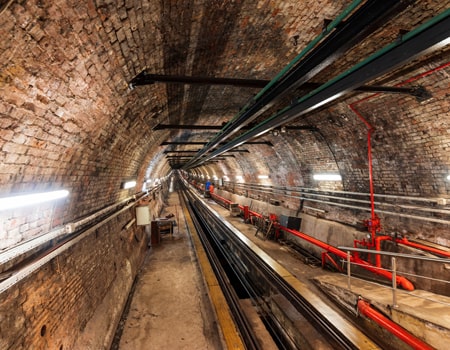
Overcoming Water Management Challenges in Tunnels
Tunnel dewatering is the continuous removal of groundwater from underground construction environments — TBM shafts, active tunnel faces, metro cut-and-cover sections, and railway tunnel drives — where standard submersible pumps cannot generate the pumping head required to lift water to the surface. Cosmos Pumps supplies the CDW Ultra High Head and CDW High Head submersible dewatering pumps for tunnel applications in India, covering shut-off heads from 40 M up to 200 M.
What Is Tunnel Dewatering?
Tunnel dewatering is the engineered removal of groundwater ingress from underground excavations to maintain safe, dry working conditions throughout the construction period. Water enters tunnel bores through fractured rock, alluvial aquifers, or urban perched water tables — often at flow rates of 2–8 m³/h per 100 m of active drive. Without continuous dewatering, TBM shields stall in saturated ground, shotcrete fails to achieve design strength, and workers face serious safety risk from flooding.
The fundamental challenge in tunnel dewatering is head: water must be pumped from the tunnel invert at depth — often 30–80 M below ground level — to a surface collection point, overcoming both the static head and friction losses in the discharge pipeline. Standard construction-grade submersible pumps rated to 15–30 M are entirely inadequate. High-head submersible pumps with multi-stage impellers, rated to 90–200 M, are the correct specification for railway and metro tunnel dewatering in India.
The Bureau of Indian Standards (BIS) and RDSO (Research Designs & Standards Organisation) publish pump-sizing guidelines referenced by EPC contractors on Indian railway tunnel projects, including minimum redundancy requirements (N+1 standby) and sump design parameters.
Tunnel Dewatering Challenges: High Head, Confined Space & TBM Operations
Tunnel dewatering is among the most demanding dewatering applications in civil construction. Three primary challenges determine pump selection:
1. High static head. Railway and highway tunnels in hilly terrain — Western Ghats, Himalayan foothills, and Northeast India — frequently involve 80–160 M of static head between the tunnel invert and the surface discharge point. Metro tunnels in coastal cities run below sea level, adding hydrostatic backpressure on top of the static depth.
2. Confined space installation. Shafts, adits, and cross-passage sumps restrict pump access. Pump outer diameter and minimum sump size must be confirmed before selection — a 300 mm diameter pump cannot be lowered into a 250 mm sump regardless of its hydraulic performance.
3. Dynamic dewatering conditions during TBM advance. As the Tunnel Boring Machine moves forward, the distance between the active face and the launch shaft increases. The required pumping head grows with each metre of drive advance. Dewatering systems must be designed for the end-of-drive condition (maximum head), not the start-of-drive condition — the most common sizing error on Indian tunnel projects.
CDW Ultra High Head: The Primary Tunnel Dewatering Pump
The CDW Ultra High Head submersible dewatering pump is Cosmos Pumps’ primary specification for deep railway and highway tunnel dewatering applications.
| Specification | CDW Ultra High Head |
|---|---|
| Shut-Off Head | 90 M – 200 M |
| Flow Rate | 50 – 200 m³/h |
| HP Range | 50 – 120 HP |
| Impeller | SS316 (2-stage) |
| Mechanical Seal | Dual SiC vs SiC + oil seal |
| Motor Body | CI FG 300 |
| Insulation Class | H (180°C) with thermal sensor |
| Shaft Material | SS431 high-torsional-strength |
| Power Cable | 20 m standard |
| Installation | Vertical or horizontal |
| Strainer | Anti-corrosive SS316 |
| Rubber Components | Viton (saline/high-abrasive tolerance) |
Why the CDW Ultra High Head for tunnels: The 2-stage SS316 impeller sustains hydraulic performance across the full 90–200 M head range without stacking compromises. Viton rubber seals handle the silty, slightly alkaline groundwater characteristic of Indian alluvial tunnel bores. The Class H thermal sensor protects the motor during heat buildup in sealed shaft sumps with limited ventilation — a critical protection for 24-hour continuous duty.
CDW Ultra High Head installation configurations for tunneling:
| Tunnel Condition | Pump Configuration |
|---|---|
| Metro tunnel (active face <3 km, head <120 M) | Single pump per sump |
| Railway tunnel (hill terrain, head 120–200 M) | Single CDW UHH at full-rated head |
| Deep drive (>4 km, head >200 M) | Series installation — CDW UHH relay staging |
| Horizontal adit sump | Horizontal installation option |
CDW High Head: Metro & Shallower Railway Tunnels
For metro tunnels in NCR, Bengaluru, and Kolkata — where dewatering heads typically fall in the 40–100 M range — the CDW High Head submersible dewatering pump provides a more economical specification without overspecifying for depth.
| Specification | CDW High Head |
|---|---|
| Shut-Off Head | 40 M – 140 M |
| Flow Rate | 350 – 2,200 LPM |
| HP Range | 5 – 75 HP |
| Solids Handling | Up to 12 mm suspended solids |
| Specific Gravity | Up to 1.1 |
| Applications | Metro cut-and-cover, railway tunnels, hydro plant penstocks, NATM drainage |
The CDW High Head is the standard specification for metro projects in cities where the average water table is above −30 M BGL and total dynamic head stays below 140 M. For coastal metro cities with higher hydrostatic conditions, the CDW Ultra High Head is specified.
TBM Shaft Dewatering vs Active Tunnel Face Dewatering
Two distinct dewatering zones exist on every TBM tunnel project. Misspecifying the pump for each zone is the most common procurement error on Indian tunnel contracts.
TBM launch shaft dewatering. The shaft — typically 20–45 M deep — is excavated before TBM assembly. Shaft dewatering manages groundwater during this excavation phase before segmental lining is installed. Required head is moderate (20–60 M) but flow rates can be high in permeable alluvial zones. CDW High Head (5–30 HP) is the typical specification for shaft-only dewatering.
Active tunnel face dewatering. Once TBM advance begins, groundwater enters at the cutting face and at segment ring joints behind the shield. Water must be pumped from the invert back through the tunnel to the shaft and then to the surface. As drive length increases, so does the required pumping head. At a 5 km drive length with a 40 M deep shaft, total dynamic head (including pipe friction) typically exceeds 100–130 M.
Application selection guide:
| Tunnel Phase | Total Dynamic Head | Recommended Pump |
|---|---|---|
| Shaft excavation (<30 M depth) | 20–40 M | CDW Standard 10–20 HP |
| Shaft excavation (30–50 M depth) | 40–70 M | CDW High Head 15–50 HP |
| Active face, <3 km drive | 60–120 M | CDW High Head / CDW UHH |
| Active face, >3 km drive | 120–200 M | CDW Ultra High Head 50–120 HP |
| Series relay (>200 M total) | 200 M+ | CDW Ultra High Head × 2 (staged) |
Railway Tunnel Dewatering
Railway tunneling in India — through the Western Ghats, Himalayan foothills, Uttarakhand, Jammu & Kashmir, and Northeast India — involves the most demanding tunnel dewatering conditions in the country. Ground conditions in these corridors include fractured granite, alluvial stream crossings, and perennial springs that can produce groundwater inflow of 5–10 m³/h per 100 m of tunnel face.
Project:
- Location: Hill terrain railway tunnel, Northeast India
- Tunnel length / drive: 6 km
- Shaft depth at launch: 35 M
- Total dynamic head (end-of-drive): 140–170 M
- Design inflow rate: 5 m³/h per 100 m
- Pump specification: CDW Ultra High Head 75 HP — 2 active units + 1 standby
- Discharge capacity: 140 m³/h per active pump
- Sump arrangement: Invert sump at active face + transfer sump at mid-drive relay point
- Redundancy: N+1 standby
Metro Tunnel Dewatering
Urban metro tunneling presents a different challenge: not extreme head, but zero-failure-tolerance dewatering in confined spaces under active urban areas. A dewatering system failure on a metro cut-and-cover section in a high water-table city can flood an active working zone within hours, causing major programme delays and significant safety risk for workers.
Project:
- Location: Metro underground section, North India
- Tunnel type: Cut-and-cover, 18–28 M deep
- Water table depth: 4–8 M below ground level (alluvial zone)
- Total dynamic head: 40–65 M (depth + pipe friction)
- Pump specification: CDW High Head 20–50 HP — 2 units per sump (active + standby)
- Contract model: Rental via Cosmos dewatering pump rental fleet — preferred by EPC contractors where purchase CAPEX is not justified
Tunnel Dewatering System Design Checklist
Confirm these parameters with the project geotechnical team before specifying a tunnel dewatering pump:
- Maximum static head — shaft depth plus tunnel face depth at the end-of-drive condition
- Design groundwater inflow rate — m³/h per 100 m of tunnel, from the geotechnical investigation report
- Peak monsoon inflow — tunnels crossing alluvial layers can see 3–5× normal inflow during June–September
- Total discharge pipeline length and diameter — required for friction head (Hazen-Williams) calculation
- Power supply quality — voltage, Hz, DG backup availability, voltage stability under motor starting load
- Sump dimensions — diameter and depth determine maximum pump OD and cable length
- Water quality — pH, suspended solids content, SG — determines seal and impeller material selection
- Redundancy requirement — railway tunnel contracts typically require N+1 standby; metro contracts often specify N+2
Rental or Purchase for Tunneling Contracts?
The rental-vs-purchase decision for tunnel dewatering pumps depends on number of tunnel drives and whether standby provision is included in the tender scope.
| Decision Factor | Rental — Cosmos Pump Fleet | Purchase — CDW Ultra High Head |
|---|---|---|
| Number of tunnel drives | 1–2 | 3 or more |
| Standby provision | Included in rental fleet | Requires additional unit purchase |
| Maintenance responsibility | Included — Cosmos Pumps team | Contractor responsibility |
| Capital outlay | Zero | Full purchase price |
Cosmos Pumps operates 500+ submersible dewatering units (3–75 HP) available pan-India with 24-hour emergency dispatch. CDW Ultra High Head units are available in the rental fleet subject to advance scheduling — contact Cosmos Pumps early to confirm availability for large tunnel projects. See our full dewatering pump rental fleet details.
EPEC option: Cosmos Pumps provides full Engineering, Procurement, Execution, and Commissioning for tunnel dewatering systems — covering pump sizing, sump design, discharge pipe layout, electrical panel specification, installation supervision, and post-commissioning O&M. Available for railway, metro, highway, and private EPC projects.
Enquire about tunnel dewatering pumps or EPEC support:
📞 +91 99333 22238
📧 cosmos@cosmospumps.com
💬 WhatsApp enquiry available
Cosmos Pumps Pvt. Ltd. — ISO & CE certified dewatering pump manufacturer, Faridabad NCR. Founded 2013. 2,500+ customers served.
Frequently Asked Questions — Tunnel Dewatering
What pump is used for tunnel dewatering in India?
High-head submersible dewatering pumps rated for 90–200 M shut-off head are required for railway and highway tunnels in hilly terrain. The Cosmos CDW Ultra High Head (50–120 HP, 90–200 M, 50–200 m³/h) is the primary specification for deep tunnel applications. For metro tunnels where head requirements are 40–100 M, the CDW High Head (5–75 HP, 40–140 M) is more economical.
What head is needed for TBM shaft dewatering?
TBM shaft dewatering head depends on shaft depth and pipe friction. A 40 M shaft with a 150 M discharge pipe (100 mm bore) will have a total dynamic head of approximately 65–75 M. For active face dewatering at the end of a 5 km drive, total head can exceed 130–150 M — requiring the CDW Ultra High Head.
How do you dewater a metro tunnel during construction?
Metro tunnel dewatering involves submersible pumps installed at the sump in the tunnel invert, with discharge piped to the surface via the construction shaft. Active and standby pumps are installed per sump (minimum N+1). Pump operation is typically controlled by sump-level float switches or by remote IoT monitoring for multi-sump fleet management.
Can submersible dewatering pumps handle TBM excavation water quality?
Yes, with correct specification. TBM drives in alluvial soils produce water with fine sand and clay fines (particle size 0.1–2 mm, SG up to 1.05–1.1). The CDW Ultra High Head with SS316 2-stage impellers and dual SiC mechanical seals is rated for solids up to 12 mm and SG up to 1.1 — covering standard TBM dewatering conditions. Slurry shield TBM discharge (bentonite slurry, SG 1.2+) requires the CSL slurry pump, not a standard dewatering pump.
What is the difference between tunnel dewatering and mine dewatering?
Tunnel dewatering is shorter-term, has more confined space constraints, and handles cleaner water than mine dewatering. Mine dewatering typically involves larger flow rates, elevated suspended solids, and more permanent systems. Both applications require high-head submersible pumps — the CDW Ultra High Head covers both. For mine water with elevated slurry content (SG >1.1), the CSL hi-chrome slurry pump is specified instead.
What redundancy is required for tunnel dewatering pumps?
Railway tunnel project specifications typically require N+1 standby — one standby pump for every active pump. Metro project specifications often require N+2 (two standby units per active pump) given the zero-downtime requirement in urban underground environments. Cosmos Pumps can configure rental or purchase packages to meet either redundancy standard.
Can Cosmos Pumps supply CDW Ultra High Head pumps on rental for a tunneling project?
Yes. CDW Ultra High Head units are available in the Cosmos rental fleet subject to scheduling. For tunneling projects requiring 3 or more high-head units, contact Cosmos Pumps in advance to confirm fleet availability. The rental option includes 24-hour breakdown response and preventive maintenance visits.
Does Cosmos Pumps provide EPEC for tunnel dewatering systems?
Yes. Cosmos Pumps offers Engineering, Procurement, Execution, and Commissioning for tunnel dewatering systems — covering pump sizing for the full drive length, sump design, pipe layout, electrical panel specification, installation supervision, and ongoing O&M. EPEC services are available for railway, metro, highway, and private EPC tunnel projects.
Objectives:

Enhance Infrastructure

Optimize Water Management

Providing Appropriate Dewatering Solutions

Ensure Operational Efficiency